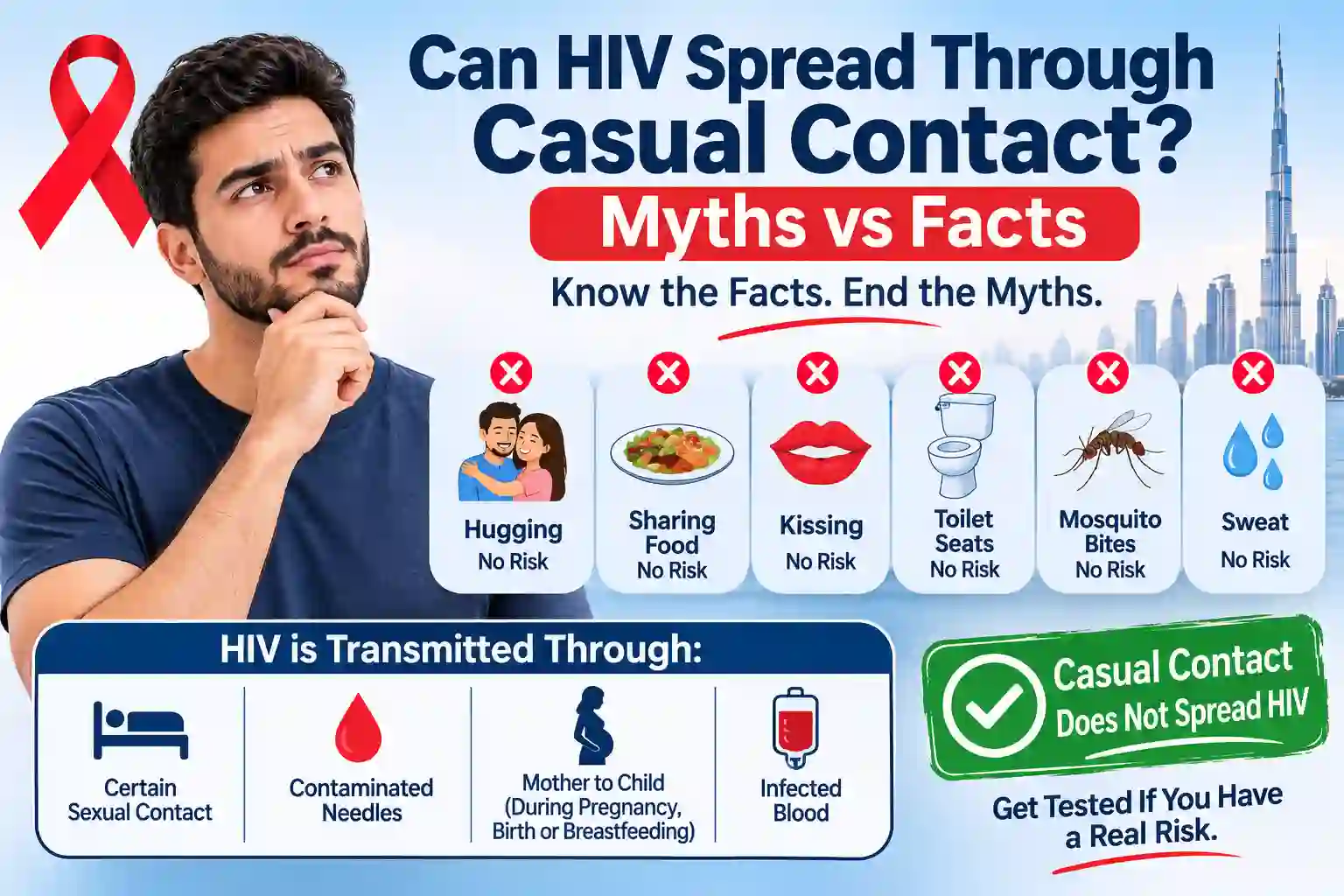
HIV is one of the most misunderstood infections, and misinformation can create unnecessary fear, stigma, and anxiety. Many people still worry about whether HIV can spread through hugging, sharing food, using the same toilet, shaking hands, or sitting next to someone who is living with HIV.
Understanding how HIV actually spreads is important for protecting your health while treating other people with dignity and respect.
If you are searching for answers in Dubai, Sharjah, Abu Dhabi, or anywhere in the UAE, this guide explains what situations do and do not transmit HIV, when testing is necessary, and why understanding the facts matters.
1. Can HIV spread through casual contact?
No. HIV does not spread through ordinary casual contact.
You cannot get HIV simply by sharing everyday spaces, touching someone, or being around a person who has HIV.
HIV is transmitted through specific body fluids under particular circumstances. The main transmission routes include certain sexual exposures, sharing contaminated needles or injecting equipment, and transmission during pregnancy, childbirth, or breastfeeding.
HIV is not transmitted through normal social interaction.
This means you can safely work, study, eat, exercise, and live alongside someone with HIV without fear of acquiring the virus through casual contact.
2. Can HIV spread through hugging or shaking hands?
No. Hugging, shaking hands, holding hands, and ordinary physical contact do not transmit HIV.
HIV cannot pass through healthy, unbroken skin. Touching someone's skin, sitting next to them, or greeting them normally is not an HIV exposure.
There is no reason to avoid a colleague, friend, family member, or other person because they are living with HIV.
Fear of casual contact is based on misinformation, not the way HIV spreads.
3. Can HIV spread through kissing?
HIV does not spread through saliva or ordinary kissing.
Closed-mouth kissing and social kissing carry no HIV transmission risk. Deep kissing is also considered extremely low risk; extremely rare cases have involved blood exposure, such as when both people had bleeding gums or open sores and infected blood entered the other person's bloodstream.
HIV is not transmitted through saliva alone.
You do not need to worry about sharing affection, greeting someone with a kiss, or normal social interaction.
4. Can HIV spread by sharing food, drinks or utensils?
No. HIV cannot be transmitted by sharing:
Food prepared by someone living with HIV
Plates, spoons, forks or other utensils
Drinking glasses or cups
Water bottles during normal use
Meals at restaurants
Food at home with family or friends
HIV does not survive or spread in food in a way that causes infection through ordinary eating.
Sharing a meal with someone living with HIV is safe.
5. Can HIV spread through toilet seats or bathrooms?
No. HIV cannot spread through toilet seats, bathroom surfaces, taps, showers, or ordinary shared bathroom facilities.
You can safely use the same toilet, bathroom, swimming pool, gym facilities, or other shared spaces as someone living with HIV.
HIV is not spread through water or environmental surfaces in ordinary daily situations.
6. Can mosquitoes transmit HIV?
No. Mosquitoes do not transmit HIV.
Even in places where mosquitoes are common, they do not spread HIV from one person to another. HIV does not reproduce inside mosquitoes in the way necessary for mosquito-borne transmission.
Mosquito bites are not considered a route of HIV transmission.
7. Can HIV spread through sweat, tears or saliva?
No. Sweat, tears, and saliva do not transmit HIV under normal circumstances.
HIV is not spread through:
Sweating
Sneezing
Coughing
Tears
Saliva
Sharing towels during ordinary use
Touching surfaces contaminated with these fluids
The exception to consider is visible blood contamination. If blood is involved and enters damaged skin or a mucous membrane, the situation may require medical assessment depending on the exposure.
8. What situations can actually transmit HIV?
HIV transmission occurs when certain infectious body fluids enter the body through mucous membranes, damaged tissue, or direct bloodstream exposure.
Potential transmission routes include:
Sexual exposure
Anal or vaginal sex can transmit HIV when prevention measures are not used and the virus is present at a transmissible level. Risk varies depending on the type of exposure and other factors.
Sharing needles or injecting equipment
Sharing contaminated needles, syringes, or other injecting equipment can expose someone directly to infected blood.
Blood exposure
Contact with infected blood through an injury, contaminated equipment, or certain unsafe procedures may create a risk.
Pregnancy, childbirth and breastfeeding
HIV can be transmitted from mother to child during pregnancy, childbirth, or breastfeeding. Medical treatment significantly reduces the risk of transmission.
HIV is preventable, and effective treatment allows people living with HIV to maintain their health and prevent sexual transmission when they achieve and maintain an undetectable viral load.
9. Do you need an HIV test after casual contact?
If your only contact was hugging, shaking hands, sharing food, using the same toilet, kissing socially, or being around someone who has HIV, that contact alone is not a reason for HIV testing.
Testing may be appropriate if you have had a genuine possible exposure, such as unprotected anal or vaginal sex, shared injecting equipment, or a blood exposure that requires evaluation.
If you are uncertain whether a particular situation involved an exposure, a qualified healthcare professional can help assess it.
If a possible exposure occurred within the last 72 hours, seek urgent medical care to assess whether post-exposure prophylaxis (PEP) is appropriate. PEP is time-sensitive and should be started as soon as possible when indicated.
10. Why HIV testing is important
Although HIV does not spread through casual contact, it can spread through exposures that may not be obvious to a person.
Testing helps you know your HIV status rather than relying on symptoms, assumptions, or a partner's appearance.
Some people with HIV may not have noticeable symptoms for years. That is why testing is important after a potential exposure and as part of routine screening when recommended.
If you are considering home screening, understand your test's detection window, sample requirements, and result interpretation.
You can explore HIV screening options through SureTestKit HIV test kits.
Related options include:
A home self-test is a screening tool. Reactive results need confirmatory testing, and a negative result taken during the window period may require repeat testing.
Frequently Asked Questions
Can HIV spread by sharing a glass of water?
No. Sharing glasses, cups, water bottles, or drinking water does not transmit HIV through ordinary contact.
Can HIV spread by sitting beside an HIV-positive person?
No. Sitting beside someone, sharing a chair, working together, or being in the same room cannot transmit HIV.
Can HIV spread through sweat?
No. Sweat alone does not transmit HIV.
Can HIV spread from mosquito bites?
No. Mosquitoes and other insects do not transmit HIV.
Can I live with someone who has HIV?
Yes. You can safely share a home, meals, bathrooms, furniture, and everyday activities. HIV does not spread through household casual contact.
Should I get tested after kissing?
Ordinary kissing, including closed-mouth and social kissing, is not an HIV transmission route. Deep kissing is an extremely rare concern only in unusual situations involving blood exposure. If there was no blood exposure or other risk, kissing alone does not warrant HIV testing.
Conclusion
HIV cannot spread through ordinary everyday contact. Hugging, shaking hands, sharing food, using the same toilet, kissing socially, sharing a workplace, or being bitten by a mosquito do not transmit HIV.
Understanding these facts helps prevent unnecessary fear and stigma toward people living with HIV.
If you have experienced a genuine possible exposure, focus on the appropriate medical steps and testing timeline rather than worrying about casual contact.
Know the facts. Protect your health. Treat everyone with respect.
Explore HIV screening information and test options at SureTestKit UAE.
This article is for educational purposes only and is not a substitute for professional medical advice.
Disclaimer
This content is intended for informational purposes only and should not be considered a substitute for professional advice. Always consult with a qualified professional for specific concerns.