Having unprotected sex can leave you feeling worried about your sexual health, especially if you are uncertain about your partner's HIV status. Many people immediately start searching questions such as: When should I take an HIV test? Can I test the next day? Will an early test give an accurate result?
If you are in Dubai, Abu Dhabi, Sharjah, or anywhere across the UAE, understanding the right testing timeline can help you make informed decisions instead of relying on anxiety, symptoms, or guesswork.
This guide explains when to take an HIV test after unprotected sex, what different tests can detect, when repeat testing may be needed, and what steps to take after a possible exposure.
1. When should you take an HIV test after unprotected sex?
The timing of your HIV test matters because HIV cannot be detected immediately after exposure. Every test has a window period, which is the time between a possible exposure and when that particular test can reliably detect infection.
Testing too early may produce a negative result even if an infection has occurred.
The appropriate testing date depends on the test type:
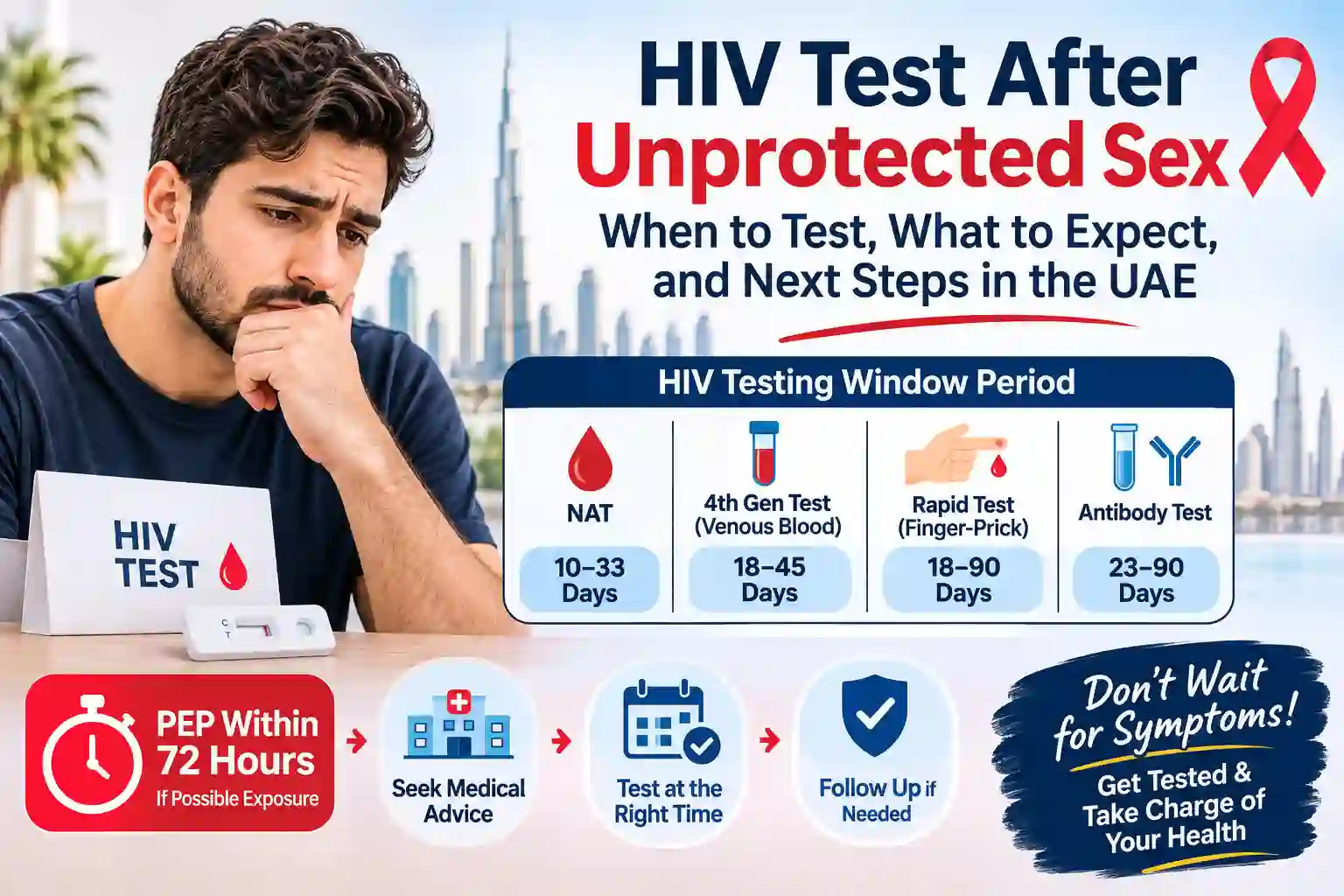
Nucleic acid test (NAT): Usually detects HIV approximately 10–33 days after exposure.
Laboratory fourth-generation antigen/antibody test using venous blood: Usually detects HIV approximately 18–45 days after exposure.
Rapid antigen/antibody test using finger-prick blood: Approximately 18–90 days.
Antibody tests, including most HIV self-tests: Approximately 23–90 days.
These are general detection windows published by the CDC. The window period for your specific test may differ, so always check the manufacturer's instructions and consult a healthcare professional.
If you take a test before the end of its window period and receive a negative result, repeat testing may be necessary.
2. What should you do within the first 72 hours?
If you think you may have been exposed to HIV during unprotected sex, do not wait for symptoms or a home test.
Seek urgent medical attention if the exposure occurred within the last 72 hours. A healthcare professional can assess whether you are eligible for HIV post-exposure prophylaxis (PEP).
PEP is a course of medication used after a potential HIV exposure to reduce the risk of infection. It should be started as soon as possible when indicated, ideally within 24 hours and no later than 72 hours.
Important points to remember:
PEP is time-sensitive.
Do not delay medical care while searching for or taking a home test.
PEP is generally taken for 28 days when prescribed.
Your healthcare provider will guide you regarding initial and follow-up HIV testing.
If your exposure was recent, medical assessment is more urgent than waiting for a test to become detectable.
3. Can an HIV test be negative one day after unprotected sex?
Yes, an HIV test taken one day after possible exposure may be negative, but it cannot rule out infection from that exposure.
This is because the virus or the markers detected by the test may not yet be present at detectable levels.
An early negative test may help establish a baseline HIV status, but it is not proof that transmission did not occur during the recent event.
This is why testing should be planned according to the specific test's window period rather than simply choosing the earliest possible day.
4. HIV 4th-generation test vs HIV self-test after exposure
Different HIV tests detect different markers and have different detection windows.
HIV 4th-generation laboratory test
A laboratory fourth-generation HIV test detects both HIV antibodies and the p24 antigen. A laboratory test using venous blood typically has a detection window of 18–45 days.
It is often used in clinical screening because it can detect HIV earlier than antibody-only tests.
HIV antibody self-test
Most HIV self-tests detect antibodies produced by the immune system in response to HIV.
They may be convenient for home screening, but antibody tests generally have a longer window period. The CDC gives a typical window of 23–90 days for antibody tests.
The exact timing depends on the test, sample type, and instructions.
If you are choosing a home test after a possible exposure, don't select a product based only on the number of days advertised. Confirm whether it detects antibodies alone or antigen and antibodies together.
5. What if you have no HIV symptoms after unprotected sex?
The absence of symptoms does not mean you are HIV-negative.
Some people develop flu-like symptoms during early HIV infection, such as:
Fever
Sore throat
Fatigue
Rash
Swollen lymph nodes
Muscle aches
Others may experience no symptoms at all.
These symptoms are also associated with many common illnesses, so they cannot diagnose HIV. Similarly, feeling completely normal does not rule it out.
Testing at the appropriate time is the reliable way to establish your HIV status.
6. When should you repeat your HIV test?
Repeat testing may be recommended if:
Your initial test was taken during the window period.
You had another possible exposure after your first test.
You used a test with a longer detection window.
You are taking PEP or PrEP.
Your healthcare professional recommends follow-up based on your exposure.
For example, if you take an antibody self-test early and it is negative, you may still need to repeat the test after the full window period specified for that product.
Do not assume that a negative result from one test type automatically applies to another test type.
7. Can you use an HIV self-test at home after unprotected sex?
Yes, a home HIV self-test can be an option for screening, provided it is suitable for your circumstances and you use it according to the instructions.
Before using one, check:
The type of test and what it detects.
The sample required.
The recommended testing window.
How to interpret negative, reactive, or invalid results.
Whether follow-up testing is recommended.
A negative result taken within the window period may require repeat testing. A reactive result requires confirmation through appropriate professional testing.
You can explore available HIV screening options through the SureTestKit HIV test kit collection.
You may also review:
Read the specifications carefully before choosing a test.
8. What should you do after a reactive HIV self-test result?
A reactive self-test is a screening result, not a confirmed diagnosis.
If your test is reactive:
Avoid panicking or assuming the result confirms HIV.
Arrange follow-up testing with a qualified healthcare provider.
Follow the recommended confirmatory testing pathway.
Seek professional guidance regarding your next steps.
If your test is invalid, follow the kit's instructions for repeating the test or seek testing from a healthcare provider.
If your test is negative, check whether it was taken after the relevant window period and whether additional testing is recommended.
9. HIV testing after unprotected sex in Dubai, Abu Dhabi and Sharjah
If you are living in Dubai, Sharjah, Abu Dhabi or another emirate, you can seek HIV testing through a healthcare provider or appropriate testing service.
Some people prefer laboratory testing and professional guidance, while others may consider home self-testing for initial screening.
Whichever option you choose, the most important factors are:
Appropriate test selection
Correct timing
Following test instructions
Repeat testing when needed
Professional follow-up for reactive results
HIV testing is a normal part of healthcare. Seeking information and getting tested when appropriate is a responsible step toward protecting your health.
Frequently Asked Questions
Can I test for HIV 3 days after unprotected sex?
You may be able to take certain tests, but a negative result at three days cannot rule out infection from that exposure. If the exposure occurred within 72 hours, seek urgent medical assessment for possible PEP.
Is an HIV test accurate after 14 days?
Some tests may detect HIV at this stage, but a negative result at 14 days is too early to rule out infection with many test types. Follow the detection window for the specific test and arrange repeat testing as recommended.
Is a fourth-generation HIV test accurate after 28 days?
A laboratory fourth-generation test can detect many infections by 28 days, but 28 days is still within its typical 18–45-day window. Follow-up testing after the full window period may be advised.
Can an HIV self-test detect infection after one month?
Some infections may be detected, but most antibody self-tests have a window period extending up to 90 days. A negative result after one month may require repeat testing.
Should I take an HIV test even if my partner has no symptoms?
Yes, symptoms are not a reliable way to determine HIV status. Testing decisions should be based on exposure, test timing, and professional advice rather than appearance or symptoms.
What is the most important thing to do after unprotected sex?
If a possible exposure happened within the last 72 hours, seek urgent medical care to assess whether PEP is appropriate. After that, follow a testing schedule based on the type of HIV test and the healthcare professional's recommendations.
Conclusion
After unprotected sex, the most important thing is not to panic or rush into interpreting an early test result. Understand the window period, seek urgent care if PEP may be needed, and choose the right testing timeline.
A negative result taken too early may not rule out HIV, while a reactive self-test needs professional confirmation.
If you are in Dubai, Abu Dhabi, Sharjah, or anywhere in the UAE, making informed decisions about HIV testing is a positive step toward your sexual health and wellbeing.
Explore HIV screening options: SureTestKit UAE
This article is for educational purposes only and does not replace medical advice, diagnosis, or treatment from a qualified healthcare professional.
Disclaimer
This content is intended for informational purposes only and should not be considered a substitute for professional advice. Always consult with a qualified professional for specific concerns.