If you have recently had a potential HIV exposure, one of the most important questions is “When should I take an HIV test?”
Testing too early can produce a negative result even when HIV infection is present because the body may not yet have produced enough detectable markers. This period is known as the HIV window period.
The right testing timeline depends on the type of HIV test you use. An HIV 1/2 antibody test and an HIV 4th generation antigen/antibody test do not have the same detection window, so understanding the difference can help you choose an appropriate testing approach.
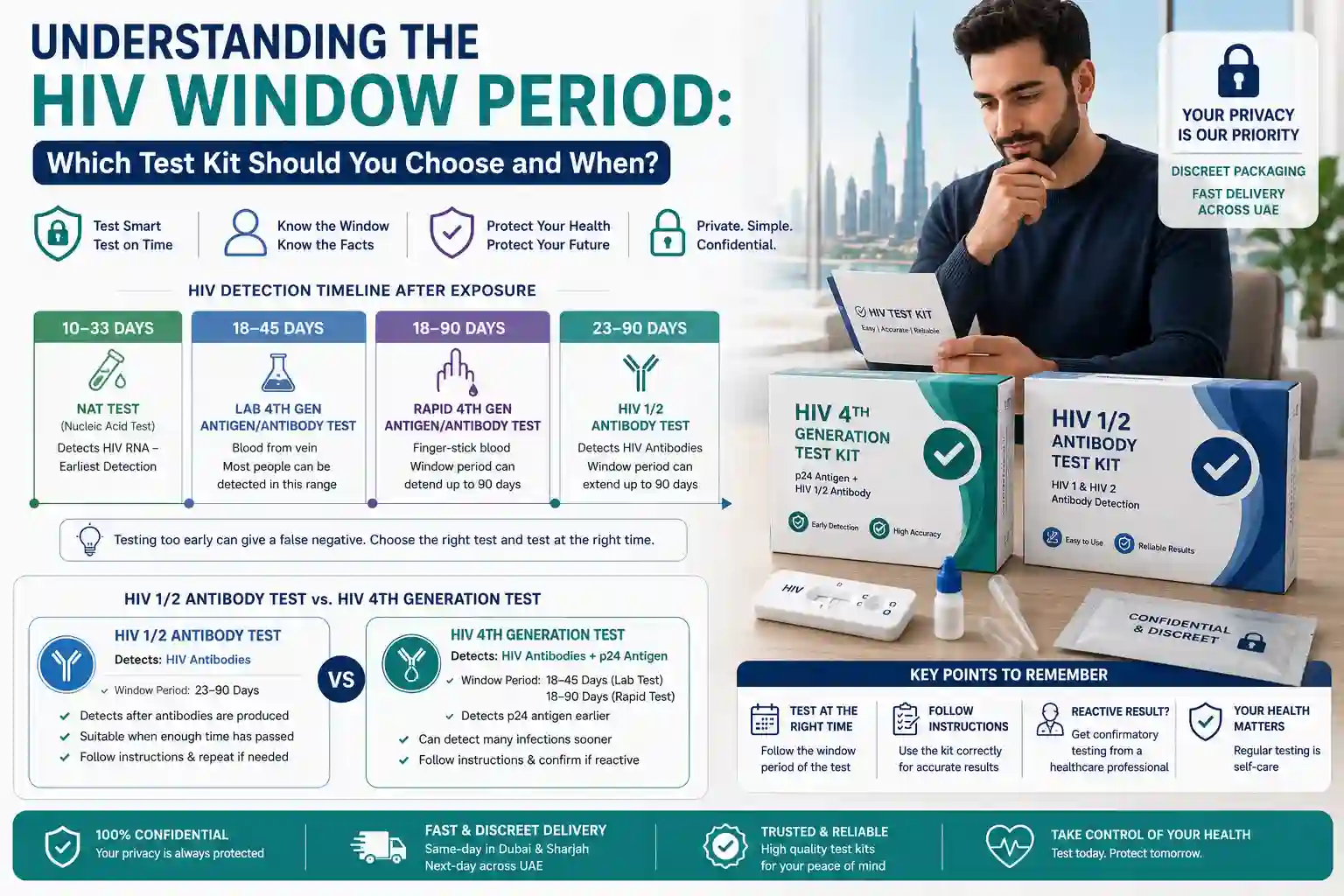
According to the CDC, antibody tests can usually detect HIV 23–90 days after exposure, while a rapid antigen/antibody test using finger-stick blood can usually detect HIV 18–90 days after exposure. A laboratory antigen/antibody test using blood from a vein generally has a window of 18–45 days.
This guide explains the HIV window period in simple terms, compares HIV 1/2 antibody tests vs. HIV 4th generation tests, provides practical testing timelines, and explains when professional follow-up testing may be appropriate.
What Is the HIV Window Period?
The HIV window period is the time between a potential HIV exposure and the point when a particular HIV test can reliably detect the infection.
HIV tests do not detect the infection immediately after exposure. Different tests look for different markers:
- Antibody tests look for antibodies produced by the immune system.
- Antigen/antibody tests look for both HIV antibodies and the p24 antigen.
- Nucleic acid tests (NATs) look for HIV genetic material in the blood.
Because these markers appear at different stages of infection, the tests have different window periods.
A simple way to understand it
Think of the window period as a period when HIV may be present but the particular test you are using may not yet be able to detect it.
Therefore:
A negative HIV test taken very soon after exposure does not necessarily rule out HIV.
The appropriate follow-up timing depends on the test type and the circumstances of the exposure.
HIV Testing Timeline: How Soon Can Different Tests Detect HIV?
The CDC provides the following general detection windows:
| HIV Test Type | Typical Detection Window After Exposure |
|---|---|
| NAT | 10–33 days |
| Laboratory antigen/antibody test | 18–45 days |
| Rapid finger-stick antigen/antibody test | 18–90 days |
| Antibody test | 23–90 days |
These are typical ranges, not guarantees for every individual. The exact timing can vary depending on the test, specimen type, individual factors, and whether antiretroviral medications are involved.
This is why the name of the test alone is not enough. You should also check the manufacturer's instructions for the specific product you are using.
HIV 1/2 Antibody Test: What Does It Detect?
An HIV 1/2 antibody test is designed to detect antibodies against HIV-1 and/or HIV-2.
After infection, the immune system needs time to produce detectable antibodies. This means antibody-based tests generally have a longer window period than tests that can also detect the p24 antigen.
According to the CDC, HIV antibody tests can usually detect infection 23 to 90 days after exposure. Most rapid HIV tests and self-tests fall into the antibody-test category.
When should you consider an HIV 1/2 antibody test?
An antibody test can be useful when enough time has passed for antibodies to develop.
If your exposure was recent, however, a negative antibody test may not be conclusive because you could still be within the window period.
For this reason, always follow the test manufacturer's instructions and consider repeat or professional testing when appropriate.
HIV 4th Generation Test: What Does It Detect?
An HIV 4th generation test is an antigen/antibody combination test.
Instead of looking only for antibodies, it can detect:
- HIV antibodies
- HIV p24 antigen
The p24 antigen can appear before antibodies become detectable. This is why antigen/antibody testing can detect many infections earlier than antibody-only testing.
However, there is an important distinction between different 4th-generation tests.
A laboratory antigen/antibody test using blood from a vein generally has a shorter detection window than a rapid finger-stick antigen/antibody test. The CDC gives approximately 18–45 days for a laboratory antigen/antibody test and 18–90 days for a rapid finger-stick antigen/antibody test.
Therefore, you should not assume that every product marketed as “4th generation” has exactly the same window period.
HIV 1/2 Antibody vs. HIV 4th Generation: What's the Difference?
The biggest difference is what the test detects.
HIV 1/2 Antibody Test
Looks primarily for:
HIV antibodies
Because antibodies take time to develop, the window can extend up to 90 days.
HIV 4th Generation Test
Looks for:
HIV p24 antigen + HIV antibodies
Because p24 antigen may become detectable before antibodies, antigen/antibody testing can detect HIV earlier than antibody-only testing in many circumstances.
Which one is earlier?
Generally, an antigen/antibody test can detect HIV earlier than an antibody-only test.
However, the exact window depends on whether the test is a laboratory venous-blood test or a rapid finger-stick test.
What Should You Do After a Potential HIV Exposure?
The timing of testing matters.
Here is a practical timeline to help you understand the options.
0–3 Days After Exposure
If you believe you have had a significant potential exposure within the last 72 hours, do not rely on a home HIV test to determine whether you are infected.
This is a situation where urgent medical advice is important, because post-exposure prophylaxis (PEP) may be an option and needs to be started as soon as possible.
A home test cannot replace urgent medical assessment during this timeframe.
Around 10–33 Days After Exposure
A NAT can generally detect HIV earlier than antibody or antigen/antibody tests. The CDC estimates a typical NAT window of 10–33 days.
NAT testing is generally a laboratory-based approach rather than a standard consumer home self-test.
If you have had a very recent high-risk exposure and are concerned about early infection, discuss appropriate testing with a healthcare professional.
Around 18–45 Days After Exposure
A laboratory HIV antigen/antibody test using blood from a vein can usually detect HIV 18–45 days after exposure.
This can make laboratory 4th-generation testing particularly useful when someone wants earlier laboratory screening after a potential exposure.
A healthcare professional can help determine whether this type of test is appropriate based on your exposure and timing.
Around 18–90 Days After Exposure
Rapid antigen/antibody tests performed using finger-stick blood can have a broader detection window.
The CDC states that rapid antigen/antibody tests using finger-stick blood can usually detect HIV 18–90 days after exposure.
Therefore, if you are using a rapid home or point-of-care test, check the specific product's instructions rather than assuming that the laboratory 18–45-day window applies.
Around 23–90 Days After Exposure
Antibody tests can usually detect HIV 23–90 days after exposure.
This includes many rapid HIV tests and self-tests.
If you test negative before the end of the applicable window period, you may need to repeat testing after the recommended window period.
When Is an HIV Test Most Reliable?
There is no single answer that applies to every HIV test.
The most important questions are:
- What type of test are you using?
- What specimen does it use?
- How long has it been since the potential exposure?
- What does the manufacturer's instructions say about the window period?
- Have you used PrEP, PEP, or other antiretroviral medication?
Antiretroviral medications can affect the timing of HIV detection, so people taking or having recently taken PrEP or PEP should discuss testing with a healthcare professional.
Which HIV Test Kit Should You Choose?
If you are specifically comparing an HIV 4th Generation Test Kit and an HIV 1/2 Antibody Test Kit, the choice should be based on your testing timeline and the exact specifications of the product.
Choose an HIV 4th Generation Test When:
You want a test that checks for both:
- HIV antibodies
- HIV p24 antigen
The antigen/antibody approach can detect infection earlier than antibody-only testing in many cases.
However, verify whether the specific product is a laboratory test or rapid finger-stick test because their detection windows differ.
HIV 4th Generation Test Kit – Sure Test Kit
Choose an HIV 1/2 Antibody Test When:
You specifically want an antibody-based HIV screening test and enough time has passed for antibodies to become detectable.
Remember that an antibody test may not detect a very recent infection.
HIV 1/2 Antibody Test Kit – Sure Test Kit
4th Generation vs. HIV 1/2 Antibody: Quick Comparison
| Feature | HIV 1/2 Antibody Test | HIV 4th Generation Test |
| Detects antibodies | Yes | Yes |
| Detects p24 antigen | No | Yes |
| Can detect earlier infection | Generally later | Generally earlier |
| Typical CDC window | 23–90 days | Depends on test type |
| Suitable for home testing | Depends on product | Depends on product |
| Best for very recent exposure | May be too early | May be preferable, but timing still matters |
| Follow-up after reactive result | Required | Required |
The exact performance and window period should always be confirmed using the instructions supplied with the specific test.
Why a Negative Result Doesn't Always Mean You're in the Clear
One of the biggest misunderstandings about HIV testing is assuming that any negative result immediately after exposure rules out HIV.
It doesn't.
If the test is taken during the window period, there may not yet be enough detectable HIV markers for the test to produce a positive result.
The CDC specifically recommends repeat testing after the applicable window period when an initial test is negative but the person may have been exposed recently.
Example
Imagine someone has a potential exposure on Day 1.
They take an antibody test on Day 5 and receive a negative result.
That result cannot necessarily exclude an infection from the Day 1 exposure because Day 5 is far earlier than the typical antibody-test window.
Testing again at an appropriate time provides much more meaningful information.
What If the HIV Test Is Positive or Reactive?
A home or rapid HIV screening test should be treated as an initial screening test.
A reactive or positive result does not by itself establish a final HIV diagnosis.
The CDC recommends follow-up testing after a positive self-test or other initial antibody test.
If your test produces a reactive or positive result:
- Stay calm.
- Do not assume the result is a confirmed diagnosis.
- Contact a qualified healthcare professional or testing facility.
- Arrange the recommended confirmatory testing.
- Follow professional medical advice.
Confirmatory testing is essential because screening tests can produce false-positive results.
What If the Result Is Negative?
If your result is negative, consider when you tested.
Negative result after a recent exposure
You may still be within the window period.
Follow the instructions for your specific test and consider repeat testing at the recommended time.
Negative result after the applicable window period
A negative result obtained after the relevant window period is more reassuring, but the interpretation still depends on the test type, exposure timing, and individual circumstances.
Can You Test for HIV at Home?
Yes, home HIV self-testing is available in many markets, but the exact products and regulatory approvals vary by country.
The CDC explains that HIV self-tests allow people to test at home or in a private location.
The important thing is to:
- Use the correct specimen.
- Follow the manufacturer's instructions.
- Check the expiry date.
- Follow the specified reading time.
- Understand the window period.
- Seek follow-up testing for a reactive result.
Do not modify the testing procedure or use a specimen that the product was not designed for.
Why Following the Instructions Matters
Even a properly designed HIV test can give an unreliable result if it is used incorrectly.
Before testing:
- Check the expiration date.
- Make sure the package is intact.
- Read the instructions completely.
- Use only the specified specimen.
- Follow the sample collection procedure.
- Read the result within the stated time.
- Do not interpret a result after the manufacturer's specified reading window.
FDA information for approved HIV self-tests emphasizes following the product's instructions and obtaining confirmatory laboratory testing after a positive result.
What About HIV Testing After PrEP or PEP?
If you are taking or have recently taken PrEP or PEP, do not rely on a standard testing timeline without professional guidance.
Antiretroviral medications can delay the ability of HIV tests to detect infection.
If this applies to you, tell the healthcare professional exactly:
- When the potential exposure occurred.
- When you started PrEP or PEP.
- When you stopped it, if applicable.
- Which HIV tests you have already taken.
- When those tests were performed.
This information can affect the appropriate testing strategy.
Home HIV Testing vs. Laboratory HIV Testing
Both approaches can have a role, but they are not identical.
Home HIV Testing
Advantages:
- Convenient
- Private
- No clinic waiting room
- Can be performed at home
- Useful for routine screening depending on the product
Limitations:
- Window period still applies
- Correct technique is important
- Reactive results require follow-up
- Some tests detect antibodies only
Laboratory Testing
Laboratory testing can provide access to different testing technologies, including laboratory antigen/antibody tests and NATs.
A laboratory antigen/antibody test using venous blood generally has a shorter window period than rapid finger-stick antigen/antibody testing.
For people concerned about a very recent exposure, professional testing may therefore be particularly important.
A Simple HIV Testing Timeline
If you're trying to decide what to do, this simplified timeline can help:
Day 0
Potential exposure
If the exposure occurred within the previous 72 hours and you are concerned about HIV, seek urgent medical advice regarding PEP rather than waiting for a home test.
Days 10–33
NAT may detect HIV
NATs generally have the earliest detection window.
Days 18–45
Laboratory 4th-generation testing
Laboratory antigen/antibody testing using venous blood can usually detect HIV during this range.
Days 18–90
Rapid finger-stick antigen/antibody testing
The detection window can extend to 90 days.
Days 23–90
Antibody testing
Antibody tests can usually detect HIV within this range.
After the applicable window period
Repeat testing if necessary
If your first test was performed too early, repeat testing according to the test's instructions or healthcare professional's advice.
Which HIV Test Is Better: 4th Generation or Antibody?
There isn't a single test that is “best” for every situation.
Instead, think about timing.
If you are testing relatively soon after a potential exposure:
An antigen/antibody test may offer earlier detection than an antibody-only test, depending on the specific test and specimen type.
If sufficient time has passed:
An HIV 1/2 antibody test may be appropriate for screening, provided you follow the product's stated window period.
If the exposure was extremely recent:
A healthcare professional may recommend a laboratory test such as a NAT or another appropriate testing strategy rather than relying solely on a home antibody test.
Why Timing Matters More Than Choosing a Test at Random
A common mistake is to purchase a test without considering when the potential exposure happened.
For example, someone exposed two days ago and someone exposed two months ago are not in the same testing situation.
The first person may require urgent professional advice and potentially a different testing approach.
The second person may have more useful results from an antibody or antigen/antibody test depending on the exact timeline.
Therefore, before purchasing an HIV test kit, ask yourself:
“How many days has it been since the potential exposure?”
That single question can help determine which testing pathway makes the most sense.
HIV Testing in the UAE: Private Home Testing Options
For UAE residents who value privacy, home HIV testing can provide a convenient way to perform initial screening without visiting a clinic for every test.
Sure Test Kit provides several HIV testing options, including:
- HIV 4th Generation Test Kit
- HIV 1/2 Antibody Test Kit
- HIV & Syphilis Rapid Dual Test Kit
- Other HIV and STD screening options
Customers can order online and receive products through discreet delivery.
However, a home test should not replace professional medical care when there has been a very recent high-risk exposure, symptoms suggest acute HIV infection, or a screening test is reactive.
Frequently Asked Questions
How long is the HIV window period?
It depends on the type of test. CDC guidance states that antibody tests can usually detect HIV 23–90 days after exposure, rapid finger-stick antigen/antibody tests 18–90 days, laboratory antigen/antibody tests 18–45 days, and NATs 10–33 days.
Is a 4th generation HIV test better than an antibody test?
A 4th-generation antigen/antibody test can generally detect HIV earlier than an antibody-only test because it looks for both antibodies and p24 antigen. However, the exact window depends on the specific test and whether it uses venous blood or finger-stick blood.
Can an HIV test be negative during the window period?
Yes. If testing occurs before the test can reliably detect infection, the result may be negative even if HIV infection is present. Repeat testing after the applicable window period may therefore be necessary.
When should I take an HIV test after exposure?
The appropriate timing depends on the test. A NAT may detect HIV from around 10 days onward, while laboratory antigen/antibody testing generally has an 18–45-day window and antibody testing generally has a 23–90-day window.
Can I use a home HIV test after a recent exposure?
A home test can be useful, but testing too soon can produce a negative result during the window period. If the exposure was very recent or considered high risk, seek professional medical advice rather than relying only on a home test.
What should I do if my home HIV test is positive?
A positive or reactive home HIV screening result needs follow-up testing by a healthcare professional to confirm the result.
What should I do if my test is negative?
Consider the time since exposure and the window period for your specific test. If you tested too early, repeat testing at the recommended time.
Final Takeaway: Test at the Right Time
Understanding the HIV window period is just as important as choosing the test itself.
An HIV 1/2 antibody test looks for antibodies and generally has a window of approximately 23–90 days. A 4th-generation antigen/antibody test looks for both HIV antibodies and p24 antigen and can detect infection earlier, although the exact window depends on whether it is a laboratory venous-blood test or a rapid finger-stick test.
For people concerned about a very recent exposure, a healthcare professional can help determine whether NAT, laboratory antigen/antibody testing, repeat testing, or another approach is appropriate.
For routine or privacy-focused screening, home HIV test kits can provide a convenient option when used correctly and at the appropriate time.
If you are looking for an HIV 4th Generation Test Kit or HIV 1/2 Antibody Test Kit in the UAE, explore the available options from Sure Test Kit and carefully review the manufacturer's instructions and stated window period before testing.
Important: No home screening test can replace professional medical evaluation when there has been a recent significant exposure, symptoms of acute HIV infection, a reactive result, or uncertainty about how to interpret your result. Always follow the specific test manufacturer's instructions and seek qualified medical advice when needed.
Disclaimer
This content is intended for informational purposes only and should not be considered a substitute for professional advice. Always consult with a qualified professional for specific concerns.