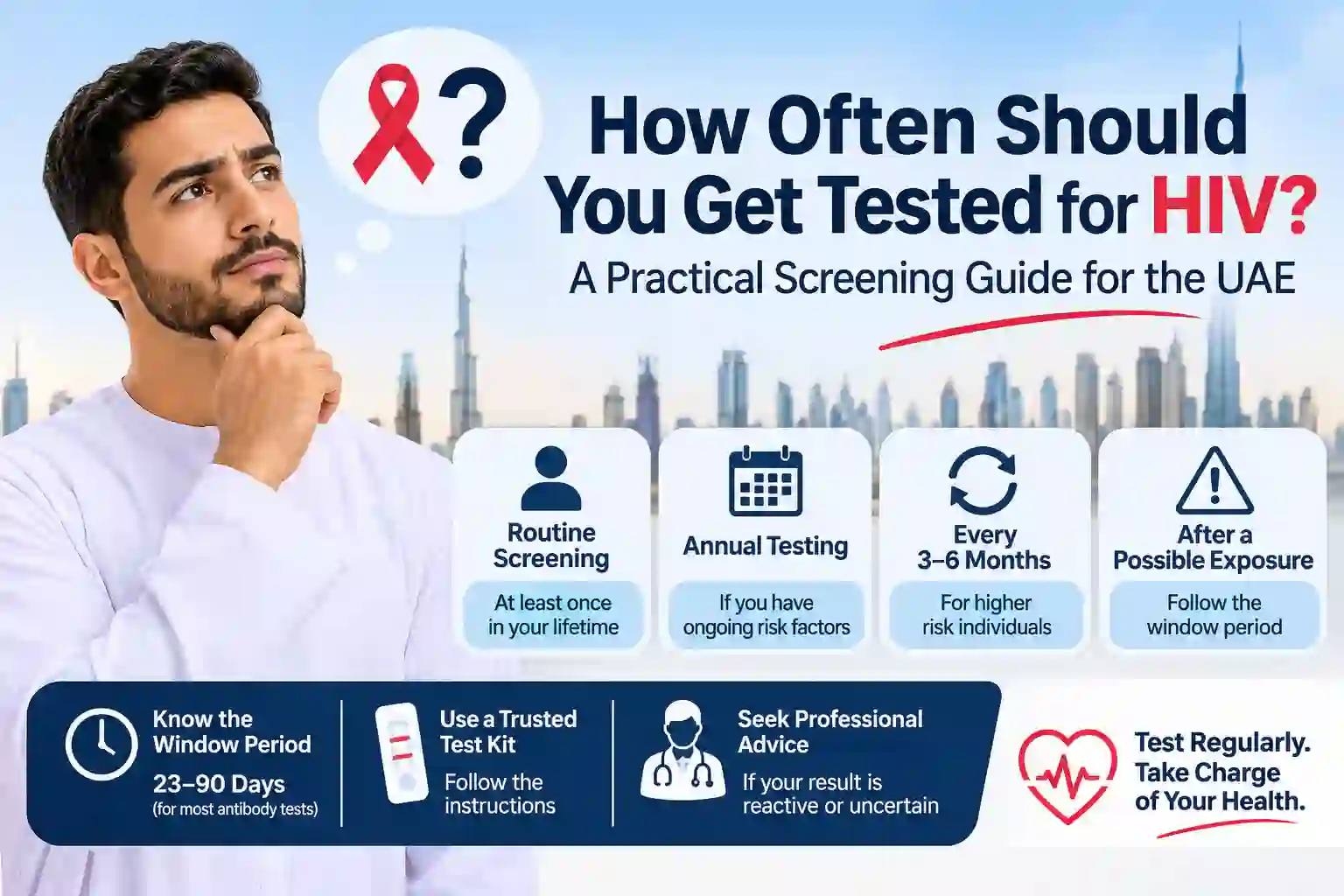
Knowing when to take an HIV test is an important part of looking after your health. Some people may only need routine screening, while others may benefit from testing more frequently because of ongoing or recent exposure risks.
If you live in Dubai, Sharjah, Abu Dhabi or another emirate, you may be wondering: How often should I get tested for HIV? Should you test every few months, once a year, or only after a possible exposure?
The answer depends on your circumstances, the type of test you use, and whether there has been a recent or ongoing possibility of exposure. This guide explains the general screening principles, when repeat testing may be appropriate, and how HIV self-test kits can fit into a responsible testing routine.
Important: This article is educational and is not a substitute for medical advice. For personal testing intervals, speak with a qualified healthcare professional.
1. How often should you get tested for HIV?
There is no single testing schedule that is right for everyone. Your recommended frequency depends on factors such as your previous test results, possible exposures, sexual health history, and whether you use HIV prevention medication.
As a general reference, the US Centers for Disease Control and Prevention (CDC) recommends that everyone aged 13–64 get tested at least once as part of routine healthcare. It also recommends more frequent testing for people with certain ongoing risk factors. These are general public-health recommendations, not a statement of UAE-specific legal requirements.
A practical overview is:
Never tested before: Consider arranging a routine HIV test with a healthcare provider.
No new possible exposure and no ongoing risk factors: You may not need frequent repeat testing after an appropriate negative test.
Ongoing exposure risks: Regular testing may be appropriate, often at least annually.
Higher or continuing risk: A healthcare professional may recommend testing every 3–6 months, depending on your circumstances.
Recent possible exposure: Test at an appropriate time, but understand that an early negative result may need to be repeated after the test's window period.
The CDC describes annual testing for people with certain risk factors and notes that some sexually active people may benefit from testing every 3–6 months. The right schedule should be based on individual circumstances.
2. Who may need more frequent HIV testing?
More frequent screening may be appropriate if you have had a possible exposure since your last test or if your circumstances involve ongoing risk.
You should discuss a testing schedule with a healthcare professional if:
You have had sex with someone whose HIV status is positive or unknown.
You have had new or multiple sexual partners since your last test.
You have shared needles, syringes or other injecting equipment.
You have been diagnosed with another sexually transmitted infection (STI).
You are taking HIV pre-exposure prophylaxis (PrEP).
A healthcare professional has advised repeat testing based on your medical or exposure history.
These examples are not a diagnosis or a judgement about anyone's lifestyle. HIV testing is a routine health measure, and deciding to test is a responsible way to understand your health status.
3. Should you get tested after every possible exposure?
A possible exposure does not always mean HIV transmission has occurred. However, if you think you may have been exposed, it is important to act promptly.
Do not wait for symptoms. HIV cannot be reliably identified by how someone looks or feels, and some people have no noticeable symptoms.
If the possible exposure happened within the last 72 hours, seek urgent medical assessment to find out whether post-exposure prophylaxis (PEP) is appropriate. PEP is medication used after a possible exposure and should be started as soon as possible if prescribed. It is generally not recommended to delay seeking care while waiting for a home test.
A healthcare professional can also advise when to take an initial HIV test and when to repeat it.
Read our related guide: What to Do After a Possible HIV Exposure in the UAE.
4. Understand the HIV testing window period
One of the most important parts of planning repeat testing is understanding the window period.
The window period is the time between a possible HIV exposure and the point when a particular test can reliably detect infection. No HIV test can detect HIV immediately after exposure.
According to CDC guidance, typical detection windows vary by test type:
| HIV test type | Typical detection window |
|---|---|
| Nucleic acid test (NAT) | 10–33 days |
| Laboratory antigen/antibody test using venous blood | 18–45 days |
| Rapid antigen/antibody test using finger-prick blood | 18–90 days |
| Antibody test, including most self-tests | 23–90 days |
These ranges are not interchangeable. A laboratory fourth-generation test and a rapid finger-prick combination test can have different detection windows, even though both may detect antigen and antibodies.
If you test negative before the window period has ended, you may need another test after the relevant window period. Follow the instructions for your specific test and the advice of your healthcare professional.
For a more detailed explanation, read: HIV 4th Generation Test vs HIV Antibody Test.
5. Can an HIV self-test kit be part of your regular screening routine?
An HIV self-test can provide a convenient way to screen for HIV at home, provided you use a suitable, quality-assured product and follow its instructions carefully.
Self-tests may be useful for people who prefer to carry out an initial screening privately or want an additional option between healthcare appointments. However, the test type matters.
Before choosing a kit, check:
Whether it is an antibody test or an antigen/antibody test.
What sample it uses, such as a finger-prick blood sample or oral fluid.
The manufacturer's stated window period.
The instructions for sample collection and result interpretation.
What follow-up is recommended for a reactive or invalid result.
Most HIV self-tests are antibody tests, but you should always confirm the specifications of the individual product.
You can explore the available options on SureTestKit's HIV test kit page. You can also review the HIV 1/2 antibody test kit and the HIV 4th-generation test kit. Check each product's intended use and detection window before choosing one.
A self-test is a screening tool. It does not replace clinical diagnosis or professional follow-up.
6. What should you do if your HIV self-test result is reactive?
A reactive self-test result does not, by itself, establish a confirmed HIV diagnosis. It means that follow-up testing is needed.
If your result is reactive:
Stay calm and avoid drawing conclusions from a screening result alone.
Contact a qualified healthcare provider or appropriate testing service promptly.
Arrange the recommended confirmatory testing.
Follow the healthcare professional's advice about next steps.
If your result is invalid, follow the manufacturer's instructions. You may need to repeat the test with a new kit or arrange testing through a healthcare provider.
If your result is negative, check whether the test was taken after the full window period. If it was too early, repeat testing may be necessary.
7. Does a negative HIV test mean you never need another test?
Not necessarily. A negative result is reassuring only when it is interpreted in the context of the test's window period and any subsequent exposure.
For example, if you had a negative antibody self-test but took it before the end of its stated window period, you may need to repeat it. Similarly, a new possible exposure after a negative test may require a new testing plan.
People taking PrEP or PEP need to follow a clinician-directed testing schedule. These medicines can affect how testing is planned, so do not rely on a general self-testing timetable.
8. HIV screening options for people across the UAE
People in Dubai, Sharjah, Abu Dhabi and other parts of the UAE can discuss appropriate HIV screening with a qualified healthcare provider or testing service.
Some people prefer clinic-based testing and professional guidance. Others may consider an HIV self-test as an initial screening option, depending on the product and their circumstances.
If you are comparing home screening options, visit SureTestKit to review the available kits. Read the product information carefully, especially the sample type, intended use and window period.
For broader screening needs, you can also browse all available test kits.
Frequently Asked Questions
1. How often should a person get tested for HIV?
It depends on individual circumstances. General guidance recommends at least one routine test for most people and more frequent testing for those with ongoing risk factors. Annual testing or testing every 3–6 months may be appropriate for some people, based on professional advice.
2. Should I get an HIV test every year?
Annual testing may be appropriate if you have ongoing exposure risks. If you have no new or continuing risk factors, you may not need annual testing. Discuss your circumstances with a healthcare professional.
3. Can I use an HIV self-test every few months?
A self-test may be one option for repeat screening, but you should select a suitable test and follow its instructions. If you are taking PrEP or PEP, follow your clinician's testing schedule instead of relying only on home testing.
4. How long after exposure should I repeat an HIV test?
It depends on the type of test. CDC guidance gives a typical window of 23–90 days for antibody tests, 18–90 days for rapid finger-prick antigen/antibody tests, and 18–45 days for laboratory antigen/antibody tests using venous blood. Follow the specific test instructions and clinical advice.
5. Should I wait for HIV symptoms before testing?
No. HIV may not cause noticeable symptoms, and symptoms alone cannot confirm or rule out infection. Testing is the reliable way to determine HIV status.
6. What if I had a possible exposure within the last 72 hours?
Seek urgent medical assessment immediately to discuss whether PEP is appropriate. Do not wait for symptoms or for a home test result before seeking advice.
Final thoughts
The right HIV testing schedule is based on your personal circumstances, not a fixed rule that applies to everyone. A one-time routine test may be sufficient for some people, while those with ongoing exposure risks may need regular screening.
Understanding the window period is just as important as choosing a test. If you have a recent possible exposure, seek timely medical advice; if you use a self-test, follow the product instructions and arrange professional follow-up for a reactive result.
For people across Dubai, Sharjah, Abu Dhabi and the wider UAE, informed screening decisions can help make HIV testing a more straightforward part of routine health awareness.
Explore HIV screening options: SureTestKit HIV Test Kits
Medical note: This article is for general educational purposes. It does not provide a diagnosis or replace advice from a qualified healthcare professional.
Disclaimer
This content is intended for informational purposes only and should not be considered a substitute for professional advice. Always consult with a qualified professional for specific concerns.