Wellness & Health Insights UAE
Stay informed with expert-written articles on HIV testing, STD awareness, prevention tips, and sexual health education tailored for UAE residents.
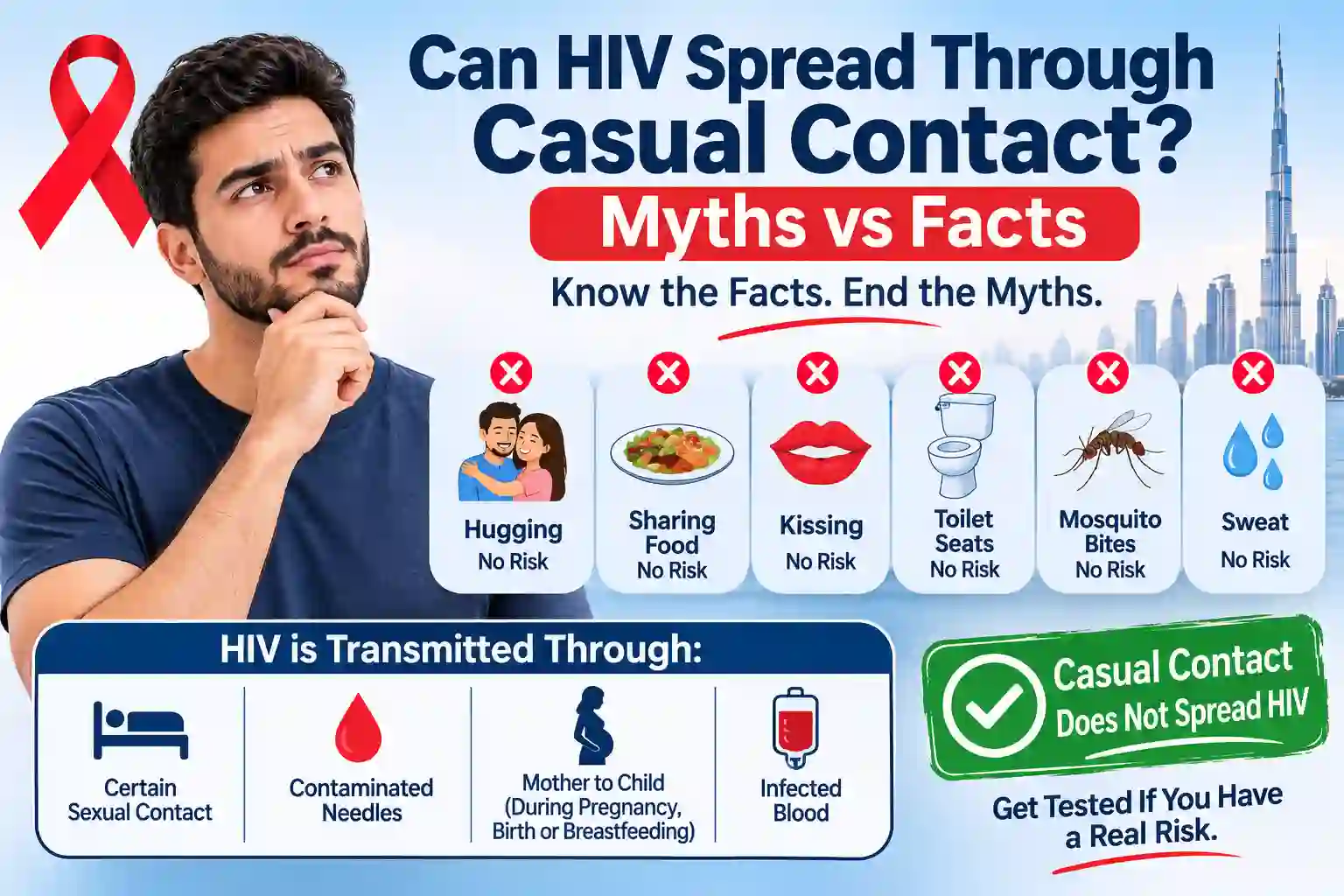
Can HIV Spread Through Casual Contact? Myths About Kissing, Food, Toilets and Everyday Life
HIV is one of the most misunderstood infections, and misinformation can create unnecessary fear, stigma, and anxiety. Many people still worry about whether HIV can spread through hugging, sharing food, using the same toilet, shaking hands, or sitting next to someone who is living with HIV.Understanding how HIV actually spreads is important for protecting your health while treating other people with dignity and respect.If you are searching for answers in Dubai, Sharjah, Abu Dhabi, or anywhere in the UAE, this guide explains what situations do and do not transmit HIV, when testing is necessary, and why understanding the facts matters.1. Can HIV spread through casual contact?No. HIV does not spread through ordinary casual contact.You cannot get HIV simply by sharing everyday spaces, touching someone, or being around a person who has HIV.HIV is transmitted through specific body fluids under particular circumstances. The main transmission routes include certain sexual exposures, sharing contaminated needles or injecting equipment, and transmission during pregnancy, childbirth, or breastfeeding.HIV is not transmitted through normal social interaction.This means you can safely work, study, eat, exercise, and live alongside someone with HIV without fear of acquiring the virus through casual contact.2. Can HIV spread through hugging or shaking hands?No. Hugging, shaking hands, holding hands, and ordinary physical contact do not transmit HIV.HIV cannot pass through healthy, unbroken skin. Touching someone's skin, sitting next to them, or greeting them normally is not an HIV exposure.There is no reason to avoid a colleague, friend, family member, or other person because they are living with HIV.Fear of casual contact is based on misinformation, not the way HIV spreads.3. Can HIV spread through kissing?HIV does not spread through saliva or ordinary kissing.Closed-mouth kissing and social kissing carry no HIV transmission risk. Deep kissing is also considered extremely low risk; extremely rare cases have involved blood exposure, such as when both people had bleeding gums or open sores and infected blood entered the other person's bloodstream.HIV is not transmitted through saliva alone.You do not need to worry about sharing affection, greeting someone with a kiss, or normal social interaction.4. Can HIV spread by sharing food, drinks or utensils?No. HIV cannot be transmitted by sharing:Food prepared by someone living with HIVPlates, spoons, forks or other utensilsDrinking glasses or cupsWater bottles during normal useMeals at restaurantsFood at home with family or friendsHIV does not survive or spread in food in a way that causes infection through ordinary eating.Sharing a meal with someone living with HIV is safe.5. Can HIV spread through toilet seats or bathrooms?No. HIV cannot spread through toilet seats, bathroom surfaces, taps, showers, or ordinary shared bathroom facilities.You can safely use the same toilet, bathroom, swimming pool, gym facilities, or other shared spaces as someone living with HIV.HIV is not spread through water or environmental surfaces in ordinary daily situations.6. Can mosquitoes transmit HIV?No. Mosquitoes do not transmit HIV.Even in places where mosquitoes are common, they do not spread HIV from one person to another. HIV does not reproduce inside mosquitoes in the way necessary for mosquito-borne transmission.Mosquito bites are not considered a route of HIV transmission.7. Can HIV spread through sweat, tears or saliva?No. Sweat, tears, and saliva do not transmit HIV under normal circumstances.HIV is not spread through:SweatingSneezingCoughingTearsSalivaSharing towels during ordinary useTouching surfaces contaminated with these fluidsThe exception to consider is visible blood contamination. If blood is involved and enters damaged skin or a mucous membrane, the situation may require medical assessment depending on the exposure.8. What situations can actually transmit HIV?HIV transmission occurs when certain infectious body fluids enter the body through mucous membranes, damaged tissue, or direct bloodstream exposure.Potential transmission routes include:Sexual exposureAnal or vaginal sex can transmit HIV when prevention measures are not used and the virus is present at a transmissible level. Risk varies depending on the type of exposure and other factors.Sharing needles or injecting equipmentSharing contaminated needles, syringes, or other injecting equipment can expose someone directly to infected blood.Blood exposureContact with infected blood through an injury, contaminated equipment, or certain unsafe procedures may create a risk.Pregnancy, childbirth and breastfeedingHIV can be transmitted from mother to child during pregnancy, childbirth, or breastfeeding. Medical treatment significantly reduces the risk of transmission.HIV is preventable, and effective treatment allows people living with HIV to maintain their health and prevent sexual transmission when they achieve and maintain an undetectable viral load.9. Do you need an HIV test after casual contact?If your only contact was hugging, shaking hands, sharing food, using the same toilet, kissing socially, or being around someone who has HIV, that contact alone is not a reason for HIV testing.Testing may be appropriate if you have had a genuine possible exposure, such as unprotected anal or vaginal sex, shared injecting equipment, or a blood exposure that requires evaluation.If you are uncertain whether a particular situation involved an exposure, a qualified healthcare professional can help assess it.If a possible exposure occurred within the last 72 hours, seek urgent medical care to assess whether post-exposure prophylaxis (PEP) is appropriate. PEP is time-sensitive and should be started as soon as possible when indicated.10. Why HIV testing is importantAlthough HIV does not spread through casual contact, it can spread through exposures that may not be obvious to a person.Testing helps you know your HIV status rather than relying on symptoms, assumptions, or a partner's appearance.Some people with HIV may not have noticeable symptoms for years. That is why testing is important after a potential exposure and as part of routine screening when recommended.If you are considering home screening, understand your test's detection window, sample requirements, and result interpretation.You can explore HIV screening options through SureTestKit HIV test kits.Related options include:HIV 4th Generation Test KitHIV 1/2 Antibody Test KitA home self-test is a screening tool. Reactive results need confirmatory testing, and a negative result taken during the window period may require repeat testing.Frequently Asked QuestionsCan HIV spread by sharing a glass of water?No. Sharing glasses, cups, water bottles, or drinking water does not transmit HIV through ordinary contact.Can HIV spread by sitting beside an HIV-positive person?No. Sitting beside someone, sharing a chair, working together, or being in the same room cannot transmit HIV.Can HIV spread through sweat?No. Sweat alone does not transmit HIV.Can HIV spread from mosquito bites?No. Mosquitoes and other insects do not transmit HIV.Can I live with someone who has HIV?Yes. You can safely share a home, meals, bathrooms, furniture, and everyday activities. HIV does not spread through household casual contact.Should I get tested after kissing?Ordinary kissing, including closed-mouth and social kissing, is not an HIV transmission route. Deep kissing is an extremely rare concern only in unusual situations involving blood exposure. If there was no blood exposure or other risk, kissing alone does not warrant HIV testing.ConclusionHIV cannot spread through ordinary everyday contact. Hugging, shaking hands, sharing food, using the same toilet, kissing socially, sharing a workplace, or being bitten by a mosquito do not transmit HIV.Understanding these facts helps prevent unnecessary fear and stigma toward people living with HIV.If you have experienced a genuine possible exposure, focus on the appropriate medical steps and testing timeline rather than worrying about casual contact.Know the facts. Protect your health. Treat everyone with respect.Explore HIV screening information and test options at SureTestKit UAE.This article is for educational purposes only and is not a substitute for professional medical advice.
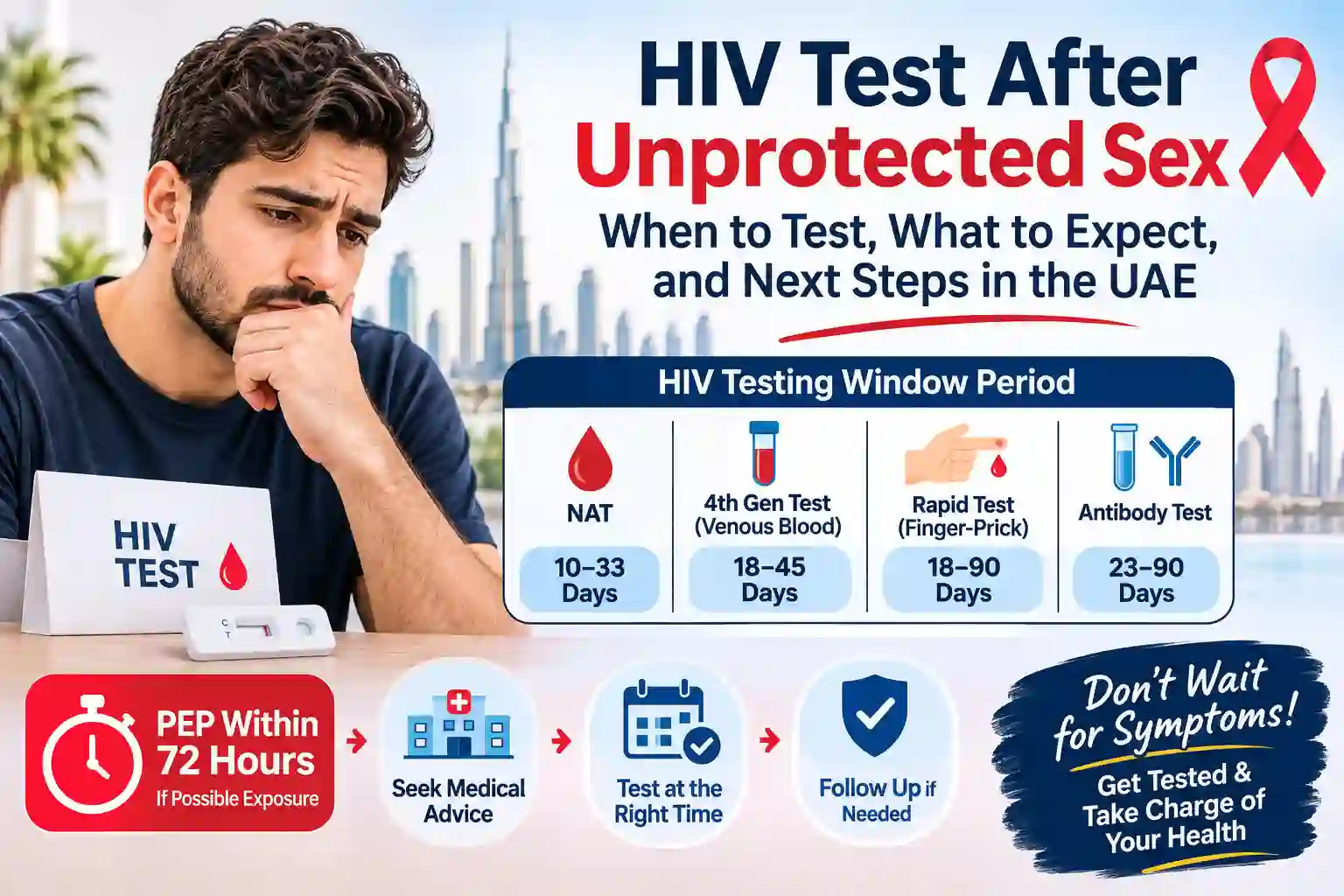
HIV Test After Unprotected Sex: When to Test, What to Expect, and Next Steps in the UAE
Having unprotected sex can leave you feeling worried about your sexual health, especially if you are uncertain about your partner's HIV status. Many people immediately start searching questions such as: When should I take an HIV test? Can I test the next day? Will an early test give an accurate result?If you are in Dubai, Abu Dhabi, Sharjah, or anywhere across the UAE, understanding the right testing timeline can help you make informed decisions instead of relying on anxiety, symptoms, or guesswork.This guide explains when to take an HIV test after unprotected sex, what different tests can detect, when repeat testing may be needed, and what steps to take after a possible exposure.1. When should you take an HIV test after unprotected sex?The timing of your HIV test matters because HIV cannot be detected immediately after exposure. Every test has a window period, which is the time between a possible exposure and when that particular test can reliably detect infection.Testing too early may produce a negative result even if an infection has occurred.The appropriate testing date depends on the test type:Nucleic acid test (NAT): Usually detects HIV approximately 10–33 days after exposure.Laboratory fourth-generation antigen/antibody test using venous blood: Usually detects HIV approximately 18–45 days after exposure.Rapid antigen/antibody test using finger-prick blood: Approximately 18–90 days.Antibody tests, including most HIV self-tests: Approximately 23–90 days.These are general detection windows published by the CDC. The window period for your specific test may differ, so always check the manufacturer's instructions and consult a healthcare professional.If you take a test before the end of its window period and receive a negative result, repeat testing may be necessary.2. What should you do within the first 72 hours?If you think you may have been exposed to HIV during unprotected sex, do not wait for symptoms or a home test.Seek urgent medical attention if the exposure occurred within the last 72 hours. A healthcare professional can assess whether you are eligible for HIV post-exposure prophylaxis (PEP).PEP is a course of medication used after a potential HIV exposure to reduce the risk of infection. It should be started as soon as possible when indicated, ideally within 24 hours and no later than 72 hours.Important points to remember:PEP is time-sensitive.Do not delay medical care while searching for or taking a home test.PEP is generally taken for 28 days when prescribed.Your healthcare provider will guide you regarding initial and follow-up HIV testing.If your exposure was recent, medical assessment is more urgent than waiting for a test to become detectable.3. Can an HIV test be negative one day after unprotected sex?Yes, an HIV test taken one day after possible exposure may be negative, but it cannot rule out infection from that exposure.This is because the virus or the markers detected by the test may not yet be present at detectable levels.An early negative test may help establish a baseline HIV status, but it is not proof that transmission did not occur during the recent event.This is why testing should be planned according to the specific test's window period rather than simply choosing the earliest possible day.4. HIV 4th-generation test vs HIV self-test after exposureDifferent HIV tests detect different markers and have different detection windows.HIV 4th-generation laboratory testA laboratory fourth-generation HIV test detects both HIV antibodies and the p24 antigen. A laboratory test using venous blood typically has a detection window of 18–45 days.It is often used in clinical screening because it can detect HIV earlier than antibody-only tests.HIV antibody self-testMost HIV self-tests detect antibodies produced by the immune system in response to HIV.They may be convenient for home screening, but antibody tests generally have a longer window period. The CDC gives a typical window of 23–90 days for antibody tests.The exact timing depends on the test, sample type, and instructions.If you are choosing a home test after a possible exposure, don't select a product based only on the number of days advertised. Confirm whether it detects antibodies alone or antigen and antibodies together.5. What if you have no HIV symptoms after unprotected sex?The absence of symptoms does not mean you are HIV-negative.Some people develop flu-like symptoms during early HIV infection, such as:FeverSore throatFatigueRashSwollen lymph nodesMuscle achesOthers may experience no symptoms at all.These symptoms are also associated with many common illnesses, so they cannot diagnose HIV. Similarly, feeling completely normal does not rule it out.Testing at the appropriate time is the reliable way to establish your HIV status.6. When should you repeat your HIV test?Repeat testing may be recommended if:Your initial test was taken during the window period.You had another possible exposure after your first test.You used a test with a longer detection window.You are taking PEP or PrEP.Your healthcare professional recommends follow-up based on your exposure.For example, if you take an antibody self-test early and it is negative, you may still need to repeat the test after the full window period specified for that product.Do not assume that a negative result from one test type automatically applies to another test type.7. Can you use an HIV self-test at home after unprotected sex?Yes, a home HIV self-test can be an option for screening, provided it is suitable for your circumstances and you use it according to the instructions.Before using one, check:The type of test and what it detects.The sample required.The recommended testing window.How to interpret negative, reactive, or invalid results.Whether follow-up testing is recommended.A negative result taken within the window period may require repeat testing. A reactive result requires confirmation through appropriate professional testing.You can explore available HIV screening options through the SureTestKit HIV test kit collection.You may also review:HIV 4th-generation test kitHIV 1/2 antibody test kitRead the specifications carefully before choosing a test.8. What should you do after a reactive HIV self-test result?A reactive self-test is a screening result, not a confirmed diagnosis.If your test is reactive:Avoid panicking or assuming the result confirms HIV.Arrange follow-up testing with a qualified healthcare provider.Follow the recommended confirmatory testing pathway.Seek professional guidance regarding your next steps.If your test is invalid, follow the kit's instructions for repeating the test or seek testing from a healthcare provider.If your test is negative, check whether it was taken after the relevant window period and whether additional testing is recommended.9. HIV testing after unprotected sex in Dubai, Abu Dhabi and SharjahIf you are living in Dubai, Sharjah, Abu Dhabi or another emirate, you can seek HIV testing through a healthcare provider or appropriate testing service.Some people prefer laboratory testing and professional guidance, while others may consider home self-testing for initial screening.Whichever option you choose, the most important factors are:Appropriate test selectionCorrect timingFollowing test instructionsRepeat testing when neededProfessional follow-up for reactive resultsHIV testing is a normal part of healthcare. Seeking information and getting tested when appropriate is a responsible step toward protecting your health.Frequently Asked QuestionsCan I test for HIV 3 days after unprotected sex?You may be able to take certain tests, but a negative result at three days cannot rule out infection from that exposure. If the exposure occurred within 72 hours, seek urgent medical assessment for possible PEP.Is an HIV test accurate after 14 days?Some tests may detect HIV at this stage, but a negative result at 14 days is too early to rule out infection with many test types. Follow the detection window for the specific test and arrange repeat testing as recommended.Is a fourth-generation HIV test accurate after 28 days?A laboratory fourth-generation test can detect many infections by 28 days, but 28 days is still within its typical 18–45-day window. Follow-up testing after the full window period may be advised.Can an HIV self-test detect infection after one month?Some infections may be detected, but most antibody self-tests have a window period extending up to 90 days. A negative result after one month may require repeat testing.Should I take an HIV test even if my partner has no symptoms?Yes, symptoms are not a reliable way to determine HIV status. Testing decisions should be based on exposure, test timing, and professional advice rather than appearance or symptoms.What is the most important thing to do after unprotected sex?If a possible exposure happened within the last 72 hours, seek urgent medical care to assess whether PEP is appropriate. After that, follow a testing schedule based on the type of HIV test and the healthcare professional's recommendations.ConclusionAfter unprotected sex, the most important thing is not to panic or rush into interpreting an early test result. Understand the window period, seek urgent care if PEP may be needed, and choose the right testing timeline.A negative result taken too early may not rule out HIV, while a reactive self-test needs professional confirmation.If you are in Dubai, Abu Dhabi, Sharjah, or anywhere in the UAE, making informed decisions about HIV testing is a positive step toward your sexual health and wellbeing.Explore HIV screening options: SureTestKit UAEThis article is for educational purposes only and does not replace medical advice, diagnosis, or treatment from a qualified healthcare professional.
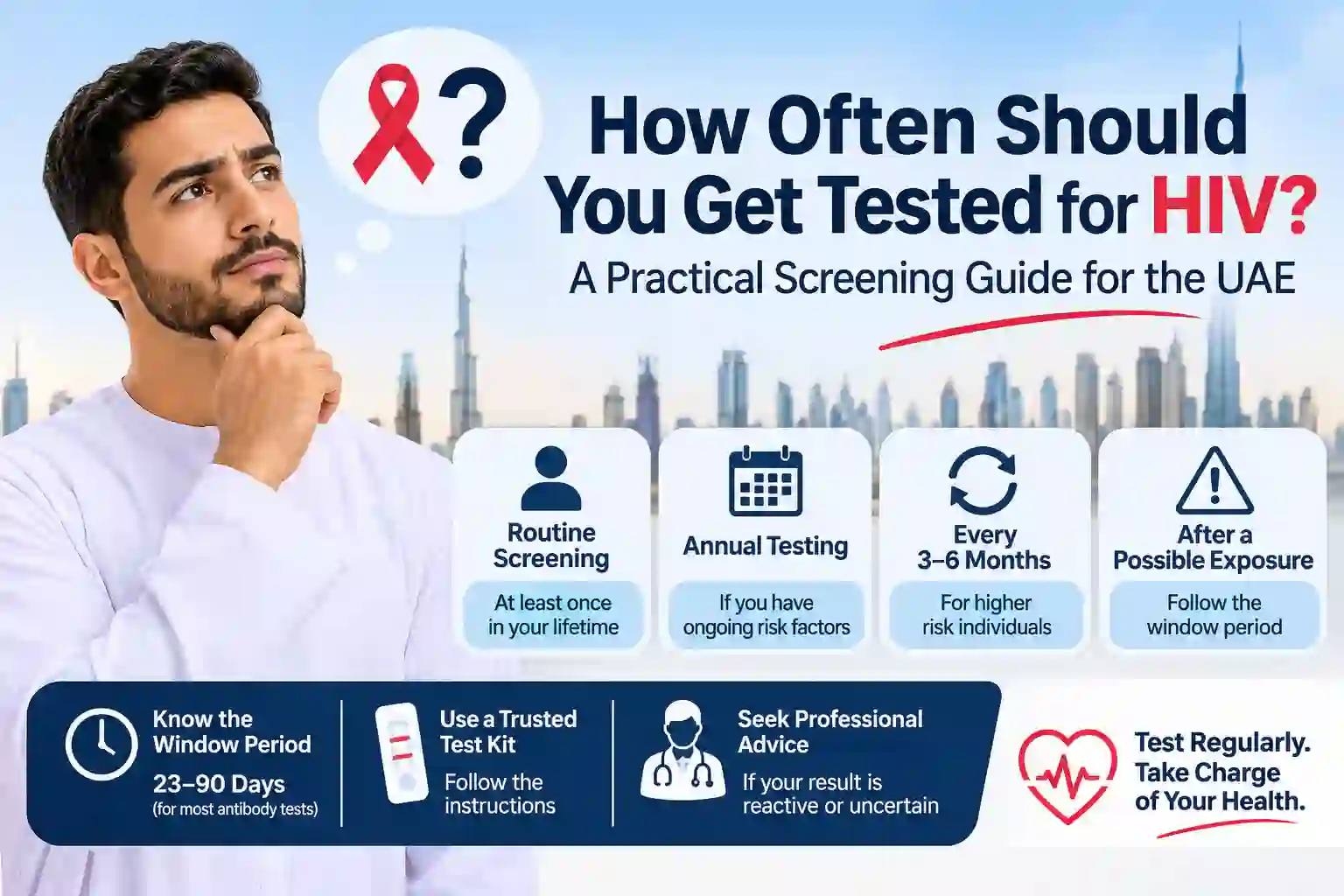
How Often Should You Get Tested for HIV? A Practical Screening Guide for the UAE
Knowing when to take an HIV test is an important part of looking after your health. Some people may only need routine screening, while others may benefit from testing more frequently because of ongoing or recent exposure risks.If you live in Dubai, Sharjah, Abu Dhabi or another emirate, you may be wondering: How often should I get tested for HIV? Should you test every few months, once a year, or only after a possible exposure?The answer depends on your circumstances, the type of test you use, and whether there has been a recent or ongoing possibility of exposure. This guide explains the general screening principles, when repeat testing may be appropriate, and how HIV self-test kits can fit into a responsible testing routine.Important: This article is educational and is not a substitute for medical advice. For personal testing intervals, speak with a qualified healthcare professional.1. How often should you get tested for HIV?There is no single testing schedule that is right for everyone. Your recommended frequency depends on factors such as your previous test results, possible exposures, sexual health history, and whether you use HIV prevention medication.As a general reference, the US Centers for Disease Control and Prevention (CDC) recommends that everyone aged 13–64 get tested at least once as part of routine healthcare. It also recommends more frequent testing for people with certain ongoing risk factors. These are general public-health recommendations, not a statement of UAE-specific legal requirements.A practical overview is:Never tested before: Consider arranging a routine HIV test with a healthcare provider.No new possible exposure and no ongoing risk factors: You may not need frequent repeat testing after an appropriate negative test.Ongoing exposure risks: Regular testing may be appropriate, often at least annually.Higher or continuing risk: A healthcare professional may recommend testing every 3–6 months, depending on your circumstances.Recent possible exposure: Test at an appropriate time, but understand that an early negative result may need to be repeated after the test's window period.The CDC describes annual testing for people with certain risk factors and notes that some sexually active people may benefit from testing every 3–6 months. The right schedule should be based on individual circumstances.2. Who may need more frequent HIV testing?More frequent screening may be appropriate if you have had a possible exposure since your last test or if your circumstances involve ongoing risk.You should discuss a testing schedule with a healthcare professional if:You have had sex with someone whose HIV status is positive or unknown.You have had new or multiple sexual partners since your last test.You have shared needles, syringes or other injecting equipment.You have been diagnosed with another sexually transmitted infection (STI).You are taking HIV pre-exposure prophylaxis (PrEP).A healthcare professional has advised repeat testing based on your medical or exposure history.These examples are not a diagnosis or a judgement about anyone's lifestyle. HIV testing is a routine health measure, and deciding to test is a responsible way to understand your health status.3. Should you get tested after every possible exposure?A possible exposure does not always mean HIV transmission has occurred. However, if you think you may have been exposed, it is important to act promptly.Do not wait for symptoms. HIV cannot be reliably identified by how someone looks or feels, and some people have no noticeable symptoms.If the possible exposure happened within the last 72 hours, seek urgent medical assessment to find out whether post-exposure prophylaxis (PEP) is appropriate. PEP is medication used after a possible exposure and should be started as soon as possible if prescribed. It is generally not recommended to delay seeking care while waiting for a home test.A healthcare professional can also advise when to take an initial HIV test and when to repeat it.Read our related guide: What to Do After a Possible HIV Exposure in the UAE.4. Understand the HIV testing window periodOne of the most important parts of planning repeat testing is understanding the window period.The window period is the time between a possible HIV exposure and the point when a particular test can reliably detect infection. No HIV test can detect HIV immediately after exposure.According to CDC guidance, typical detection windows vary by test type:HIV test typeTypical detection windowNucleic acid test (NAT)10–33 daysLaboratory antigen/antibody test using venous blood18–45 daysRapid antigen/antibody test using finger-prick blood18–90 daysAntibody test, including most self-tests23–90 daysThese ranges are not interchangeable. A laboratory fourth-generation test and a rapid finger-prick combination test can have different detection windows, even though both may detect antigen and antibodies.If you test negative before the window period has ended, you may need another test after the relevant window period. Follow the instructions for your specific test and the advice of your healthcare professional.For a more detailed explanation, read: HIV 4th Generation Test vs HIV Antibody Test.5. Can an HIV self-test kit be part of your regular screening routine?An HIV self-test can provide a convenient way to screen for HIV at home, provided you use a suitable, quality-assured product and follow its instructions carefully.Self-tests may be useful for people who prefer to carry out an initial screening privately or want an additional option between healthcare appointments. However, the test type matters.Before choosing a kit, check:Whether it is an antibody test or an antigen/antibody test.What sample it uses, such as a finger-prick blood sample or oral fluid.The manufacturer's stated window period.The instructions for sample collection and result interpretation.What follow-up is recommended for a reactive or invalid result.Most HIV self-tests are antibody tests, but you should always confirm the specifications of the individual product.You can explore the available options on SureTestKit's HIV test kit page. You can also review the HIV 1/2 antibody test kit and the HIV 4th-generation test kit. Check each product's intended use and detection window before choosing one.A self-test is a screening tool. It does not replace clinical diagnosis or professional follow-up.6. What should you do if your HIV self-test result is reactive?A reactive self-test result does not, by itself, establish a confirmed HIV diagnosis. It means that follow-up testing is needed.If your result is reactive:Stay calm and avoid drawing conclusions from a screening result alone.Contact a qualified healthcare provider or appropriate testing service promptly.Arrange the recommended confirmatory testing.Follow the healthcare professional's advice about next steps.If your result is invalid, follow the manufacturer's instructions. You may need to repeat the test with a new kit or arrange testing through a healthcare provider.If your result is negative, check whether the test was taken after the full window period. If it was too early, repeat testing may be necessary.7. Does a negative HIV test mean you never need another test?Not necessarily. A negative result is reassuring only when it is interpreted in the context of the test's window period and any subsequent exposure.For example, if you had a negative antibody self-test but took it before the end of its stated window period, you may need to repeat it. Similarly, a new possible exposure after a negative test may require a new testing plan.People taking PrEP or PEP need to follow a clinician-directed testing schedule. These medicines can affect how testing is planned, so do not rely on a general self-testing timetable.8. HIV screening options for people across the UAEPeople in Dubai, Sharjah, Abu Dhabi and other parts of the UAE can discuss appropriate HIV screening with a qualified healthcare provider or testing service.Some people prefer clinic-based testing and professional guidance. Others may consider an HIV self-test as an initial screening option, depending on the product and their circumstances.If you are comparing home screening options, visit SureTestKit to review the available kits. Read the product information carefully, especially the sample type, intended use and window period.For broader screening needs, you can also browse all available test kits.Frequently Asked Questions1. How often should a person get tested for HIV?It depends on individual circumstances. General guidance recommends at least one routine test for most people and more frequent testing for those with ongoing risk factors. Annual testing or testing every 3–6 months may be appropriate for some people, based on professional advice.2. Should I get an HIV test every year?Annual testing may be appropriate if you have ongoing exposure risks. If you have no new or continuing risk factors, you may not need annual testing. Discuss your circumstances with a healthcare professional.3. Can I use an HIV self-test every few months?A self-test may be one option for repeat screening, but you should select a suitable test and follow its instructions. If you are taking PrEP or PEP, follow your clinician's testing schedule instead of relying only on home testing.4. How long after exposure should I repeat an HIV test?It depends on the type of test. CDC guidance gives a typical window of 23–90 days for antibody tests, 18–90 days for rapid finger-prick antigen/antibody tests, and 18–45 days for laboratory antigen/antibody tests using venous blood. Follow the specific test instructions and clinical advice.5. Should I wait for HIV symptoms before testing?No. HIV may not cause noticeable symptoms, and symptoms alone cannot confirm or rule out infection. Testing is the reliable way to determine HIV status.6. What if I had a possible exposure within the last 72 hours?Seek urgent medical assessment immediately to discuss whether PEP is appropriate. Do not wait for symptoms or for a home test result before seeking advice.Final thoughtsThe right HIV testing schedule is based on your personal circumstances, not a fixed rule that applies to everyone. A one-time routine test may be sufficient for some people, while those with ongoing exposure risks may need regular screening.Understanding the window period is just as important as choosing a test. If you have a recent possible exposure, seek timely medical advice; if you use a self-test, follow the product instructions and arrange professional follow-up for a reactive result.For people across Dubai, Sharjah, Abu Dhabi and the wider UAE, informed screening decisions can help make HIV testing a more straightforward part of routine health awareness.Explore HIV screening options: SureTestKit HIV Test KitsMedical note: This article is for general educational purposes. It does not provide a diagnosis or replace advice from a qualified healthcare professional.
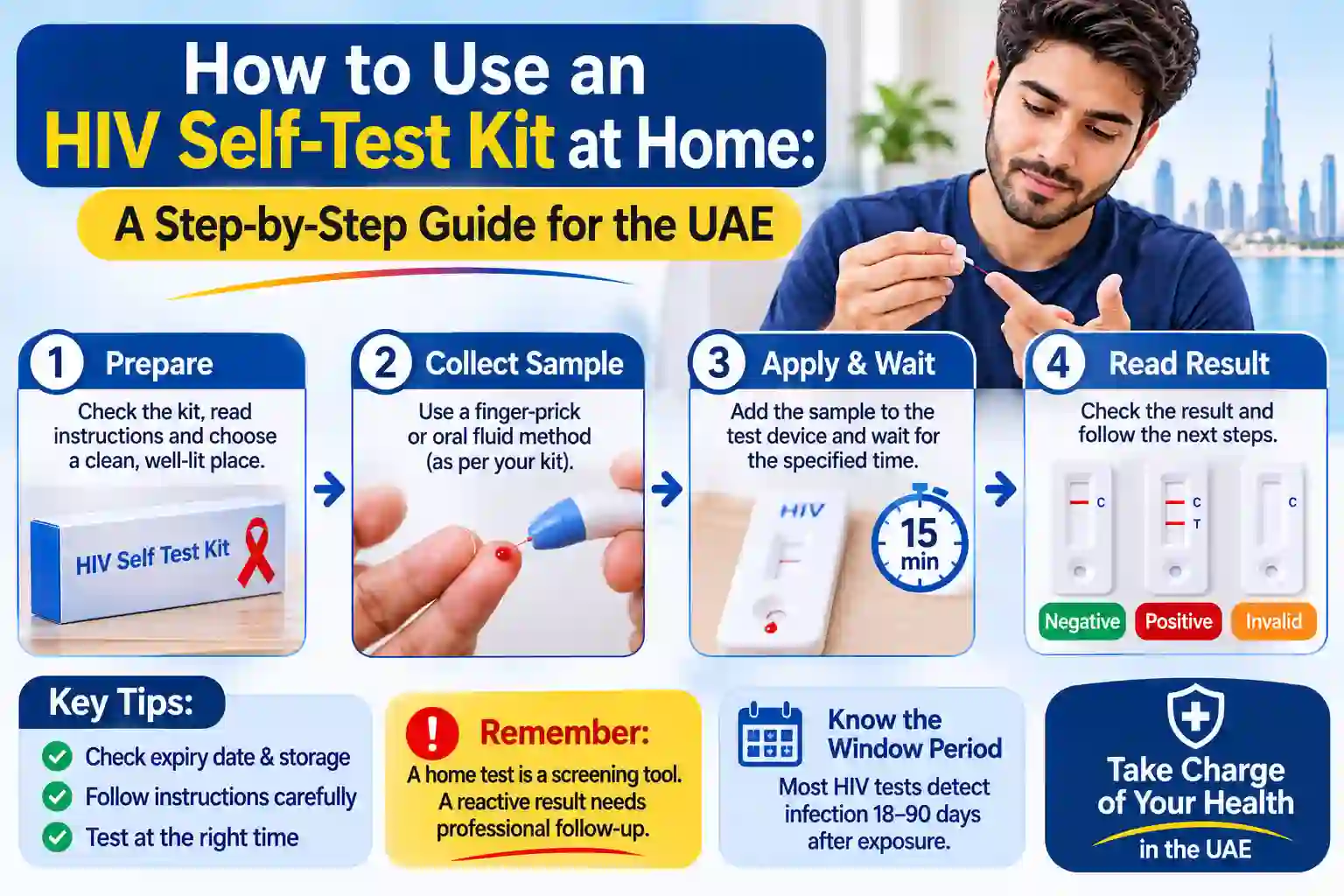
How to Use an HIV Self-Test Kit at Home: A Step-by-Step Guide for the UAE
Taking an HIV test can feel uncomfortable for some people, particularly when they are concerned about privacy or prefer not to visit a testing facility. An HIV self-test offers another option: it allows a person to collect their own sample, perform the test, and interpret the result privately.However, using a home HIV test kit correctly is essential. Incorrect sample collection, unsuitable storage, testing too early, or reading the result outside the recommended time can affect the outcome.If you are considering an HIV self-test kit in Dubai, Sharjah, Abu Dhabi, or elsewhere in the UAE, this guide explains how home testing works, what to check before starting, how to understand the result, and when professional follow-up is necessary.1. What Is an HIV Self-Test Kit?An HIV self-test kit is a screening test that allows an individual to collect their own specimen and perform the test without a healthcare professional conducting the procedure.Depending on the product, an HIV self-test may use:A small finger-prick blood sample.An oral-fluid sample collected using a swab.Many home HIV self-tests detect HIV antibodies. The exact testing method, sample type, and result time depend on the product.The World Health Organization (WHO) recognises HIV self-testing as an additional approach to HIV testing services. It can make testing more accessible to people who prefer a private and convenient option.Important: An HIV self-test is a screening test, not a definitive diagnosis. A reactive result must be followed by testing through a qualified healthcare provider.2. Before Using Your HIV Home Test KitBefore opening the kit, take a few minutes to check the packaging and instructions.Check the following:Expiry date: Do not use an expired test kit.Packaging: Make sure the sealed packaging is intact and the components appear undamaged.Storage conditions: Confirm that the kit has been stored within the temperature range stated by the manufacturer.Sample type: Check whether the test requires finger-prick blood or oral fluid.Instructions: Read the complete instructions before beginning.Testing time: Check how long the test takes and when the result must be read.Choose a clean, well-lit, private place where you can follow the instructions without interruption.Do not use a different sample type, substitute equipment, or change the number of drops or waiting time specified by the manufacturer.3. How to Use an HIV Self-Test Kit at Home: Step by StepThe procedure varies between products. A finger-prick blood test and an oral-fluid test do not use the same sample collection method.The following is a general overview. Always follow the exact instructions supplied with your particular kit.Step 1: Prepare the testing areaWash and dry your hands if required by the product instructions.Place all supplied components on a clean, flat surface. Check that you have everything needed before starting.Avoid touching the sample collection area or other parts of the test device that should remain clean.Step 2: Collect the required sampleThe collection method depends on the test.For a finger-prick blood test:Use the supplied lancet according to the instructions.Collect the required amount of blood using the supplied collection device.Avoid using an alternative lancet or collection tool.For an oral-fluid test:Follow the manufacturer's instructions for collecting the oral-fluid sample.Use the supplied collection device.Observe any restrictions concerning eating, drinking, or oral hygiene before testing.Do not assume that all HIV self-tests use the same sample collection procedure.Step 3: Apply the sample to the test deviceTransfer the sample to the specified area of the test device.Some kits require a particular number of drops or an additional solution. Other products use a different collection mechanism.Follow the instructions carefully. Adding too much or too little sample, or using the wrong application area, may produce an invalid result.Step 4: Wait for the specified timePlace the test device on a stable surface and wait for the time stated in the product instructions.Do not move the device unnecessarily or attempt to interpret the result too early.Different kits have different reading times. Never assume that every HIV test produces a result within the same number of minutes.Step 5: Read the result correctlyCheck the result window at the exact time specified by the manufacturer.Most rapid cassette-style tests include a control indicator and a test indicator, often marked C and T. However, result interpretation varies by product.Do not rely on an online picture or another kit's instructions to interpret your result. Use the result guide supplied with your own test.4. How to Understand Your HIV Self-Test ResultMost HIV self-tests produce one of three broad outcomes.Non-reactive resultA non-reactive result generally means the test did not detect the HIV markers it is designed to identify.However, a negative result does not always rule out infection from a recent exposure.If you tested during the window period, repeat testing or a different test may be necessary.Reactive resultA reactive result means the test detected a marker that requires further investigation.It does not, by itself, confirm an HIV diagnosis.Arrange follow-up testing with a qualified healthcare provider as soon as possible. Do not attempt to confirm the result using another home test alone.Invalid resultAn invalid result means the test did not produce a reliable reading.Possible reasons include:Incorrect sample collection.Incorrect sample quantity.Failure to follow the instructions.An expired or damaged kit.Reading the test outside the specified time.Follow the manufacturer's guidance. You may need to repeat the test using a new kit or obtain testing from a healthcare provider.5. When Is the Right Time to Use an HIV Self-Test?The timing of an HIV test is extremely important.The period between a possible HIV exposure and the point when a test can reliably detect infection is called the window period.According to the US Centers for Disease Control and Prevention (CDC), typical detection windows are:HIV test typeTypical detection windowNAT10–33 daysLaboratory antigen/antibody test using venous blood18–45 daysRapid antigen/antibody test using finger-prick blood18–90 daysAntibody test23–90 daysMost HIV self-tests are antibody tests, although the exact product specifications must always be checked.If you receive a non-reactive result before the relevant window period has passed, you may need to test again.If you have had a possible significant HIV exposure within the last 72 hours, do not wait to use a home test. Seek urgent medical assessment for possible post-exposure prophylaxis (PEP). PEP should be started as soon as possible when indicated, and no later than 72 hours after exposure.6. Common Mistakes to Avoid When Using an HIV Self-TestEven a properly manufactured test can produce an unreliable result if it is not used correctly.Avoid these common mistakes:Using an expired kit: Always check the expiry date before opening the package.Ignoring storage instructions: Excessive heat, humidity, or unsuitable storage conditions may affect the test.Using the wrong sample: Only use the specimen specified by the manufacturer.Applying the wrong sample quantity: Follow the stated sample and buffer requirements.Reading the result too early: A test line may develop over time. Observe the specified reading interval.Reading the result too late: Changes after the permitted reading time may not be valid.Ignoring a missing control indicator: If the required control indicator does not appear, the test may be invalid.Testing too soon after exposure: A non-reactive result during the window period may not rule out infection.7. Can You Use an HIV Self-Test While Taking PEP or PrEP?If you are taking PEP or PrEP, do not rely on a home HIV self-test as your only testing method.Antiretroviral medicines can affect the timing and interpretation of HIV test results. People taking PEP need a healthcare professional's follow-up testing schedule.People starting or continuing PrEP also need the HIV testing recommended as part of their clinical care.Discuss your medication history with the healthcare professional before interpreting a self-test result.8. Where Can You Buy an HIV Self-Test Kit in the UAE?If you are comparing HIV home testing options in Dubai, Sharjah, Abu Dhabi, Ajman, or another UAE emirate, review the product information carefully before purchasing.Look for:A clearly identified test type.The sample collection method.Manufacturer instructions.Detection-window information.Expiry and storage details.Appropriate product documentation.You can explore the available options through SureTestKit:HIV Testing CollectionHIV 4th Generation Antigen/Antibody Test KitHIV 1/2 Antibody Test KitAll Available Test KitsBefore ordering, check the individual product page to confirm the test method and sample requirements. Do not assume that every product described as an HIV home test uses the same technology.9. What Should You Do After Taking an HIV Self-Test?Your next step depends on the result and the timing of your test.Non-reactive: Check whether the relevant window period has passed. If you tested too early, follow the recommended repeat-testing schedule.Reactive: Arrange professional follow-up testing. A reactive self-test is not a confirmed diagnosis.Invalid: Repeat with a new kit according to the instructions or seek testing from a healthcare provider.Uncertain: Do not guess. Ask a qualified healthcare professional or testing service for guidance.If you have ongoing exposure risk, discuss regular testing and prevention options such as PrEP with a healthcare professional.Frequently Asked Questions1. Can I perform an HIV test at home by myself?Yes. HIV self-test kits are designed to allow individuals to collect their own sample and perform screening privately. Follow the specific manufacturer's instructions.2. How long does an HIV home test take?The result time depends on the test. Some rapid self-tests provide results in approximately 10–20 minutes, but you must follow the reading time specified for your product.3. Are HIV home test kits accurate?The performance of a home HIV test depends on the specific product, correct sample collection, storage, and timing. Testing during the window period can produce a non-reactive result even when infection is present.4. What does one line on an HIV test mean?The meaning depends on the test's design and the location of the line. On many cassette-style tests, a control line without a test line indicates a non-reactive result. Always use the interpretation guide supplied with your specific kit.5. What if a faint second line appears?Some tests interpret any visible test line within the specified reading period as reactive, even if it is faint. Other products may have different interpretation rules. Follow the product instructions and arrange professional follow-up if the result is reactive.6. What should I do if my HIV self-test is reactive?Contact a qualified healthcare provider and arrange follow-up testing. Do not treat a reactive home screening result as a confirmed diagnosis.7. Can I take an HIV home test immediately after exposure?A home test immediately after exposure cannot rule out infection from that exposure. If the exposure may carry HIV risk and occurred within 72 hours, seek urgent medical assessment for possible PEP.8. Can I use an HIV self-test in Dubai, Sharjah, or Abu Dhabi?You can review home screening options available through online retailers serving the UAE. Check the product's specifications, instructions, and suitability before ordering. Final ThoughtsAn HIV self-test can be a convenient way to screen privately, but getting a meaningful result depends on using the correct kit, collecting the sample properly, and testing at the appropriate time.Before using a home HIV test kit, read the instructions carefully, check the expiry date, and understand the result interpretation guide.Most importantly, remember that a reactive self-test needs professional follow-up, while a negative result during the window period may require repeat testing.Whether you are in Dubai, Sharjah, Abu Dhabi, or elsewhere in the UAE, informed testing is an important part of taking care of your health.Test correctly. Understand your result. Seek professional follow-up when needed.Medical disclaimer: This article is for general educational purposes only and does not replace professional medical advice, diagnosis, or treatment. Always follow the instructions supplied with your specific test kit.
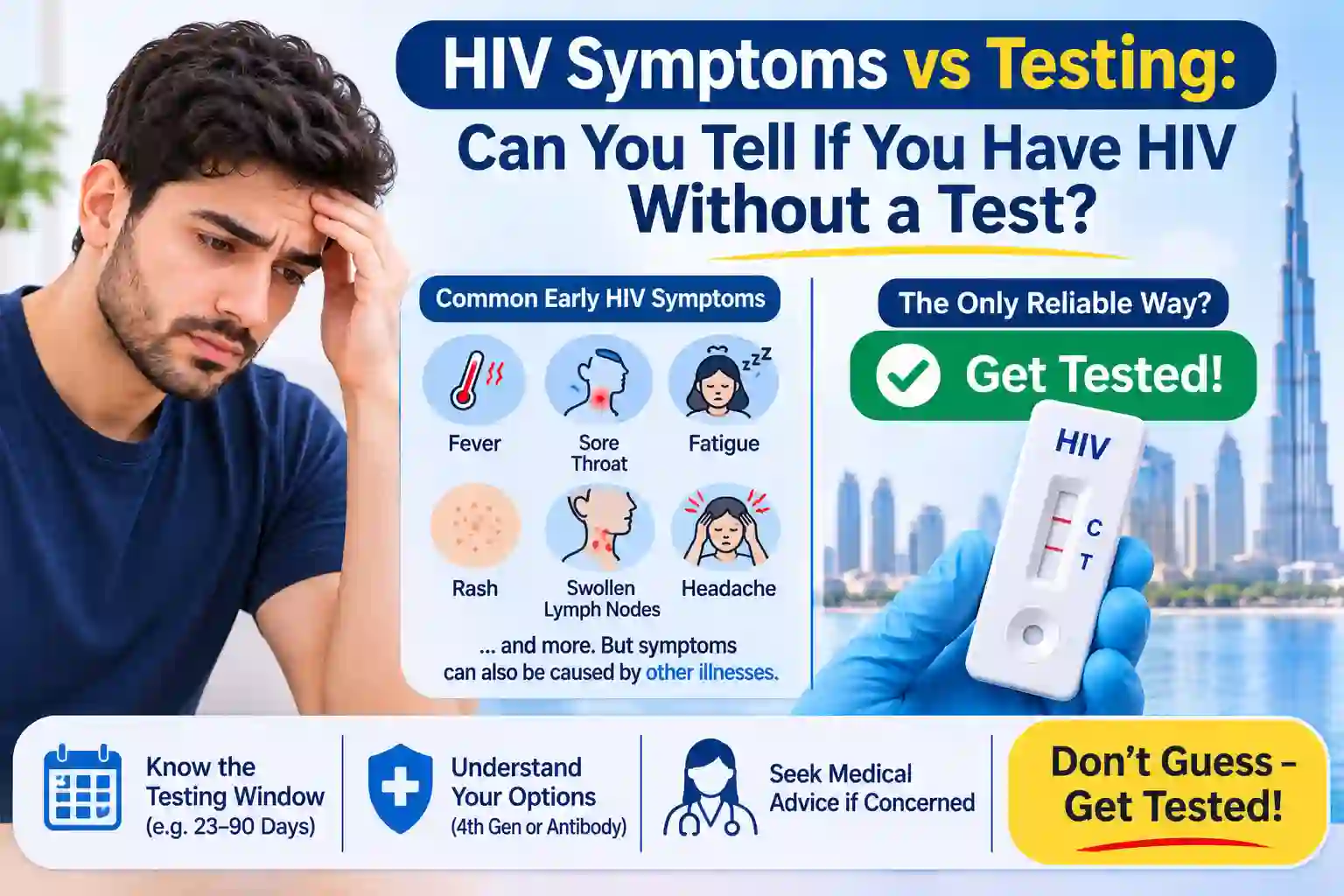
HIV Symptoms vs Testing: Can You Tell If You Have HIV Without a Test?
Many people become concerned about HIV after noticing unusual symptoms such as fever, fatigue, a sore throat, swollen lymph nodes, or a skin rash. Others may have had a possible exposure but feel completely healthy.This often leads to an important question: Can you tell whether you have HIV by looking at your symptoms?The answer is no. HIV symptoms can vary considerably from person to person, and some people experience no noticeable symptoms for years. Even when symptoms occur, they can resemble common illnesses such as influenza or other viral infections.The only reliable way to determine your HIV status is through appropriate HIV testing.If you are looking for information about HIV symptoms or an HIV test kit in Dubai, Sharjah, Abu Dhabi, or elsewhere in the UAE, this guide explains what to watch for, when to get tested, and why testing is more reliable than symptom checking.1. What Are the Early Symptoms of HIV?Some people develop flu-like symptoms during the early stage of HIV infection, also known as acute HIV infection.These symptoms may appear approximately two to four weeks after infection, although the timing and severity vary.Possible early symptoms include:FeverSore throatHeadacheFatigue or unusual tirednessSwollen lymph nodesSkin rashMuscle and joint achesNight sweatsMouth ulcersDiarrhoeaNot everyone experiences these symptoms. Some people have only mild symptoms, while others do not notice anything unusual.Important: Experiencing these symptoms does not mean you have HIV. Many other infections and medical conditions can cause similar symptoms.Equally, feeling healthy does not mean you are definitely HIV-negative.2. Can You Have HIV Without Any Symptoms?Yes. A person can have HIV without experiencing noticeable symptoms.After the initial stage, HIV can enter a chronic stage in which the virus remains active in the body but may not cause obvious illness.During this period:You may feel completely healthy.You may continue your normal daily activities.You may have no visible signs of infection.HIV can still be present in the body.Without appropriate treatment, HIV can gradually damage the immune system over time.This is why waiting for symptoms before getting tested is not a reliable approach.If you have had a possible exposure, consider testing according to the recommended window period, even if you feel perfectly well.3. HIV Symptoms vs Common Illnesses: Why It Is Difficult to TellOne reason people become confused about HIV symptoms is that many of them overlap with ordinary illnesses.For example:SymptomPossible alternative causesFeverFlu, COVID-19, and other infectionsSore throatViral or bacterial throat infectionsSkin rashAllergies, skin irritation, and viral infectionsFatiguePoor sleep, stress, and many medical conditionsSwollen lymph nodesCommon infections and inflammatory conditionsHeadacheDehydration, stress, and other illnessesNight sweatsInfections, medication effects, and other conditionsThese symptoms cannot identify HIV on their own.Searching online for symptoms and comparing them with your experience may increase anxiety without giving you a reliable answer.Instead of trying to diagnose yourself through symptoms, focus on whether a possible exposure occurred and whether an HIV test is appropriate.4. When Should You Take an HIV Test?The timing of an HIV test matters because different tests detect infection at different stages.The period between a possible exposure and the time a test can reliably detect HIV is called the window period.According to the US Centers for Disease Control and Prevention (CDC), typical detection windows are:Test typeTypical detection windowNAT (Nucleic Acid Test)10–33 daysLaboratory antigen/antibody test using venous blood18–45 daysRapid antigen/antibody test using finger-prick blood18–90 daysAntibody test23–90 daysThese are general ranges, not guarantees for every product or individual.If you test too early, the result may be negative even if infection has occurred. Follow the manufacturer's instructions and healthcare professional's advice about repeat testing.If you have taken PEP or PrEP, your testing schedule may need to be adjusted by a healthcare professional.For a more detailed explanation, read our guide:When Should You Take an HIV Test After Exposure? A UAE Testing Timeline5. Should You Choose a 4th Generation HIV Test or an Antibody Test?Different HIV tests look for different markers of infection.HIV 4th Generation TestA fourth-generation antigen/antibody test looks for:HIV antibodies.p24 antigen, a protein associated with HIV.Laboratory-based fourth-generation tests using blood from a vein generally detect infection earlier than antibody-only tests.HIV Antibody TestAn antibody test looks for antibodies produced by the immune system in response to HIV.Many rapid and home HIV self-tests use this method. They can offer a convenient screening option, but their window period must be considered.The choice depends on the timing of possible exposure, sample type, test specifications, and whether you need professional assessment.You can read our detailed comparison here:HIV 4th Generation Test vs HIV Antibody Test6. Can an HIV Home Test Kit Detect HIV Without Symptoms?Yes. HIV tests detect specific markers associated with infection, not the symptoms a person experiences.This means a suitable HIV test may detect infection even when someone feels completely healthy.Home HIV self-tests can be useful for initial screening when used correctly and at the appropriate time.Before choosing a home test kit, check:Whether it detects HIV antibodies or both antigen and antibodies.The recommended detection window.The required sample type.The manufacturer's instructions.The expiry date and storage requirements.What follow-up is required after a reactive result.A home self-test is a screening tool. A reactive result requires follow-up testing through a qualified healthcare provider.A negative result obtained during the window period may also require repeat testing.7. What Should You Do If You Think You Have HIV Symptoms?If you have symptoms that concern you, consider the following steps.Step 1: Do not assume the symptoms mean HIVFever, fatigue, rash, and swollen lymph nodes can have many different causes.Step 2: Consider whether a possible exposure occurredThink about whether you may have had an exposure that could transmit HIV. A healthcare professional can help assess the risk.Step 3: Seek urgent medical advice if exposure was recentIf a possible significant exposure occurred within the previous 72 hours, seek urgent medical assessment for PEP. PEP should be started as soon as possible, ideally within 24 hours, and no later than 72 hours when indicated.Do not wait for symptoms or a home test result before seeking assessment.Step 4: Choose the appropriate HIV testA healthcare professional can recommend a test based on your exposure date, medical history, and testing needs.Step 5: Follow up on the resultA reactive screening result requires further testing. A negative result may require repetition if it was taken before the end of the relevant window period.8. Where Can You Find HIV Testing Options in the UAE?People living in Dubai, Sharjah, Abu Dhabi, Ajman, Fujairah, and other UAE locations can explore different HIV screening options depending on their circumstances.Some people prefer clinic-based testing, while others may consider home screening for convenience and privacy.If you are comparing home HIV test kits, you can review the following SureTestKit pages:HIV Test Kit CollectionHIV 4th Generation Antigen/Antibody Test KitHIV 1/2 Antibody Test KitExplore All Available Test KitsReview the exact specifications and detection window of each product before ordering.Remember that home testing is not a replacement for urgent medical care after a recent possible exposure.9. Why Early HIV Testing MattersKnowing your HIV status is an important part of looking after your health.If someone receives an HIV diagnosis, effective treatment can help them live a long and healthy life. Antiretroviral therapy (ART) reduces the amount of HIV in the body and helps protect the immune system.People who achieve and maintain an undetectable viral load through treatment do not sexually transmit HIV. This is known as Undetectable = Untransmittable (U=U).Testing also helps people who receive a negative result make informed decisions about prevention, including discussing PrEP with a healthcare professional when appropriate.The key is to avoid relying on symptoms alone.Frequently Asked Questions1. What are the first signs of HIV in men?Possible early symptoms can include fever, sore throat, fatigue, swollen lymph nodes, rash, headache, and muscle aches. However, some men experience no symptoms, and these signs cannot confirm HIV.2. What are the first signs of HIV in women?Women may experience the same early flu-like symptoms as men, including fever, fatigue, rash, sore throat, and swollen lymph nodes. Symptoms vary, and some people have none.3. Can HIV remain undetected without symptoms?Yes. HIV can remain present in the body without noticeable symptoms. Testing is necessary to determine HIV status.4. Can a normal blood test detect HIV?Not necessarily. A routine blood count or general blood test does not automatically test for HIV. A specific HIV screening or diagnostic test is required.5. Can an HIV test be negative even if I have symptoms?Yes. A negative result may occur if testing is performed during the window period. Symptoms alone cannot determine HIV status, so follow the recommended testing schedule.6. How soon do HIV symptoms appear?Some people develop acute symptoms approximately two to four weeks after infection. Others have no noticeable symptoms. Testing, not symptom timing, is the reliable way to assess HIV status.7. Can I use a home HIV test if I have no symptoms?Yes. A suitable home HIV self-test can be used for screening even when you have no symptoms. Follow its instructions and detection window, and obtain professional follow-up if the result is reactive.8. Where can I buy an HIV test kit in Dubai?You can explore available HIV screening products through SureTestKit's HIV testing collection. Check the product specifications and instructions before choosing a kit. Final ThoughtsHIV cannot be diagnosed by looking at symptoms, and the absence of symptoms does not rule out infection.Whether you are in Dubai, Sharjah, Abu Dhabi, or elsewhere in the UAE, the most reliable approach is to understand your possible exposure risk, select an appropriate HIV test, and follow the recommended testing window.If you are concerned about a recent exposure, seek medical advice promptly. If you are considering routine screening, compare available testing options and follow the manufacturer's instructions.Do not guess your HIV status from symptoms. Get tested at the appropriate time.Medical disclaimer: This article provides general educational information and does not replace professional medical advice, diagnosis, or treatment.
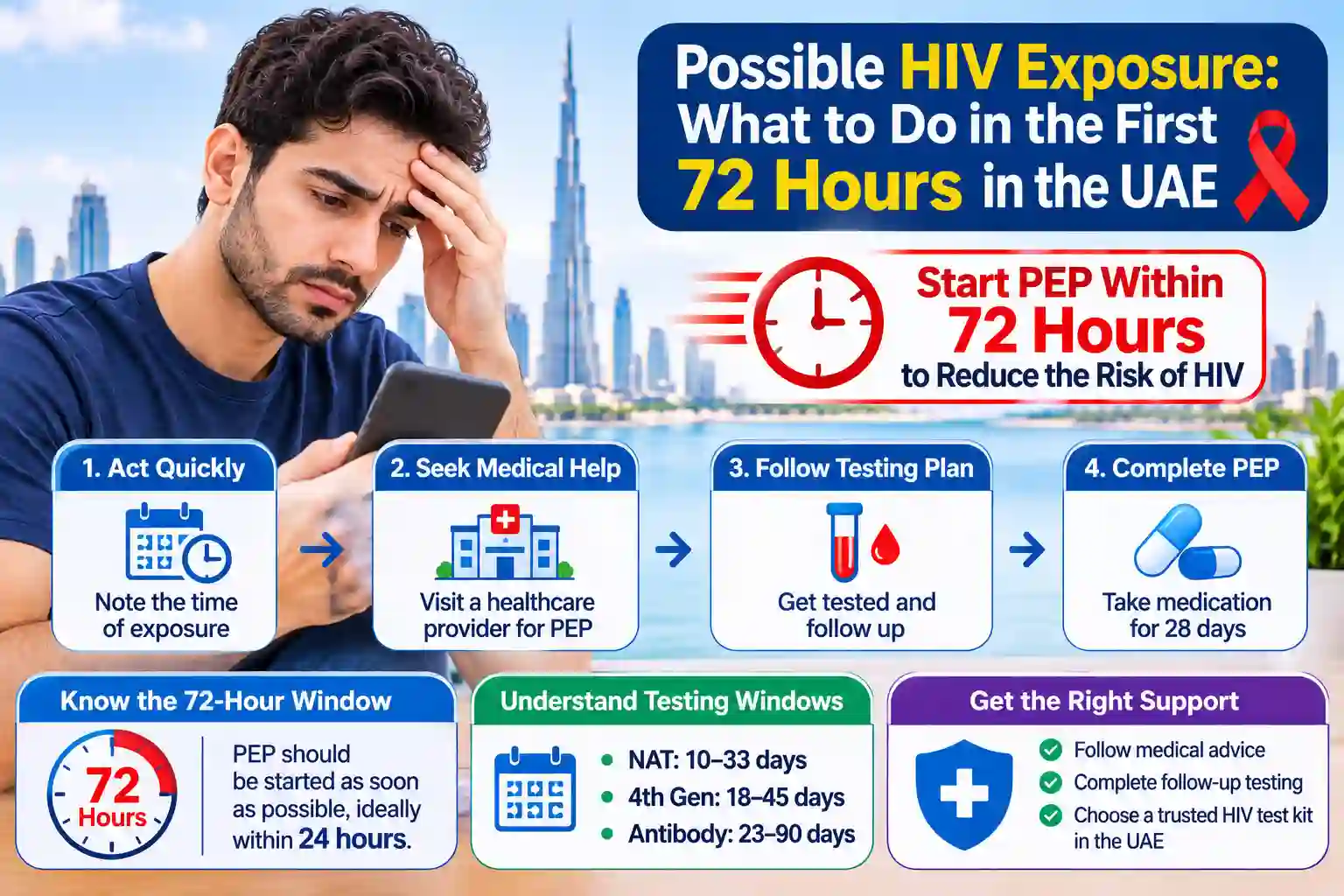
Possible HIV Exposure: What to Do in the First 72 Hours in the UAE
A possible HIV exposure can cause anxiety and uncertainty. You may wonder whether you need an HIV test immediately, whether you should visit a hospital, or whether there is anything you can do to reduce the risk of infection.The most important thing to understand is that you may have a time-sensitive prevention option called HIV post-exposure prophylaxis (PEP).PEP is a short course of prescription medication that can help prevent HIV infection after a possible exposure. It must be started as soon as possible, ideally within 24 hours and no later than 72 hours after exposure.If you are in Dubai, Sharjah, Abu Dhabi, or another part of the UAE and think you may have been exposed to HIV, this guide explains the immediate steps to consider, how PEP works, when to test, and why a home HIV test alone is not enough to manage a recent exposure.1. What Should You Do Immediately After Possible HIV Exposure?If you think you may have been exposed to HIV, do not panic, but do not delay seeking medical advice.Take these steps:Step 1: Note the time of possible exposureTry to establish when the incident occurred. The time matters because PEP must be started within 72 hours.Step 2: Seek urgent medical assessmentVisit an emergency department or a healthcare facility that can assess HIV exposure and provide PEP when indicated. Do not wait for symptoms to appear.Step 3: Explain what happened to the healthcare professionalShare relevant information, including:When the possible exposure occurred.The type of exposure.Whether a condom was used and whether it broke or slipped.Whether the other person is known to have HIV, if this information is available.Any medicines you currently take, including PrEP.Step 4: Follow the recommended testing and prevention planA healthcare professional may recommend an initial HIV test, other blood tests, and PEP depending on the circumstances. If PEP is indicated, it should not be delayed while waiting for laboratory results.2. What Is HIV PEP?PEP stands for Post-Exposure Prophylaxis.It involves taking antiretroviral medicines after a possible HIV exposure to reduce the chance of infection.PEP is intended for emergency situations, not routine HIV prevention. It is not necessary after every type of contact; a healthcare professional assesses the exposure and determines whether PEP is appropriate.Important facts about PEP:It should be started as soon as possible.Ideally, treatment begins within 24 hours.It must be started no later than 72 hours after possible exposure.A standard course is generally 28 days.It must be taken exactly as prescribed.Follow-up appointments and HIV testing are important.The World Health Organization (WHO) and the US Centers for Disease Control and Prevention (CDC) both emphasize starting PEP promptly. UAE Ministry of Health and Prevention guidance also describes urgent initiation and a four-week treatment course.Remember: PEP can reduce the risk of HIV infection, but it is not a guarantee. Do not obtain or take HIV medicines without medical assessment and a prescription.3. Which Situations May Require a PEP Assessment?Not every contact with another person creates a meaningful risk of HIV transmission.A healthcare professional may consider PEP after certain exposures involving potentially infectious blood or sexual fluids reaching a mucous membrane, an open wound, or the bloodstream.Examples that may require urgent assessment include:Condom breakage or slippage during sex when HIV transmission risk is possible.Condomless vaginal or anal sex involving a person with HIV whose viral suppression is not known or not sustained.Sharing needles or other injection equipment.A needlestick or occupational injury involving potentially infectious blood.Sexual assault involving a possible HIV exposure.The need for PEP depends on the details of the exposure and the source person's HIV status and treatment information.Some activities, such as hugging, sharing food, using the same toilet, or contact with sweat and intact skin, do not transmit HIV. Ordinary social contact is not a reason to take PEP.If you are unsure whether an incident presents a risk, seek professional assessment rather than trying to decide from a checklist.4. Why the First 72 Hours Are So ImportantPEP works best when started quickly after a possible exposure.The recommended maximum starting window is 72 hours. Waiting until the last few hours is not advisable because every delay reduces the opportunity to start treatment promptly.<underline>General PEP timeline</underline>Time after possible exposureWhat to doAs soon as possibleSeek urgent medical assessmentWithin 24 hoursIdeal time to begin PEP if prescribed24–72 hoursPEP may still be considered; seek care immediatelyMore than 72 hoursPEP is generally not recommended; seek medical advice about testing and other careIf more than 72 hours have passed, do not assume there is nothing you can do. A healthcare professional can advise on HIV testing, other sexually transmitted infection screening, and prevention for the future.5. Should You Take an HIV Test Immediately After Exposure?An initial HIV test may be recommended when you attend a medical facility for PEP assessment.However, an important distinction exists between a baseline test and a test that can detect a recent infection.A test taken immediately after an exposure cannot rule out HIV infection from that same recent incident because the infection may not yet be detectable.The baseline test helps healthcare professionals assess whether HIV infection may have existed before the recent exposure. Follow-up testing is needed to evaluate the more recent event.Different tests have different detection windows:Test typeTypical detection windowNAT10–33 daysLaboratory antigen/antibody test using venous blood18–45 daysRapid antigen/antibody test using finger-prick blood18–90 daysAntibody test23–90 daysThese are general CDC ranges for people not taking antiretroviral medication. PEP and PrEP can affect test detection timelines, so people taking these medicines need a clinician-directed testing schedule.For more information, read our guide: When Should You Take an HIV Test After Exposure?.6. What Happens During the 28-Day PEP Course?If a healthcare professional determines that PEP is appropriate, you will receive a prescription and instructions for taking the medication.The standard course is generally 28 days.During treatment:Take the medication exactly as prescribed.Do not skip doses.Do not stop early without speaking to your healthcare professional.Report side effects or difficulties taking the medication.Attend recommended follow-up appointments.Ask about other STI and hepatitis screening if appropriate.Your healthcare professional may arrange baseline tests and additional monitoring based on your health, medication history, and exposure.If you miss a dose, contact your healthcare provider or pharmacist for advice rather than doubling your next dose unless specifically instructed.7. When Should You Take Follow-Up HIV Tests After PEP?Follow-up testing is essential because a baseline HIV test cannot rule out infection from the recent exposure.Your healthcare provider will determine the testing schedule based on the PEP regimen, timing, and clinical circumstances.Current CDC guidance recommends follow-up HIV testing that includes a laboratory antigen/antibody test and a diagnostic NAT. It describes interim testing around 4–6 weeks after exposure and final testing around 12 weeks after exposure.UAE Ministry of Health and Prevention guidance also describes follow-up testing after PEP, including testing at the end of treatment and at a later follow-up point.Because recommendations can vary with the clinical situation and the tests available, follow the schedule given by your treating healthcare professional rather than relying on a generic calendar.Do not use a negative home self-test to replace the follow-up testing recommended after PEP.8. Can You Use a Home HIV Test Kit After Possible Exposure?Home HIV self-tests can be useful for screening, particularly when someone wants a convenient and private way to test. However, they are not a substitute for urgent medical care after a recent possible exposure.A home antibody test may not detect a recent infection during its window period. PEP can also affect the timing and interpretation of follow-up tests.A home HIV test may be considered as part of general screening when appropriate, but:It cannot determine whether you need PEP.It cannot rule out infection immediately after exposure.A reactive result requires confirmatory testing.A negative result during the window period may require repeat testing.It should not replace a clinician-directed testing plan after PEP.If you are looking for general HIV screening options in the UAE, you can explore:SureTestKit HIV Testing CollectionHIV 4th Generation Antigen/Antibody Test KitHIV 1/2 Antibody Test KitAlways review the product's actual test type, sample requirements, detection window, and instructions before choosing a kit.9. What If More Than 72 Hours Have Passed?If you discover the possible exposure more than 72 hours later, you should still contact a healthcare professional.Although PEP is generally not recommended after this period, you can still take important steps:Arrange an appropriate HIV test.Ask when repeat testing should be performed.Discuss screening for other STIs, including syphilis, gonorrhea, and chlamydia.Follow medical advice if you develop symptoms or have other concerns.Discuss PrEP if you may have ongoing or repeated HIV exposure risk.Do not rely on the absence of symptoms to determine your HIV status. Some people have no noticeable symptoms, particularly during early infection.10. HIV Prevention and Screening in Dubai, Sharjah and Abu DhabiPeople across the UAE have access to different healthcare and screening options. If you have experienced a possible HIV exposure, the priority is to obtain urgent medical assessment rather than waiting to order a home test.For people seeking routine screening, home testing can offer an additional option when used according to the manufacturer's instructions and the appropriate testing window.Whether you are in Dubai, Sharjah, Abu Dhabi, Ajman, Fujairah, or another emirate, understanding the difference between emergency prevention and routine screening can help you make informed decisions.SureTestKit provides information about HIV screening products so customers can compare available options and review product specifications before ordering.Frequently Asked Questions1. Can I prevent HIV after exposure?PEP can help prevent HIV infection after certain possible exposures. It must be started as soon as possible and no later than 72 hours after exposure. A healthcare professional must assess whether it is appropriate.2. Is PEP effective after 72 hours?PEP is generally not recommended when more than 72 hours have passed. Seek medical advice about appropriate HIV testing and other prevention options.3. Can I take an HIV home test immediately after exposure?You can take a test if advised, but a negative result immediately after exposure cannot rule out infection from that incident. Urgent PEP assessment is more important if you are still within the 72-hour window.4. How long do I need to take PEP?A standard PEP course is generally 28 days. Follow the exact prescription and do not stop treatment early without medical advice.5. Can I take PEP without a prescription?PEP requires medical assessment and a prescription. A healthcare professional must evaluate the exposure, medical history, possible drug interactions, and appropriate treatment.6. Do I need an HIV test after completing PEP?Yes. Follow-up HIV testing is important even if you completed the medication course and feel well. Your healthcare professional will determine the appropriate tests and timing.7. Does a negative HIV test during PEP mean I am HIV-negative?Not necessarily. A test during or shortly after PEP may not provide a final answer about the recent exposure. Follow the recommended testing schedule.8. Can I buy an HIV test kit in Dubai or Abu Dhabi instead of visiting a hospital?Home HIV test kits can support routine screening, but they cannot replace urgent medical assessment when a recent exposure may require PEP. If the exposure occurred within the past 72 hours, seek medical care immediately. Final TakeawayA possible HIV exposure can be stressful, but timely action matters.Remember these three points:Act quickly: Seek urgent medical assessment if you may have had a significant HIV exposure.Know the PEP window: PEP should begin as soon as possible and no later than 72 hours after exposure, if prescribed.Complete follow-up testing: A baseline test or home test alone cannot rule out infection from a recent exposure.The most important decision is not which home test kit to buy first. It is getting the right medical assessment at the right time.Medical disclaimer: This article is for general educational purposes only. It does not provide an individual diagnosis or treatment recommendation. PEP is a prescription intervention that requires urgent assessment by a qualified healthcare professional.
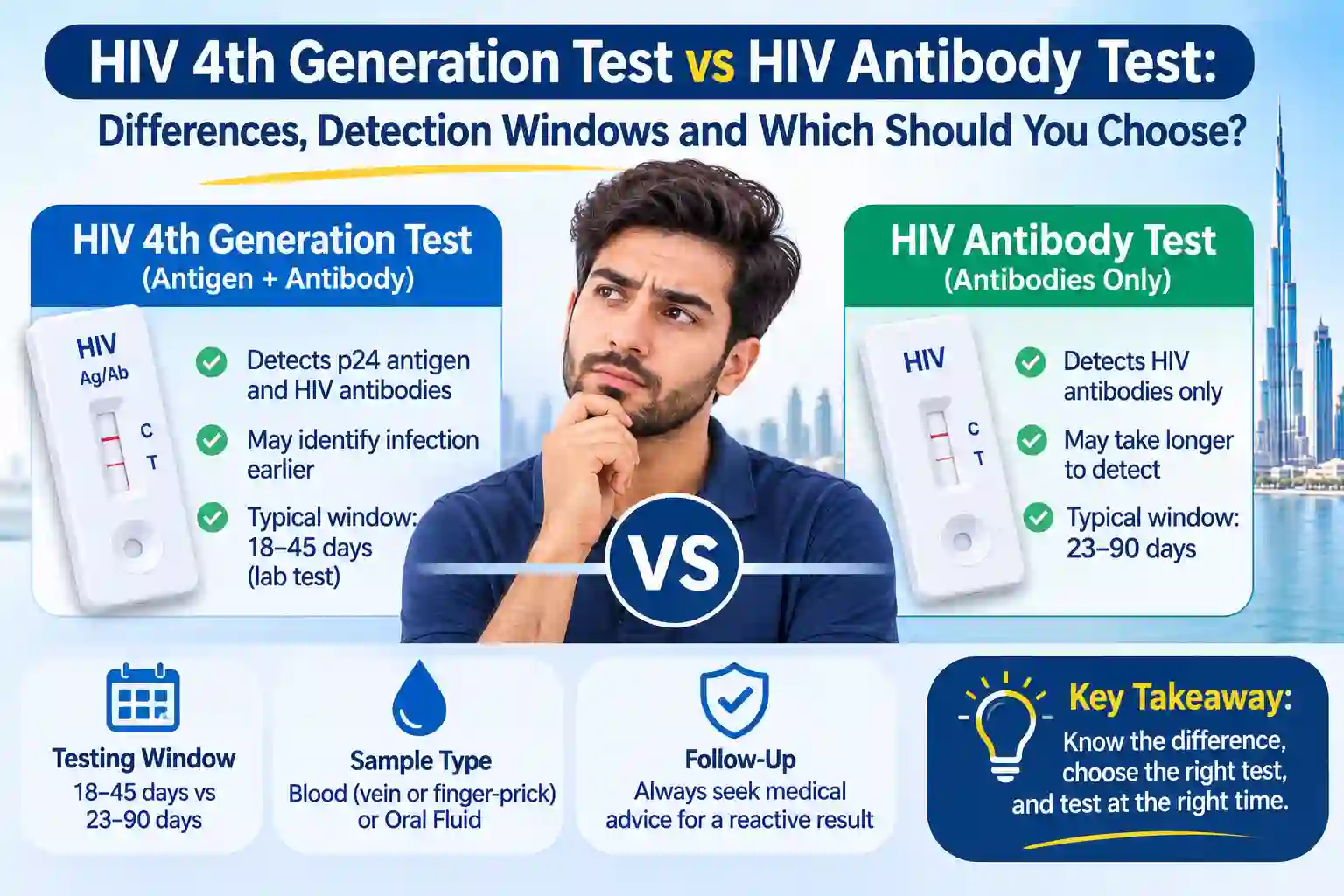
HIV 4th Generation Test vs HIV Antibody Test: Differences, Detection Windows and Which Should You Choose?
Choosing an HIV test can be confusing, especially when you come across terms such as 4th Generation HIV Test, HIV 1/2 Antibody Test, and HIV Self-Test. Although all these tests are designed to screen for HIV, they do not detect the infection in exactly the same way.Understanding the difference can help you choose an appropriate screening option, avoid testing too early, and understand when follow-up testing may be needed.For people looking for an HIV test kit in Dubai, Sharjah, Abu Dhabi, or elsewhere in the UAE, this guide explains how fourth-generation and antibody tests work, their detection windows, and what to consider before purchasing a home testing kit.1. What Is an HIV 4th Generation Test?An HIV 4th Generation Test is also called an HIV antigen/antibody combination test.Unlike an antibody-only test, it looks for two markers:HIV-1/2 antibodies: Proteins produced by the immune system in response to HIV infection.p24 antigen: A protein associated with HIV that can become detectable before the body produces enough antibodies to be detected.By checking for both antigen and antibodies, a fourth-generation test can generally detect HIV earlier than an antibody-only test, depending on the test method and specimen used.Laboratory-based fourth-generation tests commonly use blood collected from a vein. Some rapid tests also detect both antigen and antibodies, but their detection window can differ from laboratory tests.2. What Is an HIV Antibody Test?An HIV Antibody Test looks specifically for antibodies that the immune system produces in response to HIV.These tests are widely used in rapid screening and home self-testing products. Depending on the product, the sample may be:A small finger-prick blood sample.A blood sample collected using a supplied device.An oral-fluid sample.Antibody tests can be convenient for people who prefer to screen themselves in a private setting. However, antibodies take time to develop to detectable levels, so an antibody test may not identify a recent infection as early as a laboratory-based fourth-generation test.Many home HIV self-tests are antibody tests. Always check the manufacturer's instructions and product specifications rather than assuming a test's type from its packaging or marketing name.3. HIV 4th Generation vs Antibody Test: Key DifferencesHere is a simple comparison of the two screening methods.Feature4th Generation TestAntibody TestWhat it detectsp24 antigen and HIV antibodiesHIV antibodiesEarly detectionCan detect infection earlier in some settingsGenerally detects laterCommon useLaboratory screening and some rapid testsRapid screening and many home self-testsSampleCommonly venous blood in laboratory tests; some rapid versions use finger-prick bloodFinger-prick blood or oral fluid, depending on the productWindow periodDepends on whether it is laboratory-based or rapidDepends on the specific antibody testFollow-upReactive results require further testingReactive results require further testingImportant: A fourth-generation test is not automatically faster in every format. A laboratory test using blood from a vein and a rapid finger-prick combination test can have different detection windows.4. HIV Test Window Period: How Soon Can Each Test Detect HIV?The window period is the time between a possible HIV exposure and the point when a particular test can reliably detect infection.According to the US Centers for Disease Control and Prevention (CDC), the usual detection windows are:HIV test typeTypical detection windowNAT (Nucleic Acid Test)10–33 daysLaboratory antigen/antibody test using venous blood18–45 daysRapid antigen/antibody test using finger-prick blood18–90 daysAntibody test23–90 daysThese ranges are important because two tests that both mention antigen and antibodies may not have the same detection window.If you receive a negative result before the relevant window period has passed, the result may not rule out infection from a recent exposure. Follow the test instructions and seek professional advice about repeat testing.If you have had a possible exposure within the last 72 hours, do not wait for a test result before seeking urgent medical assessment for possible post-exposure prophylaxis (PEP).5. Which Test Is Better: 4th Generation or Antibody?There is no single answer for everyone. The appropriate test depends on when the possible exposure occurred, the type of sample, the test's validated performance, and whether you need professional assessment.A laboratory-based 4th Generation Test may be appropriate when:You need screening that can detect infection earlier than an antibody-only test.You are attending a clinic or laboratory.A healthcare professional recommends an antigen/antibody combination test.An antibody-based home test may be appropriate when:You want a convenient initial screening option.You prefer to collect your sample at home.You understand the test's window period and follow its instructions carefully.You are prepared to obtain professional follow-up if the result is reactive.A home test should not be treated as a substitute for laboratory testing when recent exposure, symptoms, or a healthcare professional's assessment indicates that additional testing is needed.6. What Should You Check Before Buying an HIV Test Kit in the UAE?If you are comparing HIV test kits online in Dubai, Sharjah, Abu Dhabi, or another UAE emirate, look beyond the product name.Check these points before ordering:Test type: Confirm whether the kit detects antibodies only or both antigen and antibodies.Sample type: Check whether it requires finger-prick blood, venous blood, or oral fluid.Detection window: Read the manufacturer's stated window period and limitations.Instructions: Make sure the kit includes clear instructions for sample collection and result interpretation.Expiry date and storage: Check the expiry date and follow the specified storage conditions.Manufacturer information: Look for identifiable manufacturer details and relevant product documentation.Follow-up guidance: Understand what to do if the result is reactive, invalid, or negative during the window period.For online screening options, you can explore the SureTestKit HIV testing collection.You can also review these product pages:HIV 4th Generation Antigen/Antibody Test KitHIV 1/2 Antibody Test KitExplore all available test kitsCheck each product's actual specifications and instructions before deciding which test is suitable.7. What If Your HIV Test Result Is Reactive or Negative?Understanding the result is just as important as choosing the test.Reactive result: A reactive home HIV self-test is a preliminary screening result, not a confirmed HIV diagnosis. Arrange follow-up testing with a qualified healthcare provider.Non-reactive result: This means the test did not detect the markers it is designed to identify. However, if you tested during the window period, repeat testing may be necessary.Invalid result: The test did not produce a valid result. Follow the manufacturer's instructions, which may require repeating the test with a new kit.If you are taking or have recently taken PEP or PrEP, discuss your testing schedule with a healthcare professional because antiretroviral medicines can affect test detection timelines.8. Choose an Informed HIV Screening Option in the UAEWhether you live in Dubai, Sharjah, Abu Dhabi, or another part of the UAE, understanding the difference between fourth-generation and antibody tests can help you make a more informed screening decision.A laboratory-based fourth-generation test checks for both p24 antigen and HIV antibodies and generally has an earlier detection window than an antibody-only test. Antibody-based home tests can offer a convenient screening option, but their detection window must be considered.At SureTestKit, you can review available HIV screening products and compare their stated specifications before ordering. Read the instructions carefully and seek professional medical advice when you need help selecting a test or interpreting a result.Remember: The right test at the right time is more useful than testing too early and assuming a negative result is conclusive.Frequently Asked Questions1. Is a 4th Generation HIV Test better than an antibody test?A laboratory-based fourth-generation test can generally detect HIV earlier because it checks for both p24 antigen and antibodies. However, the best option depends on the test format, sample type, timing, and clinical situation.2. Can an HIV antibody test detect infection after 10 days?An antibody test generally cannot reliably detect HIV that early. The CDC gives a typical antibody-test detection window of 23–90 days after exposure.3. Is every HIV home test a 4th Generation Test?No. Many HIV home self-tests are antibody-only tests. Always check the product specifications to identify exactly what the kit detects.4. How long should I wait before taking a 4th Generation HIV Test?A laboratory-based antigen/antibody test using blood from a vein can usually detect HIV 18–45 days after exposure. Rapid finger-prick antigen/antibody tests can have a window of 18–90 days. Follow the specific test instructions and professional advice.5. Can a negative HIV test result be wrong?A negative result may not rule out infection if the test was taken during its window period. Repeat testing after the relevant window period may be needed.6. Does a reactive HIV self-test mean I have HIV?No. A reactive self-test is a preliminary screening result. Further testing by a qualified healthcare provider is necessary to establish a diagnosis.7. Where can I buy an HIV test kit in Dubai or Abu Dhabi?You can review available screening options through SureTestKit, which lists HIV testing products for customers across the UAE. Check the product specifications, delivery information, and instructions before ordering. Medical note: This article is for general educational purposes and does not replace professional medical advice, diagnosis, or testing. If you may have been exposed to HIV within the last 72 hours, seek urgent medical care to discuss PEP.
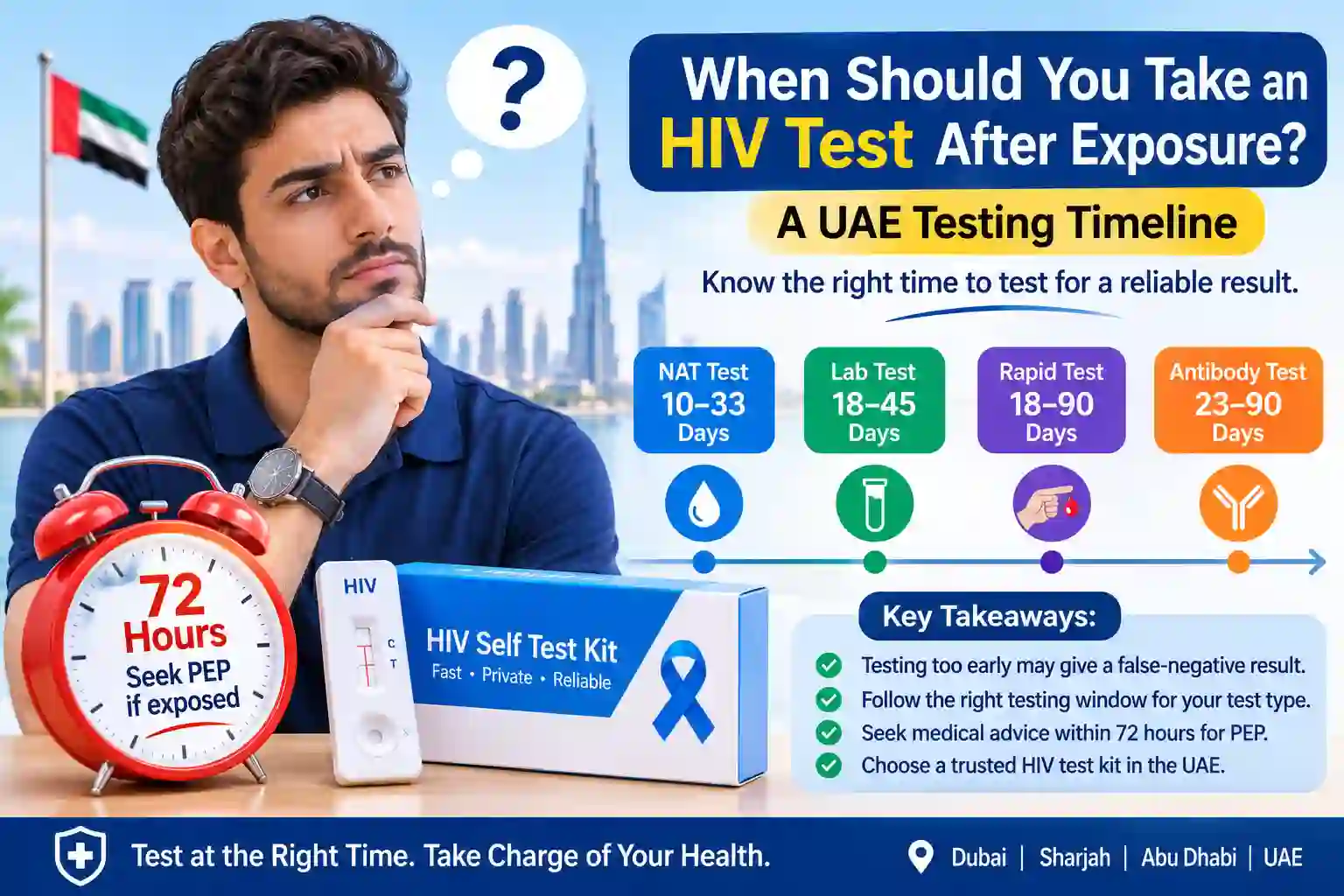
When Should You Take an HIV Test After Exposure? A UAE Testing Timeline
If you are worried about a possible HIV exposure, one of the most important questions is: When should you take an HIV test to get a reliable result?Testing too early can produce a non-reactive result even when an infection has occurred. This is because different HIV tests detect different markers, and those markers become detectable at different times.Whether you are looking for an HIV test in Dubai, Sharjah, Abu Dhabi, or elsewhere in the UAE, understanding the HIV testing window period can help you decide when to test and whether repeat testing may be necessary.This guide explains when different HIV tests can usually detect infection, what to do during the first 72 hours after possible exposure, and how to choose an appropriate testing option.1. Can an HIV Test Detect Infection Immediately After Exposure?No. No HIV test can detect infection immediately after exposure.The period between possible exposure and the point when a particular test can detect HIV is called the window period.During this period, the virus or the markers detected by a particular test may not yet be present at detectable levels.This means:A test taken too early may produce a non-reactive result.Different HIV tests have different detection windows.A negative result may need to be repeated after the relevant window period.The correct testing schedule may differ if you have taken PEP or PrEP.The CDC explains that the window period depends on the type of HIV test used.2. What Should You Do Within the First 72 Hours After Possible Exposure?<escape>Important: If a possible HIV exposure occurred within the past 72 hours, seek urgent medical assessment for post-exposure prophylaxis (PEP). Do not wait for a home test kit or an online delivery.</escape>PEP is a course of HIV medicines used after a possible exposure to reduce the risk of acquiring HIV.When PEP is indicated, it should be started as soon as possible, ideally within 24 hours, and no later than 72 hours after exposure.A healthcare professional will assess the circumstances and determine whether PEP is appropriate.Keep in mind:PEP is time-sensitive.A home HIV test immediately after exposure cannot rule out infection from that recent event.A baseline HIV test may be performed during the medical assessment.Follow-up testing is required according to the healthcare provider's schedule.Do not delay seeking care while trying to arrange an online test.For more information, read the CDC's clinical guidance for PEP.3. HIV Testing Timeline: When Can Different Tests Detect HIV?The appropriate testing time depends on the test method and sample type.According to the CDC, the usual detection windows are:HIV test typeUsual detection window after exposureNucleic acid test (NAT)10–33 daysLaboratory antigen/antibody test using blood from a vein18–45 daysRapid antigen/antibody test using finger-stick blood18–90 daysAntibody test, including most self-tests23–90 daysThese are general detection ranges, not guaranteed dates for every person or product. The ranges also assume that antiretroviral medicines such as PEP or PrEP have not affected detection.NAT test: usually 10–33 daysA nucleic acid test looks for the virus itself in the blood.It can usually detect HIV earlier than antibody or antigen/antibody tests. A healthcare provider may consider this test when there has been a recent possible exposure or when early infection is suspected.NAT testing is generally performed by a laboratory using blood collected from a vein.Laboratory fourth-generation test: usually 18–45 daysA laboratory antigen/antibody test detects both HIV antibodies and the p24 antigen.Because it detects two types of markers, it can usually identify HIV earlier than an antibody-only test.The CDC gives a usual detection window of 18–45 days for laboratory antigen/antibody tests using blood from a vein.Rapid finger-stick antigen/antibody test: usually 18–90 daysSome rapid tests detect both antigen and antibodies using a finger-stick blood sample.Their usual detection window can be longer than that of laboratory antigen/antibody testing using venous blood.Antibody self-test: usually 23–90 daysMost HIV self-tests are antibody tests. They look for antibodies produced by the immune system in response to HIV.The CDC gives a usual detection window of 23–90 days for antibody tests.If you are considering a home HIV test, check the exact detection window in the product instructions.4. When Should You Take an HIV Home Test?The best time depends on the type of test and how long it has been since possible exposure.For example:If exposure was very recent, seek medical advice rather than relying on an immediate home test.If you are considering testing during the first few weeks, ask a healthcare professional whether a laboratory-based test or another assessment is more appropriate.If you are using an antibody self-test, follow its stated detection window and repeat-testing instructions.If you receive a non-reactive result before the relevant window period has ended, arrange repeat testing at the appropriate time.Do not assume that all HIV home test kits have the same detection window.A product's intended use, test method, and sample type are important when deciding when to use it.5. Does a Negative HIV Test Mean You Do Not Have HIV?A negative or non-reactive result means the test did not detect the marker it was designed to identify.However, the result must be interpreted in relation to the timing of the test.A non-reactive result may not rule out HIV if:You tested before the window period ended.You had another possible exposure after the test.The test was not performed according to the instructions.You are taking or have recently taken PEP or PrEP and need a specific testing schedule.If you tested too early, repeat testing after the relevant window period may be necessary.If you have taken PEP or PrEP, ask your healthcare provider which tests and follow-up dates are appropriate. These medicines can affect the timing and interpretation of HIV testing.6. What If Your HIV Test Result Is Reactive?A reactive HIV self-test is a preliminary screening result. It does not, by itself, confirm an HIV diagnosis.If your home test is reactive:Avoid assuming that the result is a confirmed diagnosis.Contact a qualified healthcare provider.Arrange follow-up testing through the recommended diagnostic process.Follow the provider's advice about further care and support.Do not try to confirm a reactive result simply by taking several home tests.Professional follow-up is important because a screening result and a confirmed diagnosis are not the same thing.7. Can Symptoms Tell You When to Take an HIV Test?Symptoms alone cannot confirm or exclude HIV.Some people may experience flu-like symptoms during early HIV infection, while others may have no noticeable symptoms.Possible symptoms can include:Fever.Sore throat.Rash.Swollen lymph nodes.Fatigue.Muscle aches.These symptoms can also occur with many other illnesses.If you have concerns about a possible exposure, do not wait for symptoms before seeking medical advice. Testing decisions should be based on exposure circumstances and the appropriate testing window, not symptoms alone.8. How to Choose an HIV Test Kit in the UAEIf you are comparing an HIV test kit in Dubai, Sharjah, Abu Dhabi, or another UAE emirate, review the product information carefully.Check the test methodFind out whether the test detects antibodies alone or both antigen and antibodies.Confirm the intended useMake sure the product is designed for home self-testing if you intend to use it yourself. Not every rapid HIV test is intended for untrained users.Review the sample typeCheck whether the test requires finger-stick blood, oral fluid, or another specified sample.Read the detection windowLook for the manufacturer's stated detection window and any repeat-testing recommendations.Check the instructionsMake sure the product explains sample collection, testing steps, result-reading time, and result interpretation.Review product and delivery informationBefore ordering online, check expiry information, storage instructions, seller details, and delivery terms for your emirate.You can explore the HIV test kit options at SureTestKit and compare the information available for individual products.You may also review:HIV 4th-generation test kitHIV 1/2 antibody test kitAll available test kitsAlways confirm that the selected product is suitable for your intended use.9. What If You Have Taken PEP or PrEP?PEP and PrEP are medicines used to prevent HIV, but they can affect how HIV testing is interpreted and scheduled.If you have taken PEP after a possible exposure, do not rely only on the usual window period for a standard home antibody test.Your healthcare provider may recommend a specific follow-up schedule and particular laboratory tests.The CDC's 2025 PEP recommendations include follow-up testing using laboratory antigen/antibody testing and diagnostic NAT in appropriate circumstances.If you are taking PrEP, discuss your testing schedule with your healthcare provider as well.Important: Do not stop or change prescribed HIV prevention medicines without medical advice.Frequently Asked Questions About HIV Testing After Exposure1. How soon after exposure can HIV be detected?It depends on the test. A NAT can usually detect HIV 10–33 days after exposure, a laboratory antigen/antibody test 18–45 days, a rapid finger-stick antigen/antibody test 18–90 days, and an antibody test 23–90 days.2. Can I take an HIV test one day after exposure?You can receive a baseline assessment, but an HIV test taken one day after exposure cannot rule out infection from that recent event. If exposure occurred within 72 hours, seek urgent medical assessment for possible PEP.3. When should I take an HIV home test after exposure?Most antibody-based self-tests have a usual detection window of 23–90 days. Check the specific product instructions and seek professional advice about the appropriate timing.4. Is a fourth-generation HIV test better for early detection?Laboratory fourth-generation antigen/antibody tests can usually detect HIV earlier than antibody-only tests. However, rapid finger-stick antigen/antibody tests can have a longer detection window. The exact test format matters.5. If my HIV test is negative after 30 days, am I clear?Not necessarily. The answer depends on the test type, sample method, and whether PEP or PrEP was used. Some tests have detection windows extending beyond 30 days. Follow the appropriate testing schedule.6. Do I need another HIV test after a negative result?You may need another test if the first test was taken during its window period. Repeat testing should follow the specific test's instructions and healthcare guidance.7. Can I order an HIV test kit online in Dubai, Sharjah, or Abu Dhabi?You can review online sellers that serve your emirate. Before ordering, check the product's intended use, sample type, detection window, instructions, and current delivery information.8. What should I do if my home HIV test is reactive?A reactive self-test is not a confirmed diagnosis. Contact a qualified healthcare provider and arrange follow-up testing through the recommended diagnostic process.Final Thoughts: Choose the Right Time for HIV TestingKnowing when to take an HIV test after possible exposure is just as important as choosing the test itself.Different HIV tests have different detection windows. A non-reactive result obtained too early may not rule out infection, so repeat testing may be necessary.If you are looking for an HIV test kit in the UAE, compare the test method, intended use, sample type, and manufacturer's instructions before ordering.Explore the HIV test kit collection at SureTestKit to review available home-screening options.Remember: if possible exposure occurred within the past 72 hours, seek urgent medical assessment for PEP rather than waiting for a home test.Medical disclaimer: This article is for general educational purposes only and does not replace professional medical advice, testing, or diagnosis. Testing schedules may differ for people taking PEP or PrEP. Consult a qualified healthcare professional for advice based on your circumstances.
Where to Buy an HIV Test Kit in the UAE: A Practical Online Buying Guide
If you are looking to buy an HIV test kit in the UAE, you may have questions about which product to choose, how home testing works, what to check before ordering, and how to protect your privacy.Online home-testing options can make screening more convenient for people in Dubai, Sharjah, Abu Dhabi, and other emirates. However, choosing an HIV test kit should involve more than comparing prices or delivery times. You should understand the test type, intended use, detection window, instructions, and limitations before purchasing.This guide explains what to consider when buying an HIV test kit online in the UAE and how to make a more informed choice.Can You Buy an HIV Test Kit Online in the UAE?People searching for an HIV test kit online in the UAE can compare available home-screening products through online sellers. Before placing an order, check the product information carefully and confirm that the specific test is intended for the way you plan to use it.A suitable home self-test should have clear instructions explaining:What the test detects.Which sample is required.How to collect and apply the sample.How long to wait before reading the result.How to interpret the result.What to do after a reactive, non-reactive, or invalid result.The product's storage requirements and expiry date.If you are comparing available options, visit the SureTestKit HIV test kit collection to review the product information.Remember that an HIV self-test is a screening tool. A reactive result requires follow-up testing with a qualified healthcare provider.1. Understand the Different Types of HIV Test KitsBefore buying an HIV test kit, understand the difference between the main testing methods. The test type affects what the kit detects and how soon it may identify infection.HIV antibody test kitsAntibody tests detect antibodies produced by the immune system in response to HIV. Many rapid HIV self-tests use this approach.According to the US Centers for Disease Control and Prevention (CDC), antibody tests can usually detect HIV around 23–90 days after exposure.If you are comparing antibody-based screening options, review the HIV 1/2 antibody test kit and check its intended use and manufacturer's instructions.HIV antigen/antibody testsAntigen/antibody tests look for both HIV antibodies and the p24 antigen.The p24 antigen can become detectable before antibodies develop, so some antigen/antibody tests can identify infection earlier than antibody-only tests.The CDC gives these usual detection windows:Laboratory antigen/antibody test using blood from a vein: 18–45 days after exposure.Rapid finger-stick antigen/antibody test: 18–90 days after exposure.You can review the HIV 4th-generation test kit information. Check the exact test format, sample type, intended use, and detection information before making a decision.Important: Do not assume that every product described as a fourth-generation test has the same detection window. Laboratory and rapid tests can differ.2. Check the HIV Test Kit's Intended UseOne of the most important things to check before purchasing is whether the product is intended for home self-testing or professional use.Not every rapid HIV test is designed to be performed by an untrained user.Look for clear information about:Intended user: self-testing or professional testing.Sample type: for example, oral fluid, finger-stick blood, or another specified sample.Required collection procedure.Testing time and result-reading instructions.Storage conditions.Expiry date.Manufacturer information and product documentation.Do not choose a product simply because its title contains the words "rapid HIV test" or "home HIV test." Read the actual product documentation.3. Understand the HIV Window Period Before OrderingThe window period is the time between possible exposure to HIV and the point when a particular test can detect infection.Testing too early may produce a non-reactive result even when infection has occurred.Here are the CDC's general detection windows:Test typeUsual detection windowNucleic acid test (NAT)10–33 daysLaboratory antigen/antibody test using venous blood18–45 daysRapid finger-stick antigen/antibody test18–90 daysAntibody test23–90 daysThese are general ranges, not guaranteed detection dates for every person or product.If you test before the relevant window period has passed, you may need to repeat testing. Follow the instructions for the specific test and seek medical advice if you are uncertain about the correct timing.What if possible exposure occurred recently?If you think you may have been exposed to HIV within the past 72 hours, do not wait for an online order or a home test.Seek urgent medical assessment for possible post-exposure prophylaxis (PEP). When indicated, PEP should be started as soon as possible and no later than 72 hours after possible exposure.4. Compare Product Information Before BuyingWhen choosing an HIV test kit online in the UAE, compare the details that affect suitability and correct use.What to checkWhy it mattersTest methodHelps you understand what the test detectsIntended useConfirms whether the test is designed for home self-testingSample typeShows what sample you need to collectDetection windowHelps determine when testing may be appropriateInstructionsExplains how to perform and interpret the testExpiry dateHelps ensure the kit is within its usable periodStorage conditionsHelps protect the product before useManufacturer detailsProvides information about the product's origin and documentationCustomer supportGives you a way to ask questions about ordering and product informationAvoid relying on unsupported claims such as "100% accurate" or "guaranteed detection." No HIV test can detect infection immediately after exposure, and all tests have limitations.5. Consider Privacy When Ordering an HIV Test KitPrivacy is an important consideration for many people purchasing sexual-health screening products.Before ordering, review the seller's privacy policy and delivery information.Consider checking:Whether the seller explains how customer information is handled.Whether discreet packaging is available.What information appears on delivery labels.Whether delivery notifications are sent.Whether customer support is available if you have an order question.Do not assume that every online seller offers anonymous ordering or identical packaging arrangements. Confirm the details before completing your purchase.6. Check Delivery Information for Your UAE EmirateDelivery arrangements can differ depending on the seller, destination, order time, and stock availability.If you are ordering an HIV test kit in Dubai, Sharjah, or Abu Dhabi, check the delivery terms at checkout before confirming the order.For any online purchase, review:Delivery charges.Estimated delivery time.Order cut-off times.Available payment methods.Whether the product is in stock.How to contact the seller about an order.SureTestKit serves customers looking for home-screening products in the UAE. You can explore the available HIV test kit options and review the current delivery and ordering information on the website.7. What Should You Do After Receiving Your HIV Test Kit?Once your order arrives, take time to check the packaging and instructions before using the test.Before testingCheck the packaging for visible damage.Confirm the expiry date.Read the complete instructions.Check the required storage conditions.Make sure you understand the sample collection method.Confirm the specified result-reading time.After testingFollow the manufacturer's instructions to interpret the result.Non-reactive: The test did not detect the marker it was designed to identify. If you tested during the window period, repeat testing may be necessary.Reactive: The test detected the marker it was designed to identify. This is a preliminary screening result, not a confirmed diagnosis. Arrange follow-up testing with a qualified healthcare provider.Invalid: The test did not produce a valid result. Follow the manufacturer's instructions for repeating the test with a new kit or seek professional testing.Do not interpret results outside the specified reading time or apply the instructions from another brand's test.8. Home HIV Testing or Clinic Testing: Which Should You Choose?Both home and clinic testing can be useful, but the appropriate option depends on your circumstances.Home HIV self-testing may suit people who:Prefer to perform screening in a private setting.Can follow the manufacturer's instructions carefully.Understand the test's detection window.Have access to follow-up testing if the result is reactive.Clinic or laboratory testing may be more appropriate when:You need assessment after a recent possible exposure.You want advice about which test to take.You have a reactive or unclear self-test result.You are taking or have recently taken PEP or PrEP.You need professional support and follow-up care.A home self-test should not delay medical assessment when it is needed.9. Where to Explore HIV Test Kit Options in the UAEIf you are comparing home HIV screening products, SureTestKit provides an online collection of HIV and other home-screening products for customers in the UAE.You can begin by reviewing the HIV test kit collection.You may also find these product pages useful when comparing specific options:HIV 4th-generation test kitHIV 1/2 antibody test kitAll available test kitsRead the individual product descriptions and instructions carefully. Confirm that the test is appropriate for your intended use before ordering.Frequently Asked Questions About Buying HIV Test Kits in the UAE1. Where can I buy an HIV test kit online in the UAE?You can compare home-screening products through online sellers serving the UAE. Review the product's intended use, test method, instructions, detection window, expiry information, and delivery terms before ordering.2. Can I order an HIV test kit in Dubai?You can review online sellers that provide delivery to Dubai. Confirm the current delivery arrangements, charges, and product availability before completing your order.3. Can I buy an HIV test kit in Sharjah or Abu Dhabi?Check whether the online seller delivers to your emirate and review its current delivery terms. Delivery estimates may depend on stock, order time, and destination.4. Which HIV test kit should I choose?Choose based on the test method, intended use, sample type, detection window, and manufacturer's instructions. A healthcare professional can help you select an appropriate test if you have had a recent possible exposure or are unsure about the timing.5. Can an HIV home test detect infection immediately?No. HIV tests have window periods. Testing too early can produce a non-reactive result even if infection has occurred. Different tests have different detection windows.6. Is a reactive HIV home test a confirmed diagnosis?No. A reactive self-test is a preliminary screening result. Follow-up testing with a qualified healthcare provider is necessary to establish a diagnosis.7. What if my HIV test result is negative?A non-reactive result means the test did not detect the marker it was designed to identify. If you tested before the relevant window period ended, repeat testing may be necessary. Seek professional advice if you are uncertain.8. Should I take a home HIV test after a possible exposure within 72 hours?Do not rely on a home test as your immediate response. Seek urgent medical assessment for possible PEP. When indicated, PEP must be started as soon as possible and no later than 72 hours after exposure.Final Thoughts: Make an Informed Choice Before Buying an HIV Test KitBuying an HIV test kit online in the UAE can be a convenient way to access home screening, but choosing the right product requires careful consideration.Check the intended use, test method, sample type, detection window, instructions, expiry date, and delivery information before ordering.Whether you are searching for an HIV test kit in Dubai, Sharjah, Abu Dhabi, or elsewhere in the UAE, remember that a home self-test is a screening tool. A reactive result requires professional follow-up, and a negative result may need repeating if testing took place during the window period.Explore the HIV test kit options available at SureTestKit and review the information for each product before making your decision.Medical disclaimer: This article is for general educational purposes and does not replace professional medical advice, HIV diagnosis, or confirmatory testing. If you may have been exposed to HIV within the past 72 hours, seek urgent medical assessment for possible PEP.
How Accurate Are HIV Home Test Kits? Results, Limitations and Follow-Up
If you are considering an HIV home test kit in the UAE, one of the first questions you may have is: How accurate are HIV self-tests, and can you trust a negative result?Home HIV test kits can provide a convenient way to screen for HIV in a private setting. However, their reliability depends on several important factors, including the type of test, the time since possible exposure, correct sample collection, and following the manufacturer's instructions.Whether you are ordering an HIV test kit in Dubai, Sharjah, Abu Dhabi, or another emirate, understanding these factors can help you make a more informed decision.In this guide, we explain HIV home test accuracy, the difference between sensitivity and specificity, why false-negative results can happen, and what to do after receiving a reactive, non-reactive, or invalid result.How Accurate Are HIV Home Test Kits?HIV self-tests can be reliable screening tools when they are properly validated, used correctly, and taken at an appropriate time after possible exposure.However, no HIV test can detect infection immediately after exposure. Every test has a detection window, and a negative result obtained too early may not rule out HIV.The World Health Organization (WHO) recognises HIV self-testing as an additional approach to HIV testing services. It can help people access screening in a private and convenient setting. However, a reactive self-test is not a confirmed HIV diagnosis and must be followed by testing with a trained healthcare provider.The important point is that test accuracy and test timing must be considered together.A test may perform well under its validated conditions but still produce a non-reactive result when used during its window period.What Do Sensitivity and Specificity Mean?When evaluating an HIV test kit, two technical terms are particularly important: sensitivity and specificity.1. SensitivitySensitivity measures how well a test identifies people who have the condition being tested for.A highly sensitive HIV test is designed to detect HIV in people who are infected. A test that fails to detect an infection may produce a false-negative result.2. SpecificitySpecificity measures how well a test identifies people who do not have the condition being tested for.A highly specific test is less likely to produce a false-reactive result in someone who does not have HIV.Why do both matter?A reliable screening test needs good performance in both areas. However, even a test with strong validated performance has limitations.For example:Testing before the detection window has passed can result in a false-negative result.Incorrect sample collection can affect the test process.Reading the result outside the manufacturer's specified time can lead to misinterpretation.A reactive screening result needs follow-up testing.When comparing products, check the manufacturer's instructions and supporting performance information rather than relying only on general claims such as "high accuracy" or "rapid results."Understanding the HIV Test Window PeriodThe HIV window period is the time between a possible exposure to HIV and the point when a particular test can detect infection.This is one of the most important factors affecting HIV self-test accuracy.Different tests detect different markers, so their detection windows are not identical.According to the US Centers for Disease Control and Prevention (CDC), the usual detection windows are:HIV test typeUsual detection window after exposureNucleic acid test (NAT)10–33 daysLaboratory antigen/antibody test using blood from a vein18–45 daysRapid finger-stick antigen/antibody test18–90 daysAntibody test, including most self-tests23–90 daysThese are general ranges, not guaranteed detection dates for every individual or product.Why can an early test be negative?After HIV exposure, the markers detected by a particular test may not yet be present at detectable levels.For example, an antibody-based home test looks for antibodies produced by the immune system. If the test is taken before enough antibodies have developed, it may return a non-reactive result even if infection has occurred.This is why a negative result during the window period should not be treated as conclusive.Practical advice: Check the exact detection window in the instructions supplied with your HIV test kit. If you tested too early, arrange repeat testing after the relevant window period.Can an HIV Home Test Give a False-Negative Result?Yes. A false-negative result is possible.A false negative occurs when a test reports a non-reactive result even though the person has HIV.Several factors can contribute to this.1. Testing too earlyThis is one of the most important reasons a home HIV test may not detect an infection.If the test is taken before its detection window has passed, the markers it looks for may not be present at detectable levels.2. Incorrect sample collectionHome testing requires the user to follow the specified sample collection procedure.Problems may include:Collecting an insufficient sample.Using the wrong sample type.Not following the required collection steps.Failing to use the supplied components correctly.Always read the instructions before starting the test.3. Incorrect testing procedureEvery HIV test kit has a specific procedure. Differences in the number of drops, sample application, buffer use, and waiting time can affect whether the test works correctly.Do not assume all HIV test kits use the same method.4. Reading the result at the wrong timeMost rapid tests specify a particular time range for interpreting the result.Reading the test too early or after the permitted time can cause confusion. Follow the exact timing instructions supplied with the product.5. Use of PEP or PrEPAntiretroviral medicines used for HIV prevention, including post-exposure prophylaxis (PEP) and pre-exposure prophylaxis (PrEP), can affect the interpretation and timing of HIV testing.If you have taken or are taking these medicines, ask a healthcare professional about the appropriate testing schedule. Do not rely on a standard self-test window period without considering your medication history.Can an HIV Home Test Give a False-Positive Result?A reactive HIV self-test does not automatically mean that a person has HIV.A false-reactive result can occur when a screening test reacts even though the person does not have HIV.This is one reason screening tests and diagnostic testing are treated differently.If your home HIV test produces a reactive result:Stay calm and avoid assuming that the result is a confirmed diagnosis.Contact a qualified healthcare provider or appropriate testing service.Arrange follow-up testing using the recommended diagnostic testing process.Follow the healthcare provider's advice about further care.The WHO recommends that reactive HIV self-test results be followed by further testing by a trained provider using the applicable testing algorithm.Do not attempt to confirm a reactive result simply by taking several home tests.What Do Non-Reactive, Reactive and Invalid Results Mean?Understanding the three common result categories can help you respond appropriately.Non-reactive resultA non-reactive result means the test did not detect the marker it was designed to identify.However, it does not necessarily rule out HIV if:You tested during the window period.You had another possible exposure after the test.The sample or procedure was incorrect.You are taking or have recently taken PEP or PrEP and need a different testing schedule.If you tested too early, repeat testing after the relevant window period.Reactive resultA reactive result means the test detected the marker it was designed to identify.It is a preliminary screening result, not a confirmed HIV diagnosis.Arrange follow-up testing with a qualified healthcare provider.Invalid resultAn invalid result means the test did not produce a valid result according to its instructions.This may happen if the control indicator does not appear or the procedure was not completed correctly.Follow the manufacturer's instructions for repeating the test with a new kit, or seek professional testing if you remain uncertain.How to Improve the Reliability of an HIV Home TestCorrect use is essential when performing an HIV self-test.Here are practical steps to follow.1. Choose a test intended for self-testingCheck whether the product is specifically designed and authorised for home self-testing in its intended market.Do not assume that every HIV rapid test is suitable for untrained users.2. Check the expiry dateNever use an expired test kit. Check the packaging before opening it.3. Follow the storage instructionsSome tests require particular storage conditions. Exposure to unsuitable temperatures, moisture, or direct sunlight may affect product performance.Follow the manufacturer's stated storage requirements.4. Read the complete instructionsBefore beginning, understand:The required sample type.How to collect the sample.How to apply the sample.Whether a buffer is required.How long to wait.The correct result-reading time.What each result means.5. Use the supplied componentsDo not substitute other collection tools or testing liquids unless the manufacturer's instructions specifically permit it.6. Read the result within the stated timeUse the manufacturer's interpretation guide. Do not interpret faint lines or other visual indicators using assumptions from a different brand or test.7. Understand the window periodEven a correctly performed test may not detect a recent infection.If you are unsure whether enough time has passed since possible exposure, seek professional advice about the most appropriate test and repeat-testing schedule.Is a Fourth-Generation HIV Test More Accurate Than an Antibody Test?Fourth-generation HIV tests are designed to detect both HIV antibodies and the p24 antigen.Antibody-only tests detect antibodies produced by the immune system.Because the p24 antigen can appear before antibodies develop, certain fourth-generation tests can detect HIV earlier than antibody-only tests.However, the type of test and sample collection method matter.For example, a laboratory antigen/antibody test using blood from a vein has a usual detection window of 18–45 days, while a rapid finger-stick antigen/antibody test has a usual window of 18–90 days.Therefore, the phrase "fourth generation" alone does not tell you the exact detection window of every product.Before choosing a test, check:Whether it detects antibodies, antigen and antibodies, or another marker.Whether it is a laboratory or rapid test.The sample type.Whether it is intended for home self-testing.The manufacturer's stated detection window.You can review the HIV 4th-generation test kit information and the HIV 1/2 antibody test kit to compare the available product information.When Should You Choose Professional HIV Testing?Home HIV testing can be useful for screening, but some situations require professional medical assessment.Consider professional testing or medical advice if:You have had a possible HIV exposure recently.Your home test result is reactive.Your test result is invalid or unclear.You tested before the recommended window period.You are taking or have recently taken PEP or PrEP.You are unsure which test is appropriate for your circumstances.Important: Seek urgent advice about PEP within 72 hoursIf you think you may have been exposed to HIV within the past 72 hours, do not wait for a home test or delivery.Contact a healthcare provider or emergency medical service immediately to ask about post-exposure prophylaxis (PEP).PEP should be started as soon as possible when indicated and no later than 72 hours after a possible exposure. A healthcare professional will assess your circumstances and advise you about treatment and follow-up testing.Choosing an HIV Test Kit in Dubai, Sharjah and Abu DhabiPeople searching for an HIV test kit in the UAE may have different priorities, including convenience, product information, privacy, and delivery arrangements.Before ordering an HIV home test kit online, consider the following:Product suitability: Confirm that the test is intended for the type of use you need.Testing method: Understand whether it is an antibody test or an antigen/antibody test.Instructions: Make sure clear instructions and result interpretation guidance are provided.Expiry and storage: Check the product's expiry date and storage requirements.Delivery information: Review the seller's delivery terms for your emirate before placing an order.Customer support: Check whether the seller provides a way to ask questions about product information and ordering.SureTestKit provides a range of home screening products for customers in the UAE. You can explore the HIV test kit collection or browse all available test kits.Always read the individual product details and instructions before making a purchase.Frequently Asked Questions About HIV Home Test Accuracy1. Are HIV home test kits accurate?HIV home self-tests can be reliable screening tools when they are appropriately validated and used correctly. Their performance depends on the specific product, sample collection, testing procedure, and timing. A test taken during its window period may produce a false-negative result.2. Can an HIV self-test be negative even if someone has HIV?Yes. A false-negative result can occur, particularly when testing takes place before the test's detection window has passed. If you have had a possible recent exposure, follow the recommended repeat-testing schedule.3. How long should I wait before taking an HIV home test?Most antibody-based HIV self-tests have a usual detection window of 23–90 days after exposure. The exact timing depends on the product. Check its instructions and seek professional advice if you need testing sooner.4. Is a fourth-generation HIV test more reliable?Fourth-generation tests detect both HIV antibodies and the p24 antigen. Certain laboratory fourth-generation tests can detect HIV earlier than antibody-only tests. However, rapid tests and laboratory tests may have different detection windows, so check the specific test's specifications.5. What should I do if my HIV home test is reactive?A reactive result is preliminary and does not confirm an HIV diagnosis. Contact a qualified healthcare provider and arrange follow-up testing through the recommended diagnostic process.6. Can I trust a negative HIV test result?A negative result is reassuring when the test has been performed correctly after its relevant window period and there has been no subsequent possible exposure. If testing occurred too early, repeat testing may be necessary.7. Does taking PEP or PrEP affect HIV test results?PEP and PrEP can affect the interpretation and timing of HIV testing. If you have used either medication, follow a healthcare professional's testing schedule rather than relying only on the standard window period for a home test.Final Thoughts: Understand HIV Home Test Accuracy Before You ChooseHIV home test kits can make screening more accessible and convenient, but understanding their limitations is essential.The most important factors are the test's intended use, detection method, window period, sample collection procedure, and correct interpretation of results.A non-reactive result taken too early may not rule out HIV. A reactive self-test requires professional follow-up, while an invalid result means the test should be repeated according to the manufacturer's instructions or replaced with professional testing.If you are comparing an HIV test kit in Dubai, Sharjah, Abu Dhabi, or elsewhere in the UAE, take time to review the product details and choose an option appropriate for your circumstances.Explore the HIV test kit options at SureTestKit and read the instructions for the specific product before use.Medical disclaimer: This article is intended for general educational purposes only. It does not replace professional medical advice, HIV diagnosis, or confirmatory testing. If you may have been exposed to HIV within the past 72 hours, seek urgent medical assessment for possible PEP.
HIV Test Kit UAE: Home Testing vs Clinic Testing — Which Option Is Right for You?
Choosing an HIV test kit in the UAE can feel confusing when you are comparing home screening options, laboratory tests, detection windows, privacy, and result interpretation. The right choice depends on when a possible exposure occurred, the type of test available, and whether you need a rapid screening option or a laboratory-based assessment.For people in Dubai, Sharjah, Abu Dhabi, and other parts of the UAE, understanding the difference between home HIV testing and clinic testing can make it easier to choose an appropriate next step.This guide explains how the two options compare, what to know about HIV test kit types, and when professional medical advice is important.What Is an HIV Test Kit?An HIV test kit is a screening tool designed to detect markers associated with human immunodeficiency virus (HIV). Depending on the test, it may detect HIV antibodies, the p24 antigen, or other markers.Some HIV self-tests are designed for use at home, allowing a person to collect a sample, perform the test, and interpret the result according to the manufacturer's instructions. Other HIV tests are performed by trained professionals in clinics or laboratories.An important distinction is that an HIV self-test is a screening tool, not a definitive diagnosis. A reactive result requires follow-up testing with a qualified healthcare provider.If you are comparing products, explore the HIV test kit options available from SureTestKit and review the instructions, intended use, sample type, and detection claims for the specific product before choosing.Home HIV Testing vs Clinic HIV TestingBoth home and clinic testing can play a role in HIV screening, but they serve different needs.1. Home HIV testingHome HIV testing allows you to carry out an appropriate self-test in a private setting, following the kit's instructions.Potential advantages include:Convenience: You can perform the test in a suitable private setting.Privacy: You manage the testing process yourself.Control: You can read the instructions carefully and take the test at the time specified by the manufacturer.Flexible access: A suitable self-test may be an option for people who prefer not to begin with an in-person screening appointment.However, home testing also has limitations. You must follow the instructions correctly, use the specified sample, check the expiry date, and interpret the result within the stated time. A home test may also be unsuitable for assessing a very recent exposure because the test's detection window may not have passed.A reactive result must be followed by professional testing. A non-reactive result may require repeat testing if the test was taken during its window period.2. Clinic or laboratory HIV testingClinic-based testing involves a healthcare professional or laboratory conducting an appropriate HIV test.Potential advantages include:Professional guidance: A healthcare professional can help select an appropriate test based on your circumstances.Laboratory options: Certain laboratory-based tests can detect infection earlier than many antibody-only self-tests.Follow-up support: The provider can explain the result and arrange further testing when required.Care pathway: If a result is reactive or there are concerns about a recent exposure, professional services can guide the next steps.The exact process and time required for results depend on the facility and test type. Clinic testing may also involve an appointment, travel, and sharing information with healthcare staff.Home vs clinic testing: comparisonConsiderationHome HIV self-testClinic or laboratory testWhere testing happensPrivate setting chosen by the userHealthcare facility or laboratoryWho performs the testUser follows kit instructionsTrained professional or laboratory processTest typesDepends on the specific approved self-testMay include laboratory antigen/antibody tests and other methodsResult interpretationUser follows the manufacturer's instructionsProfessional guidance may be availableReactive resultNeeds follow-up testingFollow-up testing is arranged according to the testing pathwayRecent exposureMay not be suitable for immediate detectionA clinician can assess which test and follow-up timing are appropriateNeither option is automatically best for every situation. The appropriate choice depends on the test's intended use, the timing of exposure, and whether professional assessment is needed.Which Types of HIV Test Kits Are Available?Understanding the test type is more important than choosing a kit based only on its name or advertised speed.HIV antibody testsAntibody tests look for antibodies produced by the immune system in response to HIV. Many rapid HIV self-tests use this method.According to the US Centers for Disease Control and Prevention (CDC), antibody tests can usually detect HIV around 23–90 days after exposure. The exact window depends on the test and the circumstances.If you are comparing antibody-based options, review the HIV 1/2 antibody test kit and confirm the manufacturer's instructions and stated detection window before use.HIV antigen/antibody testsThese tests look for both HIV antibodies and an antigen called p24. Depending on the test format, they may detect infection earlier than antibody-only tests.The CDC gives the following usual detection windows:Laboratory antigen/antibody test using blood from a vein: 18–45 days after exposure.Rapid antigen/antibody test using a finger-stick blood sample: 18–90 days after exposure.These ranges are not interchangeable. A test described as a fourth-generation test should not automatically be assumed to have the same detection window in every format or setting.You can review the HIV 4th-generation test kit information, then check the specific product's intended use, sample type, and instructions. If you need to assess a recent exposure, a healthcare professional can advise whether a laboratory test is more appropriate.Why the HIV Window Period MattersThe window period is the time between a possible HIV exposure and the point when a particular test can reliably detect infection.Testing too early can produce a non-reactive result even when infection has occurred. This is why the test type and the date of possible exposure both matter.The CDC's general detection windows are:Test typeUsual detection window after exposureNucleic acid test (NAT)10–33 daysLaboratory antigen/antibody test using venous blood18–45 daysRapid finger-stick antigen/antibody test18–90 daysAntibody test23–90 daysThese ranges are general guidance, not a guarantee for an individual. The product's instructions and clinical circumstances may affect the appropriate testing schedule.If your result is negative but you tested before the window period ended, repeat testing after the relevant window period may be necessary. If you have taken HIV prevention medicines such as PEP or PrEP, ask a healthcare professional about the appropriate testing schedule.For further guidance, see the CDC's HIV testing information.How to Choose an HIV Test Kit in the UAEBefore choosing an HIV test kit in the UAE, consider the following factors.1. Check the test's intended useConfirm whether the product is intended for self-testing or professional use. A test designed for use by trained professionals should not be assumed suitable for home use.2. Understand what the test detectsCheck whether the test detects antibodies alone or both antigen and antibodies. Read the product documentation rather than relying only on the product title.3. Review the sample requirementsDifferent tests may use different sample types. Confirm the required sample, collection method, and handling instructions before purchasing.4. Consider the timing of possible exposureIf the exposure was recent, a self-test may not detect infection yet. If the possible exposure occurred within the past 72 hours, do not wait for a home kit: seek urgent medical assessment for possible post-exposure prophylaxis (PEP).5. Read the instructions and limitationsCheck the expiry date, storage requirements, result-reading time, and the meaning of reactive, non-reactive, and invalid results.6. Check delivery and ordering informationIf ordering online in Dubai, Sharjah, Abu Dhabi, or another UAE emirate, review the seller's delivery terms, product information, payment options, and customer support details before placing an order.You can browse the SureTestKit product range to compare available screening options. Always confirm the details of the individual product before purchase.What Do HIV Test Results Mean?The interpretation depends on the particular test, so follow its instructions exactly.Non-reactive resultA non-reactive result means the test did not detect the marker it was designed to detect. It does not necessarily exclude infection if you tested during the window period or did not follow the instructions correctly.If exposure was recent, follow the recommended testing schedule. Seek professional advice if you are uncertain about the result.Reactive resultA reactive self-test is a preliminary screening result, not a confirmed HIV diagnosis.Arrange follow-up testing with a qualified healthcare provider as soon as possible. Do not attempt to diagnose yourself based on a single self-test.Invalid resultAn invalid result means the test did not produce a valid result according to its instructions. Possible causes include an incorrect procedure or a missing control indicator.Follow the manufacturer's instructions for repeating the test with a new kit if permitted. If you remain uncertain, seek professional testing.When Should You Seek Medical Care Instead of Relying on a Home Test?A home HIV test is not the right first step in every situation.Seek urgent medical assessment if a possible HIV exposure occurred within the past 72 hours. A healthcare professional can assess whether PEP is appropriate. PEP should be started as soon as possible when indicated and no later than 72 hours after exposure.You should also seek professional guidance if:Your self-test result is reactive.You tested during the window period.You have symptoms that concern you after a possible exposure.You are unsure which test is suitable.You are taking or have recently taken PEP or PrEP and need a testing schedule.Testing is a step toward understanding your health status. If you need medical care, do not delay it while waiting for a kit to arrive or trying another home test.Is Home HIV Testing Private?Home testing can offer greater control over where you perform the test. However, privacy depends on the product, seller, ordering process, delivery arrangements, and how you store or dispose of the packaging.If privacy is important to you, review the seller's privacy policy and confirm the available packaging and delivery arrangements before ordering. Avoid assuming that every seller offers anonymous ordering or identical packaging.For UAE customers, read the relevant product and delivery information carefully so you know what to expect before completing your order.Frequently Asked Questions1. Can I use an HIV test kit at home in the UAE?Some HIV self-tests are designed for home use. Check that the specific product is intended for self-testing and follow its instructions. If you need medical assessment, have a reactive result, or are concerned about a recent exposure, contact a qualified healthcare professional.2. Is a home HIV test as good as a laboratory test?The answer depends on the specific test, its intended use, the timing of testing, and how correctly it is performed. Laboratory antigen/antibody tests using blood from a vein generally have a shorter usual detection window than many antibody self-tests. No test should be judged without considering its specifications and limitations.3. How soon after exposure can I take an HIV test?Different tests have different detection windows. A NAT may usually detect HIV around 10–33 days after exposure, while antibody tests may take 23–90 days. If exposure occurred within the past 72 hours, seek urgent medical assessment for possible PEP rather than waiting for a test.4. Does a negative HIV self-test mean I definitely do not have HIV?Not in every circumstance. A negative result may not exclude infection if the test was taken during its window period or was not performed correctly. Follow the product instructions and seek advice about repeat testing when needed.5. What should I do if my HIV self-test is reactive?Arrange follow-up testing with a qualified healthcare provider. A reactive self-test is not, by itself, a confirmed diagnosis.6. Can I buy an HIV test kit online in Dubai, Sharjah, or Abu Dhabi?You can review the product information and ordering terms available from online sellers serving the UAE. Before purchasing, confirm the product's intended use, instructions, delivery arrangements, and applicable requirements.7. Which HIV test kit should I choose?Choose based on the test method, sample type, detection window, intended user, and timing of possible exposure—not simply the product name. A healthcare professional can help you decide if you need testing sooner or a laboratory-based option.Final Thoughts: Choose the Right HIV Testing OptionWhen comparing an HIV test kit in the UAE, consider more than convenience. The test method, window period, correct use, and follow-up plan all matter.Home self-testing may suit people who prefer a private screening option and can follow the instructions carefully. Clinic or laboratory testing may be more appropriate when a recent exposure needs assessment, earlier detection is important, or professional guidance is required.Explore the available HIV test kit options from SureTestKit and read the information for each product before making a decision.Important medical note: This article is for general educational purposes and does not replace medical advice, testing, or diagnosis. Follow the specific test instructions and consult a qualified healthcare professional when you have concerns about HIV exposure or test results.
HIV Test Kit in Abu Dhabi: How to Choose the Right Home Testing Option (2026 Guide)
Looking for an HIV test kit in Abu Dhabi? Choosing a suitable test starts with understanding what different tests detect, when they can detect HIV after a possible exposure, and what to do after receiving a result.For residents of Abu Dhabi who are researching home HIV screening, online product information can make it easier to compare available options. However, not every HIV test is designed for self-testing, and different products may have different sample requirements, detection windows, and limitations.This guide explains how to compare HIV test kits, what to check before ordering online, how to understand testing windows, and when professional medical advice is important.Why Consider HIV Testing in Abu Dhabi?People consider HIV testing for many reasons, including routine sexual health screening, a new relationship, a possible exposure, or a healthcare professional's recommendation.HIV can be present without noticeable symptoms. Feeling healthy does not confirm HIV status, and symptoms alone cannot reliably establish whether someone has HIV.Testing can provide useful information, but the result must be interpreted in the context of the test type and the time since possible exposure.Before choosing an HIV test kit in Abu Dhabi, consider these questions:What type of HIV test is appropriate for my situation?How long has it been since the possible exposure?Is the product intended for self-testing?What sample does the test require?What does the manufacturer say about the window period?What follow-up is recommended after a reactive or invalid result?Understanding these points can help you make an informed choice instead of selecting a product based only on price or delivery speed.What Types of HIV Tests Can You Compare?HIV tests differ in the markers they detect and their intended use. Understanding these differences is essential when comparing products.1. HIV antibody testsAntibody tests detect antibodies produced by the immune system in response to HIV.These tests can be used for screening when appropriate for the situation and used according to their instructions. However, antibodies take time to develop, meaning an antibody test may not detect a very recent infection.Before selecting an antibody test, review its intended use, sample requirements, window period, and result interpretation instructions.You can review the HIV 1/2 Antibody Test Kit for product-specific information.2. Fourth-generation antigen/antibody testsFourth-generation tests detect HIV antibodies and the p24 antigen. Laboratory-based fourth-generation tests can generally detect infection earlier than antibody-only tests.However, laboratory tests, rapid tests, and self-testing products should not automatically be considered interchangeable. The detection window depends on the specific test method and sample type.Explore the HIV 4th Generation Test Kit and review its specifications and instructions before deciding whether it meets your needs.3. Laboratory HIV testingA healthcare professional may recommend laboratory testing based on the timing of a possible exposure, symptoms, or the need for a particular testing method.Clinical testing is especially important when you need help choosing a test, have had a recent possible exposure, receive a reactive screening result, or require follow-up.Important: A product's name alone does not establish its suitability for every situation. Always check its intended use, sample type, detection window, and limitations.How Soon After Exposure Can an HIV Test Detect Infection?The HIV window period is the time between a possible exposure and when a particular test can reliably detect infection.If you test during this period, your result may be negative even if infection has occurred. That is why the timing of testing matters when choosing an HIV test kit in Abu Dhabi.The US Centers for Disease Control and Prevention (CDC) provides the following general detection windows:Test typeTypical window periodNucleic acid test (NAT)10–33 daysLaboratory antigen/antibody test using blood from a vein18–45 daysRapid finger-stick antigen/antibody test18–90 daysAntibody test23–90 daysThese are general ranges and should not be applied automatically to every home test product. Follow the instructions for the specific test you use.If your result is negative but you tested before the relevant window period had passed, you may need repeat testing.What if a possible exposure occurred within the last 72 hours?Seek urgent medical assessment for HIV post-exposure prophylaxis (PEP) if you think you may have been exposed to HIV within the past 72 hours.PEP should be started as soon as possible and no later than 72 hours after exposure. Do not wait for a home test result before seeking medical care.How to Choose an HIV Test Kit in Abu DhabiBefore ordering an HIV test kit online, compare the product's specifications carefully.Check whether it is intended for self-testingSome tests are intended for professional use rather than self-testing. Confirm that the product is suitable for the intended user and setting.Understand what the test detectsCheck whether the product detects HIV antibodies, antigen and antibodies, or another marker. Two products with similar names may not have the same capabilities.Review the sample requirementsRead the instructions to understand what sample is required and how it must be collected. Correct sample collection and handling are important for obtaining a valid result.Check the detection windowLook for clear guidance on when the test may detect infection and whether follow-up testing is recommended after an early negative result.Read the result interpretation instructionsBefore using the test, understand what the manufacturer says about negative, reactive, and invalid results.Negative: The test did not detect the marker it was designed to identify. An early negative result may require follow-up.Reactive: The screening result requires confirmatory testing. It is not, by itself, a final diagnosis.Invalid: The test did not produce a result that can be interpreted reliably. Follow the manufacturer's instructions.Check expiry and storage requirementsReview the expiry date, packaging condition, and storage instructions. Do not use a test that appears damaged or has been stored outside its specified conditions.To compare available products, visit the SureTestKit HIV test kit page.Is Home HIV Testing Private?Privacy is an important consideration for people researching HIV screening options.Home testing can offer convenience, while online ordering can provide an alternative to purchasing a product in person. However, privacy arrangements depend on the provider, ordering process, delivery method, and applicable policies.Before placing an order, review:The retailer's privacy policy.How orders are packaged.What information appears on delivery notifications.Which payment methods are available.How customer support handles order information.SureTestKit provides online product information for customers in the UAE. Review the current website policies and checkout details to understand the arrangements that apply to your order.Do not assume that every retailer offers anonymous ordering or identical packaging and delivery arrangements.HIV Test Kit Delivery in Abu Dhabi: What Should You Check?Delivery arrangements can be an important consideration when comparing online screening products.Before ordering, check:Whether delivery is available at your address.The current shipping fee.The estimated delivery timeframe.Any applicable order cut-off times.Available payment methods.Whether the product is in stock.SureTestKit provides delivery information through its website. Check the current terms at checkout because delivery timing and availability may depend on the destination and operational conditions.Remember that delivery speed does not affect a test's biological window period. Receiving a test quickly does not mean it can detect an infection immediately after exposure.What Should You Do After Taking an HIV Test?Knowing what to do after testing is an important part of choosing a suitable screening option.If your result is negativeA negative result means the test did not detect the marker it was designed to identify. Whether it rules out infection depends on the test type and the time since possible exposure.If you tested during the window period, follow the instructions and seek advice about repeat testing.If your result is reactiveA reactive screening result does not, by itself, confirm HIV infection. Arrange appropriate confirmatory testing through a healthcare professional.If your result is invalidAn invalid result cannot be interpreted as negative. Follow the manufacturer's instructions and seek professional guidance if you are unsure about the next step.If you have symptoms or ongoing concernsSeek medical advice even if your home test is negative. A healthcare professional can assess your circumstances and determine whether further testing or evaluation is needed.Home HIV Testing vs. Clinic Testing in Abu DhabiBoth home screening and clinical testing may be useful, depending on your circumstances.Home testing may be worth considering when:You want to compare suitable self-testing options.The product is specifically intended for self-testing.You understand its detection window and limitations.You can follow the instructions and arrange follow-up if needed.Clinical testing may be preferable when:You have had a recent possible exposure.You need advice about PEP.You have symptoms or an uncertain result.You need confirmatory testing.You are unsure which test or sample is appropriate.Home screening should not delay urgent medical care or replace confirmatory testing when it is required.Where Can You Explore HIV Test Kits in Abu Dhabi?If you are comparing HIV screening options, start by reviewing the product information and checking whether a test is suitable for your needs.SureTestKit provides online product information for customers in Abu Dhabi and other UAE locations. You can compare individual HIV products and review their specifications before ordering.Useful starting points include:Explore HIV test kit optionsHIV 1/2 Antibody Test KitHIV 4th Generation Test KitBrowse all test kitsReview each product's intended use, sample requirements, detection window, and limitations. If you are uncertain which option is appropriate for your circumstances, consult a qualified healthcare professional.Frequently Asked Questions1. Can I order an HIV test kit online in Abu Dhabi?You can review online product listings, including options available through SureTestKit. Before ordering, check the product's intended use, sample requirements, detection window, and current delivery terms.2. Which HIV test kit is suitable for home testing?The appropriate option depends on the test method, intended use, sample requirements, and time since possible exposure. Choose a product specifically intended for self-testing and follow its instructions. Seek professional advice if you are unsure.3. Can an HIV test detect infection immediately after exposure?No test should be assumed to detect HIV immediately after exposure. Different tests have different window periods, and an early negative result may require follow-up.4. Is a fourth-generation HIV test different from an antibody test?Yes. Fourth-generation antigen/antibody tests detect HIV antibodies and the p24 antigen, while antibody-only tests detect antibodies. Their detection windows differ.5. What should I do if my home HIV test is reactive?Arrange confirmatory testing through a healthcare professional. A reactive screening result is not a final diagnosis.6. Is home HIV testing confidential?Privacy depends on the retailer, ordering process, delivery arrangements, and privacy policy. Review the provider's current policies before placing an order.7. Can a negative home test rule out recent HIV exposure?Not necessarily. A negative result may be inconclusive if the test was taken during the window period. Follow the product instructions and seek advice about repeat testing.8. Where can I compare HIV test kits for Abu Dhabi?You can review the SureTestKit HIV test kit page and the All Kits collection for available product information.Final ThoughtsChoosing an HIV test kit in Abu Dhabi requires more than comparing product names or prices. The test method, intended use, sample requirements, window period, and follow-up instructions all matter.Home screening may be convenient for some people, but a negative result cannot always rule out a recent exposure, and a reactive screening result requires confirmatory testing.If a possible HIV exposure occurred within the last 72 hours, seek urgent medical assessment for PEP rather than waiting for a home test.For people researching HIV screening options in Abu Dhabi, review product information carefully and choose a test that matches your needs.Explore the SureTestKit HIV test kit collection to compare available options and product-specific information.
HIV Test Kit in Sharjah: How to Choose a Suitable Home Testing Option (2026 Guide)
Searching for an HIV test kit in Sharjah? Understanding the available testing options can help you make an informed decision about your sexual health. Before choosing a home screening product, it is important to understand what the test detects, when it may detect HIV after exposure, how to use it correctly, and what follow-up may be necessary.For residents of Sharjah, home HIV screening products can provide an option to explore outside an initial in-person purchase. However, not every test is designed for self-testing, and different products have different detection windows and limitations.This guide explains how to compare HIV test kits, what to consider before ordering online, how to interpret results, and when professional medical advice is important.Why Consider an HIV Test Kit in Sharjah?People consider HIV testing for many reasons, including routine screening, a new relationship, a possible exposure, or a healthcare professional's recommendation.HIV can be present without noticeable symptoms. Feeling healthy does not confirm HIV status, and symptoms alone cannot reliably establish whether someone has HIV.Testing provides information about HIV status, but the usefulness of a result depends on the test used and the timing of testing.When exploring HIV screening options in Sharjah, consider these questions:What type of HIV test do I need?How long has it been since the possible exposure?Is the product intended for self-testing?What sample does it require?What should I do if the result is negative, reactive, or invalid?Where can I seek follow-up testing if needed?Answering these questions before purchasing can help you choose a suitable product rather than relying only on price or delivery speed.Types of HIV Test Kits: What Should You Know?HIV tests differ according to the markers they detect and how they are intended to be used. Understanding the differences is an important step when comparing products.1. HIV antibody testsAntibody tests look for antibodies produced by the immune system in response to HIV.These tests can be useful for screening when used according to their instructions. However, antibodies take time to develop, so an antibody test may not detect a very recent infection.Before selecting an antibody-based product, check its intended use, sample requirements, window period, and result interpretation instructions.Review the HIV 1/2 Antibody Test Kit for product-specific information.2. Fourth-generation HIV testsFourth-generation antigen/antibody tests detect HIV antibodies and the p24 antigen. Laboratory-based fourth-generation tests can generally detect infection earlier than antibody-only tests.However, laboratory tests, rapid tests, and home self-tests are not automatically interchangeable. The applicable detection window depends on the test method and sample type.You can review the HIV 4th Generation Test Kit to examine its product information and instructions.3. Laboratory testingA healthcare professional may recommend laboratory testing based on your exposure history, symptoms, or the need for a particular testing method.Clinical testing is especially important when you need help choosing a test, have a recent possible exposure, receive a reactive screening result, or require follow-up.Remember: The name of a product alone does not establish its suitability for every situation. Check the specific test method, intended use, sample requirements, and detection window.How Soon After Exposure Can an HIV Test Detect Infection?The HIV window period is the time between a possible exposure and when a particular test can reliably detect infection.If you test during this period, the result may be negative even when infection has occurred. This is why timing matters when choosing an HIV test kit.The US Centers for Disease Control and Prevention (CDC) provides the following general detection windows:Test typeTypical window periodNucleic acid test (NAT)10–33 daysLaboratory antigen/antibody test using blood from a vein18–45 daysRapid finger-stick antigen/antibody test18–90 daysAntibody test23–90 daysThese are general ranges, not guaranteed detection dates for every product. Do not automatically apply the window period of a laboratory test to a home self-test.If your result is negative but you tested before the applicable window period had passed, follow the test instructions and seek advice about repeat testing.What if the exposure happened within the last 72 hours?If you think you may have been exposed to HIV within the past 72 hours, seek urgent medical assessment for post-exposure prophylaxis (PEP).PEP should be started as soon as possible and no later than 72 hours after exposure. Do not wait for a home test result before seeking medical care.How to Choose an HIV Test Kit in SharjahBefore ordering an HIV test kit online, compare the product's specifications carefully.Check the test's intended useConfirm that the product is intended for the type of testing you plan to undertake. Some tests are designed for professional use rather than self-testing.Understand what the test detectsCheck whether the test detects HIV antibodies, antigen and antibodies, or another marker. Do not assume two similarly named products have the same capabilities.Review sample requirementsRead the instructions to understand what sample is required and how it must be collected. Using the correct sample and following the instructions are essential.Check the window periodLook for clear information about when the test can detect infection and whether repeat testing may be necessary after an early negative result.Understand the result instructionsBefore using the product, make sure you understand what its instructions say about negative, reactive, and invalid results.A negative result may require follow-up if the test was taken during the window period.A reactive screening result requires confirmatory testing.An invalid result cannot be treated as negative. Follow the manufacturer's instructions.Review storage and expiry informationCheck the expiry date, packaging condition, and storage requirements. Do not use a product that appears damaged or has been stored outside its specified conditions.To compare available products, visit the SureTestKit HIV test kit page.Is Home HIV Testing Private?Privacy is an important consideration for people researching HIV screening.Home testing can offer convenience, while online ordering can provide an alternative to purchasing a product in person. However, privacy arrangements depend on the provider, ordering process, delivery method, and applicable policies.Before ordering, review:The retailer's privacy policy.How orders are packaged.What information appears on delivery notifications.Available payment methods.How customer support handles order information.SureTestKit provides online product information for customers in the UAE. Review the current website policies and checkout details to understand the arrangements that apply to your order.Do not assume that all retailers offer anonymous ordering or identical packaging arrangements.HIV Test Kit Delivery in Sharjah: What to CheckDelivery can be an important consideration when comparing online HIV screening products.Before placing an order, check:Whether delivery is available at your address.The current shipping fee.The estimated delivery timeframe.Any order cut-off times or delivery conditions.Available payment methods.Whether the product is in stock.SureTestKit provides delivery information through its website. Check the current terms at checkout because availability and delivery timing can depend on the destination and operational conditions.Delivery speed does not affect the biological window period. Receiving a test quickly does not mean that it can detect an infection immediately after exposure.What Should You Do After an HIV Test?Understanding what to do after testing is as important as choosing the product.If your result is negativeA negative result means the test did not detect the marker it was designed to identify. Whether the result rules out infection depends on the test type and the time since possible exposure.If you tested too early, you may need repeat testing.If your result is reactiveA reactive screening result does not by itself confirm HIV infection. Arrange appropriate confirmatory testing through a healthcare professional.If your result is invalidAn invalid result cannot be interpreted as negative. Follow the manufacturer's instructions and seek professional guidance if you are uncertain about the next step.If you have symptoms or ongoing concernsSeek medical advice even if your home test is negative. A healthcare professional can assess your circumstances and recommend any additional testing that may be appropriate.Home HIV Testing vs. Clinic Testing in SharjahBoth home screening and clinical testing may be useful, depending on your situation.Home testing may be worth considering when:You want to compare suitable self-testing options.The product is specifically intended for self-testing.You understand the test's detection window and limitations.You can follow the instructions and arrange follow-up if needed.Clinical testing may be preferable when:You have had a recent possible exposure.You need advice about PEP.You have symptoms or an uncertain result.You need confirmatory testing.You are unsure which test or sample is appropriate.Home screening should not delay urgent medical care or replace confirmatory testing when it is required.Where Can You Explore HIV Test Kits in Sharjah?If you are comparing HIV screening options, start by checking the available product information and selecting a test appropriate for your needs.SureTestKit offers online product information for customers in Sharjah and other UAE locations. You can review individual HIV products and compare their specifications before ordering.Useful starting points include:Explore HIV test kit optionsHIV 1/2 Antibody Test KitHIV 4th Generation Test KitBrowse all test kitsCheck each product's intended use, sample requirements, detection window, and limitations. If you are unsure which option suits your circumstances, consult a qualified healthcare professional.Frequently Asked Questions1. Can I order an HIV test kit online in Sharjah?You can review online product listings, including options available through SureTestKit. Before ordering, check the product's intended use, sample requirements, detection window, and current delivery information.2. Which HIV test kit is suitable for home testing?The appropriate option depends on the test method, intended use, sample requirements, and time since possible exposure. Choose a product specifically intended for self-testing and follow its instructions. Seek professional advice if you are uncertain.3. Can an HIV test detect infection immediately after exposure?No test should be assumed to detect HIV immediately after exposure. Different tests have different window periods, and an early negative result may require follow-up.4. Is a fourth-generation HIV test different from an antibody test?Yes. Fourth-generation antigen/antibody tests detect HIV antibodies and the p24 antigen, while antibody-only tests detect antibodies. Their detection windows differ.5. What should I do if my home HIV test is reactive?Arrange confirmatory testing through a healthcare professional. A reactive screening result is not a final diagnosis.6. Is home HIV testing confidential?Privacy depends on the retailer, ordering process, delivery arrangements, and privacy policy. Review the provider's current policies before placing an order.7. Can a negative home test rule out recent HIV exposure?Not necessarily. A negative result may be inconclusive if the test was taken during its window period. Follow the product instructions and seek advice about repeat testing.8. Where can I compare HIV test kits for Sharjah?You can review the SureTestKit HIV test kit page and the All Kits collection for available product information.Final ThoughtsChoosing an HIV test kit in Sharjah requires understanding the test type, intended use, sample requirements, window period, and follow-up instructions.Home screening may be convenient for some people, but a negative result cannot always rule out a recent exposure, and a reactive screening result requires confirmatory testing.If a possible HIV exposure occurred within the last 72 hours, seek urgent medical assessment for PEP rather than waiting for a home test.For people exploring HIV screening options in Sharjah, review the product information carefully and choose a test that matches your needs.Explore the SureTestKit HIV test kit collection to compare available options and their product-specific information.
HIV Test Kit in Dubai: How to Choose the Right Home Testing Option (2026 Guide)
Looking for an HIV test kit in Dubai? Choosing a suitable test involves more than comparing prices. It is important to understand what the test detects, when it can detect HIV after a possible exposure, how to use it correctly, and what to do after receiving a result.For residents of Dubai who prefer to explore home screening options, online product information can make it easier to compare available tests before ordering. However, not every HIV test is intended for self-testing, and different products have different detection windows and limitations.In this guide, we explain how to choose an HIV test kit in Dubai, compare common test types, understand testing windows, and make informed decisions about privacy, delivery, and follow-up care.Why Do People Look for HIV Test Kits in Dubai?People may consider HIV testing for different reasons. Some want routine sexual health screening, while others may have had a possible exposure and want to understand their testing options.Common reasons to explore HIV testing include:Routine sexual health screening.A new sexual relationship or a change in circumstances.A partner's HIV status or a recommendation from a healthcare professional.A possible exposure that requires an appropriate testing plan.A desire to understand personal sexual health and prevention options.HIV can be present without noticeable symptoms. Feeling healthy does not establish HIV status, and symptoms alone cannot confirm or exclude infection.Testing is the appropriate way to assess HIV status. If you have had a recent possible exposure, choosing the correct test and testing at the appropriate time are particularly important.What Types of HIV Test Kits Are Available?HIV tests differ in the markers they detect and the settings in which they are intended to be used. Understanding these differences can help you compare products more effectively.1. HIV antibody testsAntibody tests look for antibodies produced by the immune system in response to HIV.These tests may be suitable for screening when used according to their instructions, but antibodies take time to develop. An antibody test may not detect a very recent infection.Before choosing an antibody-based product, check its intended use, sample requirements, stated window period, and instructions for interpreting the result.Explore the HIV 1/2 Antibody Test Kit for product-specific information.2. Fourth-generation HIV testsFourth-generation antigen/antibody tests detect HIV antibodies and the p24 antigen. Laboratory-based fourth-generation tests can generally detect infection earlier than antibody-only tests.However, laboratory tests and rapid or self-testing products should not automatically be treated as interchangeable. The exact detection window depends on the test method and sample type.You can review the HIV 4th Generation Test Kit and check its product-specific instructions before deciding whether it suits your needs.3. Laboratory HIV testingLaboratory testing may be appropriate when you need clinical assessment, testing after a recent exposure, or help interpreting an uncertain result.A healthcare professional can recommend an appropriate test based on the exposure date, medical history, and testing requirements. If a screening test is reactive, further testing is needed to establish a diagnosis.Important: Do not choose a test based on its name alone. Confirm the actual test method, intended use, sample type, and detection window.How Soon After Exposure Can You Take an HIV Test?One of the most important factors when choosing an HIV test kit in Dubai is the time since a possible exposure.The HIV window period is the time between exposure and when a particular test can reliably detect infection. A test taken during this period may produce a negative result even when infection has occurred.The US Centers for Disease Control and Prevention (CDC) provides these general detection windows:Test typeTypical window periodNucleic acid test (NAT)10–33 daysLaboratory antigen/antibody test using blood from a vein18–45 daysRapid finger-stick antigen/antibody test18–90 daysAntibody test23–90 daysThese ranges are general guidance and do not automatically apply to every product marketed as an HIV test kit. Follow the instructions for the exact test you use.If your test is negative but you took it before the relevant window period had passed, you may need repeat testing.What if the possible exposure happened within the last 72 hours?Do not wait for a home test result. Seek urgent medical assessment for HIV post-exposure prophylaxis (PEP).PEP should be started as soon as possible and no later than 72 hours after a possible exposure. A healthcare professional can assess whether it is appropriate.How to Choose an HIV Test Kit in DubaiWhen comparing home screening options, focus on suitability, clear instructions, and reliable follow-up rather than price alone.Check what the test detectsRead the product specifications to confirm whether the test detects HIV antibodies, antigen and antibodies, or another marker.Do not assume that two products with similar names have identical performance or detection windows.Review the intended useSome tests are designed for professional use, while others are intended for self-testing. Check that the product is appropriate for the person using it and the setting in which it will be used.Understand the sample requirementsProducts may require different types of samples and collection procedures. Follow the manufacturer's instructions carefully and check what equipment is included.Check the window periodLook for clear guidance on when the test can detect infection and whether a negative result may require follow-up.Understand what happens after each resultA suitable product should have clear instructions for negative, reactive, and invalid results.A negative result may require repeat testing if taken during the window period.A reactive screening result requires confirmatory testing.An invalid result cannot be interpreted as negative and should be handled according to the manufacturer's instructions.Review storage and expiry informationCheck the expiry date, packaging condition, and storage requirements. Use the test only as instructed.To compare available options, visit the SureTestKit HIV test kit page.Is Home HIV Testing Private?Privacy is an important consideration for many people exploring sexual health screening.Home testing can offer convenience, and online ordering may provide an alternative to starting the process with an in-person product purchase. However, privacy arrangements depend on the retailer, delivery process, payment method, and applicable policies.Before ordering, review:The retailer's privacy policy.How orders are packaged.What information appears on delivery notifications.Which payment methods are available.How customer support handles personal information.SureTestKit provides product information and online ordering options for customers in the UAE. Review the current website policies and checkout details to understand the arrangements that apply to your order.Avoid assuming that every retailer offers anonymous ordering or that packaging and delivery arrangements are identical across all orders.HIV Test Kit Delivery in Dubai: What Should You Check?If you are comparing HIV test kits online, delivery information is another practical consideration.Before placing an order, check the current delivery coverage, estimated arrival time, shipping charge, payment options, and any conditions that apply to your location.For Dubai customers, SureTestKit provides delivery information through its website. Check the latest terms at checkout because delivery timing may depend on the order time, destination, and operational conditions.A fast delivery option does not change the test's biological window period. Receiving a test quickly does not necessarily mean it can detect an infection immediately after exposure.What Should You Do After an HIV Test?Understanding the next step is part of choosing a suitable test.If the result is negativeA negative result means the test did not detect the marker it was designed to identify. Whether it rules out infection depends on the test type and the time since possible exposure.If you tested during the window period, follow the product instructions and seek advice about repeat testing.If the result is reactiveA reactive screening result does not, by itself, confirm HIV infection. Arrange appropriate confirmatory testing through a healthcare professional.If the result is invalidDo not treat an invalid result as negative. Follow the manufacturer's guidance and repeat the test only as instructed, or seek professional assistance.If you have symptoms or ongoing concernsSeek medical advice even if your home test is negative. A healthcare professional can determine whether additional testing or evaluation is needed.Home HIV Testing vs. Clinic Testing in DubaiBoth home screening and clinical testing may be useful, depending on your situation.Home testing may be worth considering when:You want to review self-testing options at home.The product is specifically intended for self-testing.You understand the detection window and limitations.You can follow the instructions and arrange follow-up if needed.Clinical testing may be preferable when:You have had a recent possible exposure.You need advice about PEP.You have symptoms or an uncertain result.You need confirmatory testing.You are unsure which test is suitable or when to take it.Home screening is not a replacement for urgent medical assessment or confirmatory testing when required.Where Can You Explore HIV Test Kits in Dubai?If you are comparing HIV testing options, start by reviewing the test type and its intended use.SureTestKit provides online product information for customers in Dubai and other UAE locations. You can review the specifications for individual HIV products and compare the information before placing an order.Start here:Explore HIV test kit optionsHIV 1/2 Antibody Test KitHIV 4th Generation Test KitBrowse all test kitsCheck each product's intended use, instructions, detection window, and limitations. If you are unsure which option is appropriate, ask a qualified healthcare professional.Frequently Asked Questions1. Can I buy an HIV test kit online in Dubai?You can review online product listings, including those available through SureTestKit. Before ordering, check the product's intended use, sample requirements, detection window, and current delivery terms.2. Which HIV test kit is best for home testing?There is no single best option for everyone. The appropriate choice depends on the test method, intended use, time since exposure, and product instructions. If you are uncertain, consult a healthcare professional.3. Can an HIV test detect infection immediately after exposure?No test can be assumed to detect HIV immediately after exposure. Different tests have different window periods. A negative result taken too early may require repeat testing.4. Is a fourth-generation HIV test the same as an antibody test?No. Fourth-generation antigen/antibody tests detect both HIV antibodies and the p24 antigen, while antibody-only tests look for antibodies. Their detection windows differ.5. What should I do if my home HIV test is reactive?Arrange confirmatory testing through a healthcare professional. A reactive screening result is not a final diagnosis.6. Is home HIV testing confidential?Privacy depends on the product provider, ordering process, delivery arrangements, and privacy policy. Review these details before ordering rather than assuming every service offers the same protections.7. Can I use a negative home HIV test to rule out a recent exposure?Not necessarily. A negative result may be inconclusive if the test was taken during its window period. Follow the instructions for the specific product and seek advice about repeat testing.8. Where can I compare HIV test kits in Dubai?You can review product information through the SureTestKit HIV test kit page and the All Kits collection.Final ThoughtsChoosing an HIV test kit in Dubai means understanding more than the product name or price. Test type, intended use, sample requirements, window periods, and follow-up instructions all matter.Home screening may be a convenient option for some people, but a negative result cannot always rule out a recent exposure, and a reactive result needs confirmatory testing.If a possible HIV exposure occurred within the last 72 hours, seek urgent medical assessment for PEP rather than waiting for a home test.For people comparing screening options in Dubai, review the available products carefully and choose an option that matches your needs.Explore the SureTestKit HIV test kit collection to review available options and product-specific information.
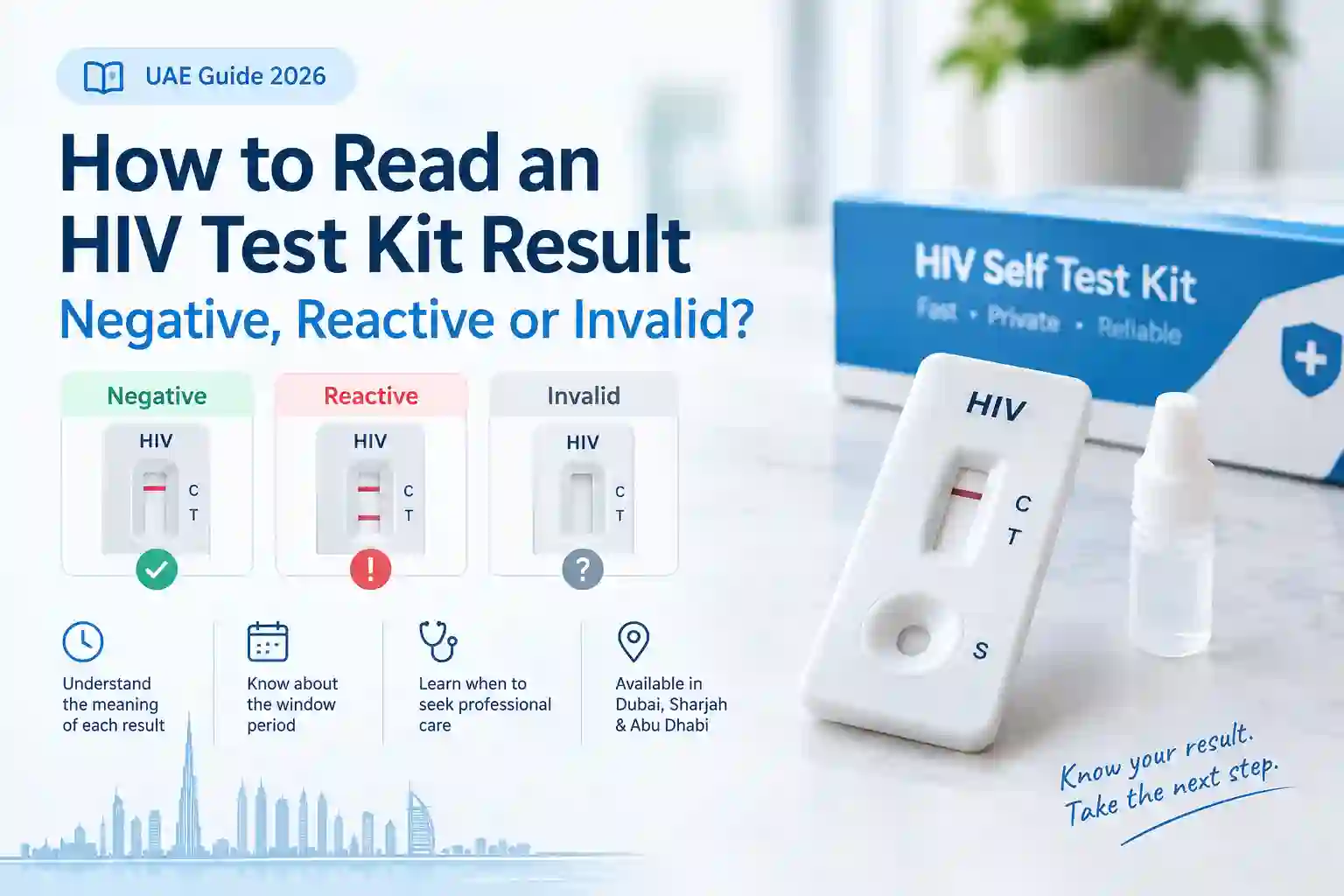
How to Read an HIV Test Kit Result: Negative, Reactive or Invalid? (UAE Guide 2026)
When using an HIV test kit at home, understanding the result is just as important as choosing the right test. You may see terms such as negative, reactive, positive, or invalid in the instructions, and knowing what they mean can help you decide what to do next.For people in Dubai, Sharjah, Abu Dhabi, and across the UAE, home HIV screening can offer a convenient way to access certain screening options. However, every test has limitations, and a result must be interpreted according to the specific product instructions, the time since possible exposure, and your circumstances.In this guide, we explain how to understand common HIV test kit results, what each result can and cannot tell you, and when follow-up testing or professional medical advice is important.What Do HIV Test Kit Results Mean?HIV home screening tests generally display a result using a visual indicator or another method specified by the manufacturer. The meaning of that result depends on the particular test.Before interpreting any result, read the instructions supplied with your kit. Different products may use different indicators, control markers, and reading procedures.The three common result categories are:Negative or non-reactive: The test did not detect the HIV marker it is designed to identify in the sample.Reactive: The test detected a marker that requires follow-up and confirmatory testing.Invalid: The test did not produce a valid result, so it cannot be interpreted as negative or positive.A screening result is not the same as a final medical diagnosis. Understanding this distinction is essential when using an HIV test kit at home.1. What Does a Negative HIV Test Result Mean?A negative result generally means the test did not detect the marker it was designed to identify.This can be reassuring when the test has been used correctly and enough time has passed since the possible exposure for the specific test to detect infection reliably.However, a negative result does not always rule out HIV.Why might a negative result need follow-up?There are several reasons:Testing too early: The test may have been used during the HIV window period, before the marker becomes detectable.Incorrect use: Not following sample collection or reading instructions can affect the validity of the result.Wrong test for the situation: Different tests detect different markers and have different detection windows.A later exposure: A negative result cannot rule out an exposure that occurred after the test.If you tested shortly after possible exposure, check the instructions for the exact test and seek medical advice about whether and when to repeat it.How soon can an HIV test detect infection?The window period varies by test type. Commonly cited ranges from the US Centers for Disease Control and Prevention (CDC) are:HIV test typeTypical detection window after exposureNucleic acid test (NAT)10–33 daysLaboratory antigen/antibody test using blood from a vein18–45 daysRapid finger-stick antigen/antibody test18–90 daysAntibody test23–90 daysThese ranges are general guidance, not a guarantee for every product. A home self-test should not automatically be assumed to have the same detection window as a laboratory test.If you are uncertain about the test type or when your result can be considered reliable, consult a qualified healthcare professional.2. What Does a Reactive HIV Test Result Mean?A reactive result means the screening test has detected a marker that needs further investigation.A reactive home screening result does not, by itself, confirm that a person has HIV. Follow-up testing through an appropriate healthcare service is necessary to establish the diagnosis.If your result is reactive:Read the manufacturer's instructions carefully.Arrange prompt medical assessment and confirmatory testing.Follow the healthcare professional's advice about additional tests and next steps.Avoid trying to confirm or dismiss the result by repeatedly using home tests without appropriate guidance.It is understandable to feel worried after a reactive result, but a screening result is a starting point for follow-up, not a final diagnosis.A healthcare professional can explain the confirmatory testing process and discuss any further care that may be needed.3. What Does an Invalid HIV Test Result Mean?An invalid result means the test has not produced a result that can be interpreted reliably.It is not the same as a negative result.Depending on the product, an invalid result may occur if the control indicator does not appear, the sample was collected incorrectly, the test was used improperly, or the test was damaged or stored outside its specified conditions.If your result is invalid:Do not interpret it as evidence that you are HIV-negative.Review the instructions to understand the product's invalid-result criteria.Check the expiry date and any storage requirements.Use a new test only as directed by the manufacturer.Contact a healthcare professional if you are uncertain or if a recent exposure requires timely assessment.If the possible exposure occurred within the last 72 hours, do not delay seeking urgent medical advice while trying another test.4. How Do You Read Lines on an HIV Test Kit?Some rapid HIV tests use visual lines or other indicators. The exact interpretation depends on the model.One test may use a control line and a test line, while another product may use a different indicator or result display.For that reason, there is no universal rule that applies to every HIV test kit.When reading a line-based test:Identify the control and test indicators shown in the manufacturer's diagram.Check that the required control indicator appears.Read the result only within the time window stated in the instructions.Compare the result with the examples provided for that exact product.Follow the manufacturer's guidance if the result is faint, unclear, or invalid.Do not assume that a faint line has the same meaning across all products. If you cannot confidently interpret the result, contact the manufacturer or a healthcare professional for guidance.5. Why the HIV Test Type MattersHIV tests differ in what they detect. Understanding the type of test can help you interpret a result more appropriately.HIV antibody testsAntibody tests look for antibodies produced by the immune system in response to HIV. Because antibodies take time to develop, an antibody test may not detect a very recent infection.You can review the HIV 1/2 Antibody Test Kit product information to understand its stated intended use and instructions.Fourth-generation antigen/antibody testsFourth-generation tests detect HIV antibodies and the p24 antigen. Laboratory-based fourth-generation tests can generally detect infection earlier than antibody-only tests.However, not every test described as a fourth-generation test has the same intended use, sample type, or detection window. Always check the exact product specifications.See the HIV 4th Generation Test Kit page for product-specific information.Choosing a suitable HIV test kitBefore choosing a product, consider:Which HIV markers it detects.Whether it is intended for self-testing or professional use.What sample it requires.Its stated detection window.How results are interpreted.What follow-up is recommended after a reactive or invalid result.You can also browse the SureTestKit HIV test kit options to review the information available for the listed product.6. When Should You Repeat an HIV Test?Repeat testing may be appropriate if your first test was taken during the window period, if your healthcare professional recommends follow-up, or if you have had another potential exposure.The timing depends on the test type and your exposure history. Do not assume that every HIV test can reliably rule out infection after the same number of days.If you have ongoing concerns after a negative result, seek professional advice about the appropriate testing schedule.Important: Possible HIV exposure within 72 hoursIf you think you may have been exposed to HIV within the past 72 hours, seek urgent medical assessment for post-exposure prophylaxis (PEP).PEP should be started as soon as possible and no later than 72 hours after exposure. Do not wait for a home test result before seeking care.7. Can You Trust a Home HIV Test Kit?A home HIV test can be useful when it is suitable for your needs and used according to its instructions. But no test should be treated as infallible.When evaluating a product, look for clear information about:The manufacturer and product identity.The intended use and sample type.The test's stated performance and limitations.The detection window.Storage conditions and expiry date.Result interpretation and follow-up instructions.Be cautious about claims that a test is 100% accurate or that a negative result immediately after exposure rules out HIV.A reliable decision involves more than the product label. Timing, proper use, and appropriate follow-up all matter.8. Ordering an HIV Test Kit in Dubai, Sharjah and Abu DhabiIf you are considering a home HIV test kit in the UAE, review the product details before ordering.SureTestKit provides online product information for customers in Dubai, Sharjah, Abu Dhabi, and other UAE locations. Delivery availability and timing depend on the destination and current order conditions; check the website and checkout information for the latest details.When comparing products, prioritize suitability and clear instructions rather than choosing solely on price or speed.For customers who want to compare the available options, start with the HIV test kit product page.Remember that a home screening product does not replace urgent medical care, confirmatory testing, or professional advice when needed.Frequently Asked Questions1. Does a negative HIV test result mean I definitely do not have HIV?Not always. A negative result may not rule out infection if the test was taken during its window period. Follow the instructions for the exact test and seek advice about repeat testing if needed.2. Does a reactive HIV test mean I have HIV?A reactive screening result needs confirmatory testing. It is not, by itself, a final diagnosis. Arrange medical follow-up promptly.3. What should I do if my HIV test kit result is invalid?Do not interpret the result as negative. Follow the manufacturer's instructions for invalid results and use a new test only as directed. Seek medical advice if you need help interpreting the result.4. Can I read an HIV test kit result after the recommended time?You should read the result only within the time window specified by the manufacturer. Reading it too early or too late may lead to misinterpretation.5. Are all HIV test kits read in the same way?No. Different products may use different indicators and result criteria. Always follow the instructions supplied with your particular test.6. Which HIV test kit should I choose?Consider the test type, intended use, sample requirements, window period, and follow-up instructions. If you are unsure which test is appropriate for your situation, consult a healthcare professional.7. Can I order an HIV test kit online in the UAE?You can review available products on the SureTestKit website. Check each product's intended use, instructions, limitations, and current delivery details before ordering.Final ThoughtsUnderstanding your HIV test result is an important part of using a home screening kit responsibly.A negative result may be reassuring, but it must be interpreted in light of the test's window period. A reactive result requires confirmatory testing, while an invalid result cannot be treated as negative.If you have questions about your result, symptoms, or the timing of a possible exposure, consult a qualified healthcare professional. If a possible HIV exposure occurred within the last 72 hours, seek urgent assessment for PEP.To review available options, visit the SureTestKit HIV test kit page.
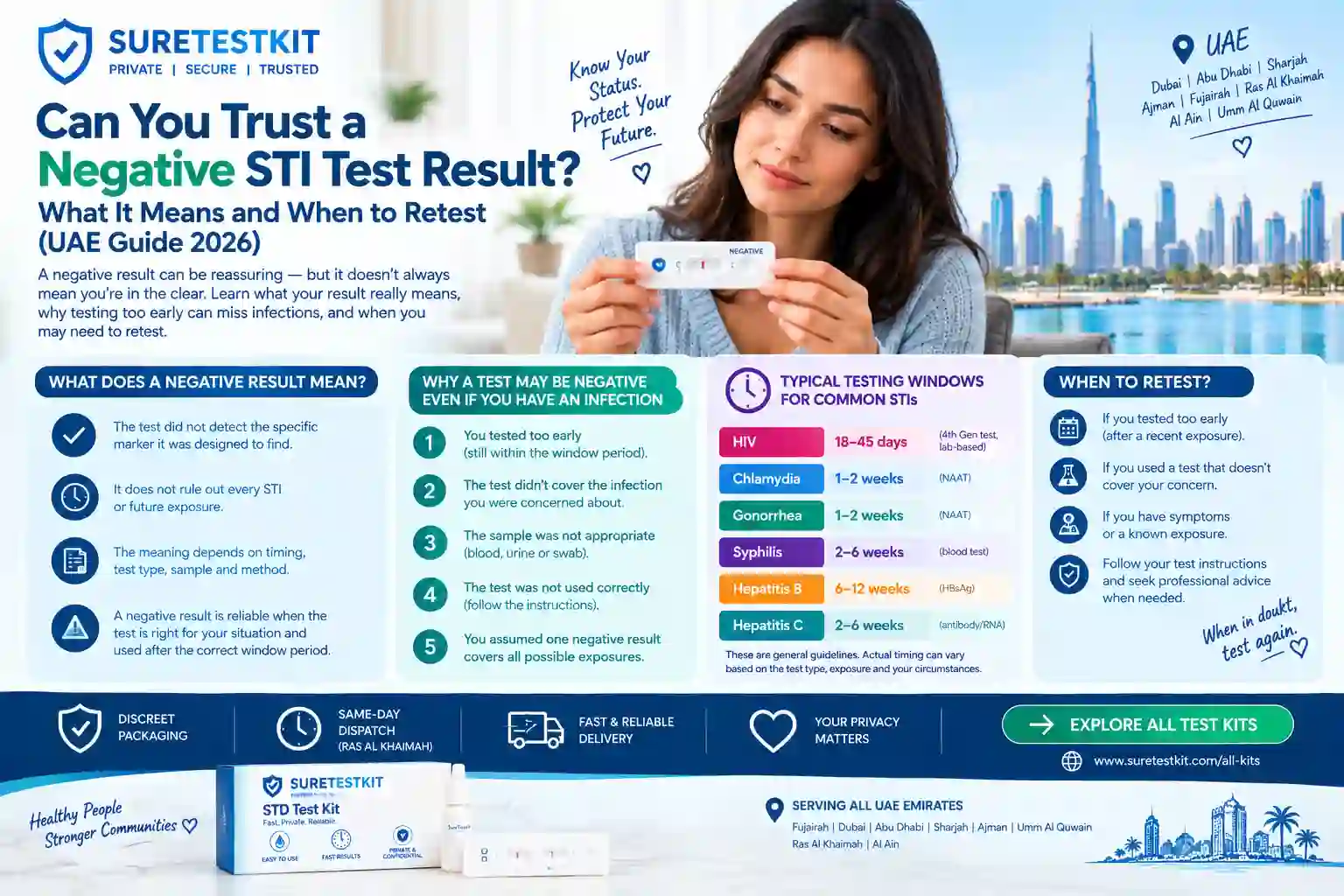
Can You Trust a Negative STI Test Result? What It Means and When to Retest (UAE Guide 2026)
Receiving a negative sexually transmitted infection (STI) test result can bring relief. But does a negative result always mean you do not have an infection?Not necessarily. A negative result is reassuring when the test is appropriate for the infection, performed correctly, and taken after the relevant detection window. If you test too soon after exposure, use an unsuitable sample, or take a test that does not screen for the infection you are concerned about, the result may not tell the whole story.For people living in Dubai, Abu Dhabi, Sharjah, Ajman, Fujairah, Ras Al Khaimah, and other parts of the UAE, understanding what a negative result means can help make sexual health decisions more confidently.In this guide, we explain when a negative STI test result is reliable, when you may need to repeat testing, how different infections are tested, and how to choose a suitable home screening option.What Does a Negative STI Test Result Mean?A negative result generally means the test did not detect the specific infection marker it was designed to identify in the sample provided.However, it does not automatically rule out every sexually transmitted infection.The meaning of your result depends on several factors:Timing: Was the test taken after the relevant detection window?Test type: Does it detect antibodies, antigens, genetic material, or another marker?Sample type: Was the correct blood, urine, or swab sample used?Collection and handling: Were the instructions followed correctly?Infection coverage: Does the test actually screen for the infection you are concerned about?Exposure site: Was testing performed at the relevant anatomical site?For example, a negative genital test may not rule out an infection in the throat or rectum if those sites were exposed but not tested.A negative result should therefore be interpreted in the context of the exposure and the test's instructions.Five Reasons an STI Test May Be Negative Even When an Infection Is Present1. You tested too earlyThis is one of the most important reasons an infection may go undetected.After exposure, an infection or the marker used to detect it may need time to become measurable. During this period, a test may return a negative result even if infection has occurred.This is known as the window period.Different infections and test methods have different window periods. A test that is suitable several weeks after exposure may be less informative when used only a few days afterward.If you tested soon after a possible exposure, check the specific test instructions and ask a healthcare professional whether repeat testing is recommended.2. The test did not cover the infection you were concerned aboutNot all STI tests screen for the same infections.An HIV test, for example, does not automatically test for chlamydia, gonorrhea, syphilis, herpes, or hepatitis.Similarly, a multi-panel screening product only covers the infections explicitly listed in its specifications.Before choosing a product, check which infections it detects and whether it is designed for the type of sample you need to provide.You can compare available options through the SureTestKit All Kits collection.3. The sample was not appropriateDifferent infections may require different samples.Depending on the infection and test method, testing may involve blood, urine, or a swab. Some infections can affect multiple anatomical sites, and a sample from one site may not identify an infection at another.If you have had oral or anal sexual contact, tell your healthcare professional. They can advise whether throat, rectal, genital, or other testing is appropriate.4. The test was not used correctlyHome screening products have specific instructions for sample collection, timing, storage, and result interpretation.Using the wrong amount of sample, reading the result outside the stated time window, or storing a test incorrectly may affect its validity.Always follow the instructions supplied with your specific product. If the result is invalid, unclear, or difficult to interpret, follow the manufacturer's guidance and seek professional advice when needed.5. You assumed a negative result covered every possible exposureA negative result relates to the sample and test performed at that time. It does not protect against future infection or automatically address exposures that occurred after testing.If you have another potential exposure after a negative test, you may need a new testing plan based on the most recent exposure.When Should You Repeat an STI Test?The correct time to repeat testing depends on the infection, the test method, the date of exposure, and whether you have symptoms.The following table offers general guidance. It is not a substitute for the instructions for a particular test or advice from a qualified healthcare professional.Infection or testWhat to consider after a negative resultHIVCheck the detection window for the exact test. Repeat testing may be necessary if the first test was taken within that window.ChlamydiaIf testing was performed very soon after exposure, a clinician may recommend repeat testing. The appropriate sample site also matters.GonorrheaEarly testing may need follow-up depending on the test, exposure site, and clinical advice.SyphilisBlood tests may be negative early in infection. Repeat testing may be advised after a recent exposure.Hepatitis BTiming depends on the marker tested, vaccination status, and exposure circumstances.Hepatitis CAntibody and RNA tests detect different markers and have different detection windows. Follow-up may be needed after recent exposure.HerpesA swab from a fresh lesion may be more informative when sores are present. Blood antibody tests have different limitations and timing considerations.Important distinction: Repeat testing after a recent exposure is not the same as retesting after treatment. For example, people treated for chlamydia or gonorrhea may be advised to test again later to check for reinfection. The schedule depends on the infection and clinical circumstances.Can You Trust a Negative HIV Test?A negative HIV test can be reassuring when it is performed correctly and after the applicable window period. The exact detection window depends on the test used.Commonly cited detection windows include:Laboratory fourth-generation antigen/antibody test using blood from a vein: usually 18–45 days after exposure.Rapid finger-stick antigen/antibody test: approximately 18–90 days.Antibody-only test: approximately 23–90 days.Nucleic acid test (NAT): approximately 10–33 days.These are general ranges, not guarantees for every product. A self-test should not automatically be assumed to have the same detection window as a laboratory test.If your HIV result is negative but the test was taken before the relevant window has passed, follow the test instructions and seek advice about repeat testing.You can review the product information for the HIV 1/2 Antibody Test Kit and the HIV 4th Generation Test Kit. Confirm the exact test method and intended use before relying on any stated detection window.What if you had a recent possible HIV exposure?Do not rely on an early negative test to rule out infection.If a possible HIV exposure occurred within the last 72 hours, seek urgent medical assessment for post-exposure prophylaxis (PEP). PEP should be started as soon as possible and no later than 72 hours after exposure. Do not wait for a home test result before seeking care.What If Your STI Test Is Negative but You Have Symptoms?A negative result does not mean you should ignore persistent or concerning symptoms.Symptoms such as unusual discharge, pain when urinating, genital sores or blisters, a rash, pelvic pain, or testicular pain can have several causes. Some STIs may also be present without obvious symptoms.If symptoms continue after a negative test:Arrange a medical assessment.Tell the clinician when the possible exposure occurred.Explain which test you took and when you took it.Mention the type of sexual contact and any symptoms.Ask whether repeat testing, a different sample, or testing for another condition is appropriate.Seek prompt medical care for severe pain, fever with significant pelvic or testicular symptoms, or other urgent concerns.Do not take antibiotics or other prescription medicines without appropriate medical advice.Does a Negative Multi-Panel STD Test Mean You Are Clear of All STIs?No. A multi-panel test can screen for several infections in one product, but it cannot automatically rule out every STI.The term “multi-panel” describes the number or selection of tests included; it does not mean that all infections are covered or that every possible exposure site has been assessed.Before buying a multi-panel product, check:The exact infections included.The type of sample required for each test.Whether the product is intended for self-testing.The stated detection window and limitations.What to do after a negative, positive, reactive, or invalid result.If you are comparing screening options, you can review the 4 Panel STD Test Kit and the Gonorrhea and Chlamydia Test Kit. Read each product's specifications carefully because test coverage and intended use vary.Home STI Testing vs. Clinic Testing After a Negative ResultHome testing and clinic testing can serve different purposes. The right choice depends on the test you need, your exposure history, and whether you have symptoms.When home testing may be usefulA suitable home test may offer convenience and privacy for screening when used according to its instructions.When comparing products, look for clear information about the infection tested, sample type, intended use, window period, and follow-up steps.SureTestKit provides an online catalogue of home screening products. Review the available test kits to understand the options and their individual specifications.When clinical testing may be more appropriateConsider professional assessment if:Your exposure was recent and you are unsure when to test.You have symptoms despite a negative result.Your partner has been diagnosed with an STI.You need testing at multiple anatomical sites.You need an infection-specific test that your home kit does not provide.Your result is reactive, invalid, or unclear.You need treatment, confirmatory testing, or follow-up.A healthcare professional can help interpret a negative result and decide whether additional testing is necessary.How to Make Your Next STI Test More InformativeIf you want to reduce the risk of misunderstanding a test result, follow these practical steps.Step 1: Record your exposure date. Note when the possible exposure happened and whether there have been any subsequent exposures.Step 2: Identify the infections relevant to your situation. Different infections require different tests.Step 3: Check the detection window. Read the instructions for the exact test rather than relying on a general timeframe found online.Step 4: Use the appropriate sample. Follow the product instructions and seek advice if testing at a different anatomical site may be needed.Step 5: Follow up when advised. If you tested early, have symptoms, or were exposed to a known infection, ask whether repeat or clinical testing is appropriate.Step 6: Interpret the result correctly. A negative result is not a guarantee against every infection. A reactive screening result may require confirmatory testing.Step 7: Consider future prevention. Condoms and other barrier methods can reduce the risk of many STIs, although protection varies by infection and type of contact. Vaccination is available for certain infections, including hepatitis B and HPV.Private STI Test Kit Options in the UAEFor residents across the UAE, online home screening products can provide another way to explore selected testing options. However, privacy and convenience should go hand in hand with understanding the product's limitations.Before ordering, verify that the test matches your screening needs and that you understand its sample requirements, detection window, and follow-up guidance.SureTestKit offers product information online, along with discreet-ordering options. Delivery availability, timing, and payment methods can depend on your location and order conditions, so check the current details at checkout.If you receive a negative result but remain concerned because of a recent exposure, symptoms, or a partner's diagnosis, do not assume that the result settles the matter. Seek appropriate medical advice.Frequently Asked Questions1. Does a negative STI test mean I do not have an STI?Not always. A negative result means the test did not detect the marker it was designed to identify. If the test was taken too early, used an unsuitable sample, or did not include the infection of concern, further testing may be necessary.2. How soon can I trust a negative STI test?There is no universal timeframe. Detection windows vary by infection and test type. Follow the instructions for your specific test and ask a healthcare professional if you are unsure when a negative result can be considered reliable.3. Should I repeat an HIV test after a negative result?You may need to repeat it if you tested before the applicable window period had passed or if a clinician recommends follow-up. The correct timing depends on whether you used a laboratory antigen/antibody test, a rapid test, or an antibody-only test.4. Can I have an STI without symptoms even if my test is negative?Yes. Some STIs can occur without symptoms, and a negative test may not exclude an infection if it was taken too early or did not test the relevant site. If you have a known exposure or ongoing concerns, seek advice about appropriate testing.5. Can a home STI test be wrong?Any test has limitations. Results may be affected by timing, sample collection, test performance, or incorrect use. Follow the instructions carefully and seek clinical advice if the result is invalid, unclear, or inconsistent with your symptoms or exposure history.6. Does a negative result mean my partner does not have an STI?No. Your result does not establish your partner's status. Each person may need appropriate testing based on their own exposure history and the timing of their test.7. What should I do if my test is negative but my partner tested positive?Contact a healthcare professional promptly. They can advise whether you need testing, repeat testing, preventive treatment, or other follow-up based on the specific infection and timing.8. Can I order a home STI test kit online in the UAE?You can review available screening products online, including options at SureTestKit. Before ordering, check exactly what the product tests for, the sample required, its detection window, and the next steps for each possible result.Final ThoughtsA negative STI test result can be reassuring, but its reliability depends on the test, the sample, and the time since exposure. Testing too early or screening for the wrong infection can leave important questions unanswered.If you have concerns after a negative result, check the test's detection window and ask whether repeat testing or a clinical assessment is appropriate. Seek urgent medical advice after a possible HIV exposure within 72 hours, because PEP is time-sensitive.For people exploring home screening options in the UAE, the best starting point is to understand what you need to test for and choose a product designed for that purpose.Explore the SureTestKit All Kits collection to review available home screening options and their product-specific information.
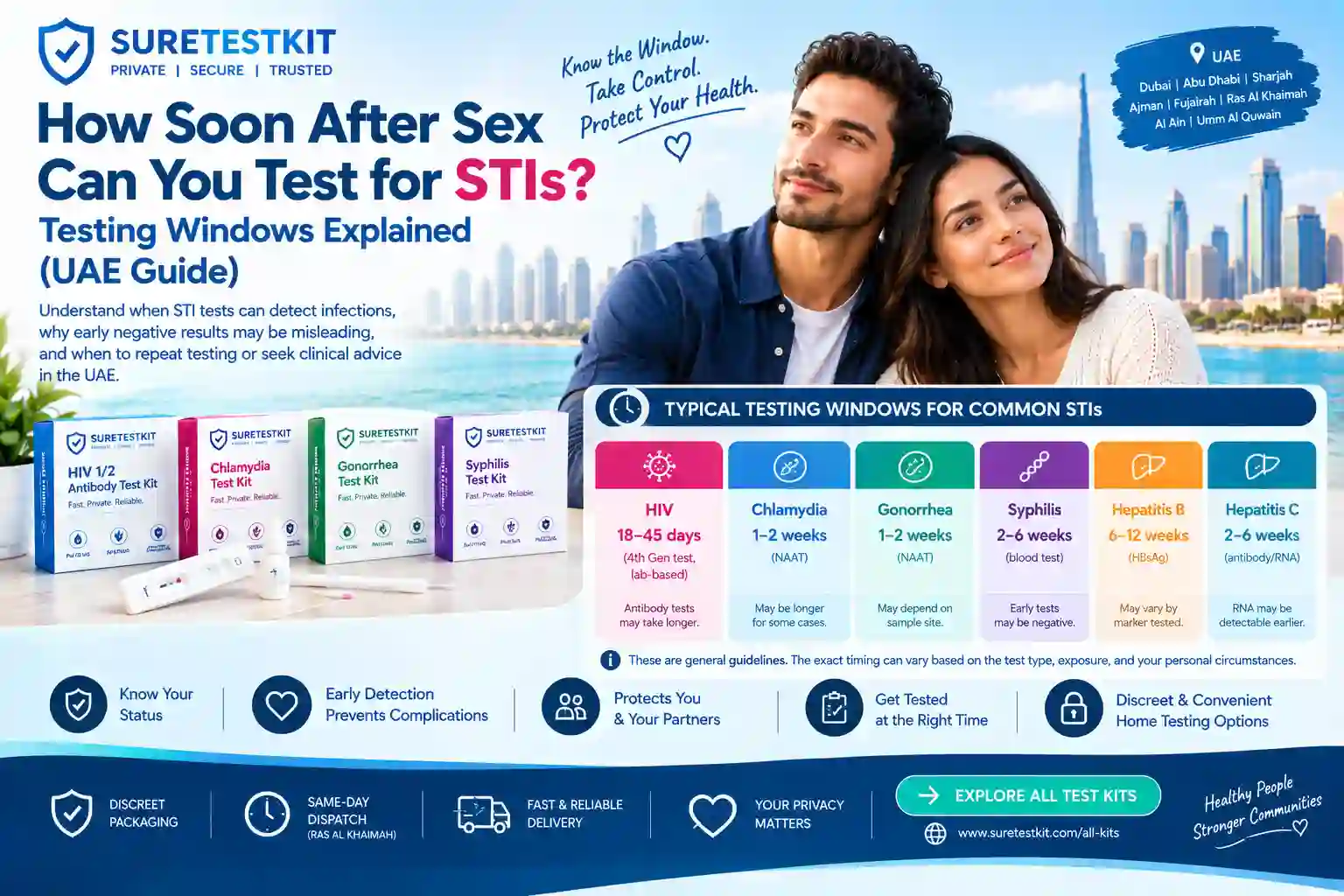
How Soon After Sex Can You Test for STIs? Testing Windows Explained (UAE Guide 2026)
Understanding when to test after sexual contact can help you make informed decisions about your sexual health. Testing too early may produce a negative result even when an infection is present. The right testing time depends on the infection, the type of test used, the sample collected, and whether you have symptoms.For people in Dubai, Abu Dhabi, Sharjah, Ajman, Fujairah, Ras Al Khaimah, and other parts of the UAE, understanding STI testing windows can make it easier to decide when to seek testing and whether a repeat test may be necessary.In this guide, we explain testing windows for common sexually transmitted infections (STIs), why early testing can be misleading, how home test kits compare with clinical testing, and when you should seek professional medical advice.What Is an STI Testing Window?An STI testing window is the period between a possible exposure to an infection and the point at which a particular test can reliably detect it.After exposure, an infection may need time to produce detectable levels of a virus, bacterium, antibody, or antigen. During this period, a test may return a negative result even if an infection has occurred.There is no single testing window that applies to every STI.For example:Some bacterial infections may be detectable within days to a few weeks, depending on the test and sample.HIV tests have different detection windows depending on whether they detect antibodies, antigens, or both.Certain infections may require follow-up testing because antibodies develop gradually.Testing may need to be repeated if the first test was taken too soon.A negative result should therefore be interpreted according to the specific test instructions and the time since the possible exposure.How Soon Can You Test for Common STIs?The following table provides general guidance, not a guarantee that an infection will be detected at a particular time. The appropriate timing can vary by test method, exposure type, symptoms, and clinical circumstances.InfectionGeneral testing considerationsChlamydiaA healthcare professional may recommend testing around 1–2 weeks after exposure. Earlier testing may miss an infection.GonorrheaTesting is often considered around 1–2 weeks after exposure, depending on the test and exposure site.HIVDetection windows vary significantly by test type. Laboratory fourth-generation antigen/antibody tests generally detect infection earlier than antibody-only tests.SyphilisBlood tests may not become reactive immediately. Testing and follow-up may be needed over several weeks.Hepatitis BDetectability depends on the marker tested and the stage of infection. Clinical advice can help determine the appropriate schedule.Hepatitis CBlood tests for antibodies and tests that detect viral RNA have different detection windows.Herpes (HSV)A fresh sore or blister can often be sampled for a PCR test. Blood antibody tests have different limitations and timing considerations.HPVThere is no universal routine screening test for every person or every HPV type. Screening recommendations depend on anatomy, age, and clinical guidelines.Important: These are broad planning ranges, not definitive deadlines. Follow the instructions for your specific test and consult a healthcare professional if you need a reliable testing schedule.HIV Testing: Why the Type of Test MattersHIV testing is one area where understanding the window period is particularly important. Different tests look for different markers of infection, so they do not all detect HIV at the same time.1. HIV antibody testsAntibody tests look for the body's immune response to HIV. Antibodies take time to develop, so an antibody-only test may not detect a very recent infection.If you are considering an antibody-based option, review the product's stated detection window and follow-up instructions.Explore the HIV 1/2 Antibody Test Kit to review the product information.2. HIV fourth-generation testsFourth-generation tests detect both HIV antibodies and the p24 antigen. Laboratory-based fourth-generation antigen/antibody tests usually detect HIV earlier than antibody-only tests.According to widely used public health guidance, a laboratory fourth-generation antigen/antibody test using blood from a vein typically detects HIV about 18–45 days after exposure. Rapid finger-stick antigen/antibody tests may have a longer window, commonly up to 90 days.These ranges apply to the specified test types and should not automatically be assumed to apply to every home kit. Check the exact product instructions and whether the test is intended for self-testing.You can review the HIV 4th Generation Test Kit product information.3. When should you repeat an HIV test?If you test during the window period and receive a negative result, you may need to repeat the test after the relevant window has passed. The recommended timing depends on the test type and any ongoing exposure.If a possible HIV exposure occurred within the last 72 hours, do not wait for a home test. Seek urgent medical assessment for post-exposure prophylaxis (PEP), which must be started as soon as possible and no later than 72 hours after exposure.Chlamydia and Gonorrhea: Timing and Sample ChoiceChlamydia and gonorrhea can occur without noticeable symptoms. Testing may be appropriate even when you feel well, particularly after a potential exposure or when a partner has been diagnosed.Healthcare professionals commonly use nucleic acid amplification tests (NAATs) to detect these infections. Depending on the exposure, testing may involve a urine sample or a swab from the relevant body site.A genital test does not necessarily detect an infection at the throat or rectum. Tell your healthcare professional about the type of contact so they can recommend appropriate sampling.Testing around one to two weeks after exposure is often discussed for these infections, but the best timing depends on the test and circumstances. If you test very early, a clinician may recommend repeating the test.Learn more about the options available on our Chlamydia Test Kit, Gonorrhea Test Kit, and Gonorrhea and Chlamydia Test Kit pages. Always verify which sample types, intended users, and detection claims apply to the specific product.Syphilis and Hepatitis: Why Follow-Up May Be NeededSyphilisSyphilis can initially cause a painless sore that may go unnoticed. Blood tests may not become positive immediately after exposure, so a negative early result does not always rule out infection.A healthcare professional may recommend an initial test followed by repeat testing based on the exposure date, symptoms, and initial result.See the Syphilis Test Kit for product-specific information.Hepatitis BHepatitis B testing may involve different blood markers, such as the surface antigen and antibodies. These markers appear at different stages, and no single test result should be interpreted without considering the testing context.Vaccination status is also important. If you may have been exposed to hepatitis B recently, contact a healthcare professional promptly because post-exposure measures may be time-sensitive.Review the Hepatitis B Self-Test Kit details and confirm its intended use and limitations.Hepatitis CHepatitis C antibody tests and tests that detect viral RNA have different detection windows. Antibodies may take weeks to develop, while RNA may become detectable earlier.If you have had a recent exposure, ask a healthcare professional which test is appropriate and whether follow-up testing is needed.You can also review the Hepatitis C Test Kit product information.Should You Test Immediately After Sexual Contact?Testing immediately may be useful in some circumstances, but it cannot reliably rule out every infection from a recent exposure.A healthcare professional may recommend an initial assessment to check for existing infections, followed by repeat testing at the appropriate time. This can be particularly important if you have symptoms, a partner has tested positive, or the exposure involved a known infection.Seek medical advice promptly if you develop unusual discharge, pain when urinating, genital sores or blisters, a rash, pelvic or testicular pain, or other concerning symptoms. Do not delay assessment simply because a test might be within its window period.Until you have received appropriate advice, consider avoiding sexual contact or using barriers to reduce the risk of transmission. Some infections can still be transmitted without symptoms.Home STI Test Kits vs. Clinic TestingBoth home testing and clinic testing may have a role in sexual health screening, but they are not interchangeable in every situation.Home testing may suit some screening needsDepending on the specific kit, home testing can offer:The convenience of reviewing test instructions at home.Privacy when ordering and receiving a product.Access to selected screening options without an initial clinic visit.Individual or multi-panel options where the product is designed and validated for those uses.Before ordering, check what the kit detects, the sample required, the test's intended user, its stated window period, and what to do after a negative or reactive result.Browse the SureTestKit All Kits collection to review available options.Clinical testing may be preferable when:The exposure was recent and the correct testing schedule is unclear.You have symptoms or a partner has a confirmed STI.You need testing from more than one anatomical site.You require a test that is not available through the home-testing option you are considering.You receive a reactive result or need treatment and follow-up.You may need time-sensitive prevention, such as HIV PEP or hepatitis B post-exposure care.A home test should not delay urgent medical assessment or replace clinical care when it is needed.How to Plan Your STI Testing TimelineIf you are unsure when to test, use these steps as a starting point.Step 1: Record the exposure date. Write down when the possible exposure occurred and whether there have been any additional exposures.Step 2: Identify the infections you may need to test for. Different sexual activities and exposure sites can require different tests.Step 3: Check the exact test method. Read the product instructions carefully. Do not assume all HIV, syphilis, hepatitis, or multi-panel tests have the same window period.Step 4: Seek urgent advice when appropriate. If HIV exposure may have occurred within 72 hours, seek PEP assessment immediately. Contact a clinician promptly for symptoms or a known exposure to an infection.Step 5: Follow the recommended testing schedule. If the first test is negative but was taken too early, arrange repeat testing when advised.Step 6: Confirm reactive results. Screening results that are reactive or positive may require confirmatory testing. Do not make treatment decisions based on a screening result alone.Ordering a Home STI Test Kit in the UAEFor residents in Dubai, Abu Dhabi, Sharjah, Ajman, Fujairah, Ras Al Khaimah, and other UAE locations, SureTestKit provides an online catalogue of home screening products.When comparing products, prioritize the test's intended use, sample requirements, stated detection window, storage conditions, expiry date, and instructions for interpreting results. Consider whether the product tests for the specific infection you are concerned about.SureTestKit offers discreet-ordering options and delivery information on its website. Delivery timing and payment availability may vary by location and order conditions, so check the current information at checkout.Remember that privacy and convenience are useful, but the most important factor is choosing an appropriate test and using it at the right time.Frequently Asked Questions1. How many days after sex should I get an STI test?There is no single number that applies to every STI. Some tests may be useful after several days, while others require weeks or longer to become reliably detectable. The correct timing depends on the infection, test method, and exposure.2. Can an STI test be negative if I have an infection?Yes. Testing too early can produce a negative result because the infection or the marker being tested for may not yet be detectable. Follow the test instructions and ask a healthcare professional whether repeat testing is needed.3. Can I take an HIV test one week after exposure?You can seek medical advice and may be offered an initial test, but a negative result after one week generally cannot rule out HIV from that exposure. Follow the detection window for the specific test. If the exposure was within 72 hours, seek urgent assessment for PEP rather than waiting for a test.4. Is a fourth-generation HIV test better for early detection?Laboratory-based fourth-generation antigen/antibody tests can detect HIV earlier than antibody-only tests in many circumstances. However, the window period depends on the specific test type. A home or rapid test should not automatically be assumed to have the same detection window as a laboratory test.5. Should I test if I have no symptoms?Yes, testing can still be appropriate after a potential exposure, because several STIs can occur without noticeable symptoms. Your testing plan should reflect your exposure, medical history, and applicable screening recommendations.6. Do multi-panel STD test kits detect every STI?No. A multi-panel kit only tests for the infections listed in its product specifications, and each component may have its own sample requirements and limitations. Review the included tests before purchasing.7. What should I do if my home STI test is reactive?Follow the instructions provided with the test and arrange appropriate confirmatory testing or clinical assessment. Avoid assuming that a screening result alone establishes a final diagnosis.8. Can I order an STI test kit online in the UAE?You can review available products through online retailers such as SureTestKit. Before ordering, verify that the product is suitable for your needs, understand its limitations, and check current delivery and payment terms.Final ThoughtsKnowing when to test after sexual contact is an important part of responsible sexual health care. A test taken too early may not detect an infection, and different STIs have different testing windows.Choose a test based on the infection you need to screen for, the test method, and the time since exposure. If you have symptoms, a known exposure, a reactive result, or uncertainty about timing, seek advice from a qualified healthcare professional.For possible HIV exposure within the past 72 hours, seek urgent PEP assessment. Do not wait for a home test result.To compare available home screening options, visit the SureTestKit All Kits page.
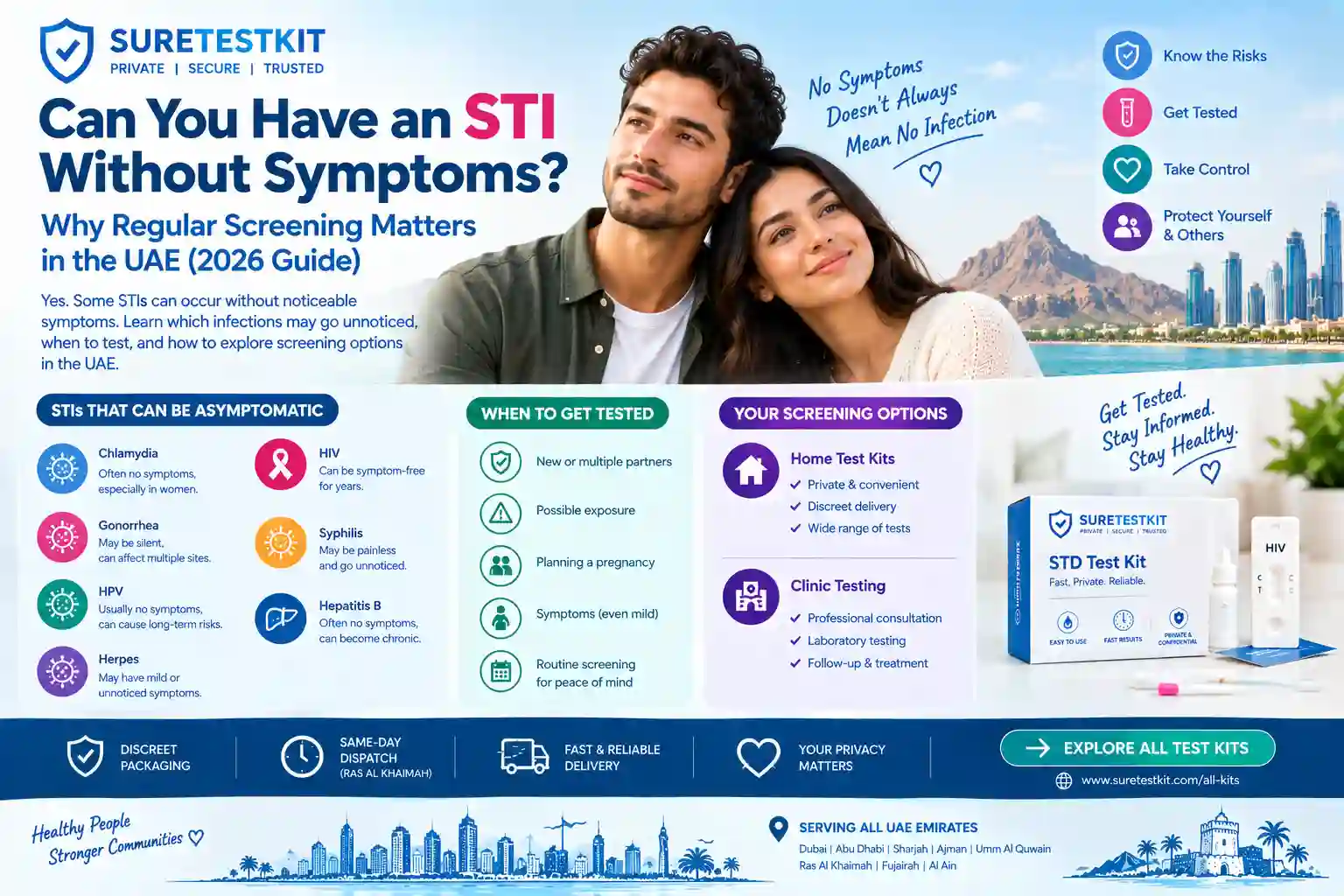
Can You Have an STI Without Symptoms? Why Regular Screening Matters in the UAE (2026 Guide)
Can you have a sexually transmitted infection (STI) without noticing any symptoms? Yes. Some STIs can be present without obvious signs, meaning a person may feel completely well and still have an infection.This is one reason sexual health screening matters. Waiting for symptoms before considering a test may delay diagnosis and treatment. It can also make it harder to know when an infection was acquired or whether a partner could have been exposed.For people in Dubai, Abu Dhabi, Sharjah, Ajman, Fujairah, Ras Al Khaimah, and other parts of the UAE, understanding asymptomatic STIs can help support informed screening decisions.In this guide, we explain which infections may go unnoticed, when testing may be appropriate, how home screening options differ, and when professional medical advice is important.1. What Does It Mean to Have an STI Without Symptoms?An asymptomatic STI is an infection that does not cause noticeable symptoms at a particular time.Some infections never cause obvious symptoms in certain people. Others may cause mild symptoms that are overlooked, disappear temporarily, or resemble another health condition.For example, a person may not notice changes in their health even when an infection is present. The absence of symptoms does not reliably establish whether an STI is present or absent.It is also important to distinguish between two situations:Asymptomatic infection: An infection is present, but noticeable symptoms are absent.No infection: Testing and clinical assessment do not identify an infection, although the meaning of a negative result depends on the test used and when it was taken.You cannot reliably distinguish between these situations based on how you feel alone. When testing is appropriate, a suitable diagnostic test provides more useful information than symptoms alone.2. Which STIs Can Occur Without Symptoms?Several sexually transmitted infections can be asymptomatic. The likelihood of symptoms varies by infection, individual circumstances, and the body site affected.ChlamydiaChlamydia frequently causes no noticeable symptoms. When symptoms do occur, they may include unusual genital discharge, pain during urination, pelvic discomfort, or testicular pain.Untreated chlamydia can lead to complications, including pelvic inflammatory disease in some women and other reproductive health problems.Because symptoms may be absent, testing can be important after a relevant exposure or when recommended by a healthcare professional.Learn more about the chlamydia test kit and confirm which testing method and sample type are appropriate for the intended use.GonorrheaGonorrhea may also occur without noticeable symptoms, particularly in some genital infections. Infections affecting the throat or rectum may be missed if testing focuses only on genital symptoms.When symptoms appear, they can include discharge, pain during urination, rectal discomfort, or throat symptoms, depending on the site of infection.A suitable test should be selected according to the exposure and body site. Nucleic acid amplification testing (NAAT) is commonly used to diagnose gonorrhea.Review the gonorrhea test kit or the combined gonorrhea and chlamydia kit, paying close attention to the stated sample requirements and intended use.Human papillomavirus (HPV)HPV is common, and many infections cause no symptoms and clear naturally. Certain types can cause genital warts, while persistent infection with particular high-risk types can contribute to cancers.There is no single routine HPV test suitable for every person or every body site. Screening recommendations depend on factors such as age, anatomy, medical history, and local guidance.If you are concerned about HPV, consult a healthcare professional about appropriate screening rather than assuming that a general STI panel will detect it.HerpesHerpes simplex virus can be present without recognizable sores. Some people have mild symptoms that they do not identify as herpes, while others experience recurring blisters or ulcers.When sores are present, a clinician may recommend a swab test. Blood tests have specific uses and limitations, and a positive antibody result does not necessarily establish when the infection was acquired or where it is located.Explore the herpes 12 IgG/IgM test kit specifications carefully and seek professional guidance about whether that testing approach is appropriate for your circumstances.HIVHIV may cause flu-like symptoms during the early stage of infection, but not everyone notices them. A person can also have HIV without feeling unwell for a prolonged period.Symptoms alone cannot determine HIV status. Testing is the reliable way to find out, but the appropriate test and timing matter.You can review the HIV 1/2 antibody test kit or the HIV fourth-generation test kit to understand the available screening categories.Different HIV tests have different window periods. A negative result taken too early after exposure may need to be repeated.Urgent reminder: If a possible HIV exposure occurred within the past 72 hours, seek urgent medical advice about post-exposure prophylaxis (PEP). Do not wait for symptoms or a home test result before seeking assessment.SyphilisSyphilis can cause a sore that is often painless and may go unnoticed, especially if it occurs in a location that is difficult to see. Later symptoms can include a rash or other changes, but symptoms may disappear even when the infection remains.Untreated syphilis can cause serious complications. If you think you may have been exposed, seek medical advice about appropriate testing and follow-up.You can review the syphilis test kit, while confirming the test's intended use and whether additional testing is recommended.Hepatitis BHepatitis B can be asymptomatic, particularly during chronic infection. Some people experience symptoms such as fatigue, nausea, abdominal discomfort, or jaundice, but others may not notice any changes.Testing depends on the clinical context and the markers being assessed. Vaccination can prevent hepatitis B, but vaccination status and the need for testing should be discussed with a healthcare professional when relevant.The hepatitis B self-test kit is one product to review. Confirm its intended use and whether its testing method is appropriate for your situation.3. Why You Should Not Wait for Symptoms Before TestingThere are several reasons why screening may be appropriate even when you feel healthy.Some infections are silent. You may not notice an infection, particularly during its early stages.Symptoms are not specific. Discharge, irritation, pain, and sores can have multiple causes. They cannot reliably identify a particular STI without appropriate assessment.Early treatment may prevent complications. Some untreated infections can cause reproductive health problems or other complications.Partners may also need testing. If an infection is diagnosed, a healthcare professional can advise whether partners should be informed, tested, or treated.Testing can clarify uncertainty. A suitable test, taken at the right time, can provide more meaningful information than trying to assess risk from symptoms alone.Screening does not need to be approached with fear or embarrassment. It is a routine part of taking care of your health when recommended or warranted by your circumstances.4. When Should You Consider STI Screening?The right screening schedule depends on your sexual history, possible exposures, age, medical circumstances, and local clinical recommendations. There is no single schedule that applies to everyone.Consider discussing testing with a healthcare professional if:You have had sex without a barrier method and are concerned about possible exposure.A current or previous partner has told you they have an STI.You have a new partner and want to discuss screening together.You have had multiple partners or other circumstances associated with increased exposure risk.You are pregnant or planning a pregnancy and need advice about recommended screening.You have symptoms that may be related to an STI.A previous test was taken too early or follow-up testing was recommended.A clinician can help determine which infections to test for and whether samples from different body sites are needed.5. Can You Test for an STI at Home in the UAE?Home screening products may offer a convenient option for certain testing situations, but the type of test matters.Some products are rapid screening devices designed for use at home. Other home-testing services provide sample-collection kits that require a laboratory to process the sample.These are not interchangeable. A product's suitability depends on its intended use, sample requirements, testing method, and limitations.Before choosing a home STI test, check:Which infection or marker the test detects.Whether the test is designed for home use.Which sample is required.When the test can reliably be used after possible exposure.Whether a reactive result requires confirmation.Whether testing at a clinic would be more appropriate.Browse the SureTestKit collection to compare available products and their stated specifications.Home screening should not replace medical assessment when you have symptoms, need urgent evaluation, or may require treatment.6. Individual STI Tests vs Multi-Panel ScreeningIf you are considering testing for more than one infection, it is important to understand what an individual test and a multi-panel product can—and cannot—tell you.Individual testsAn individual test is designed to screen for a specific infection or marker. It may be appropriate when there is a particular testing need, provided the method and sample are suitable.Examples include products intended for HIV or syphilis screening.Multi-panel testsA multi-panel product combines multiple screening targets, but the exact targets vary. The number of panels does not automatically indicate that a product is more suitable for every person.Before purchasing a multi-panel kit, review the complete list of targets and confirm whether the test methods and sample types are appropriate.For example, the 4-panel STD test kit lists HIV, syphilis, hepatitis B, and hepatitis C screening targets in its product name. Review the product details to understand exactly what it detects and what additional testing may be necessary.A screening panel may not cover every STI. Chlamydia, gonorrhea, HPV, and herpes may require different approaches depending on the infection and the clinical situation.7. What If You Have No Symptoms but Your Test Is Positive?A positive or reactive result can be worrying, especially when you feel completely well. However, the next step is to follow the instructions for that particular test and arrange the recommended medical follow-up.Here is a practical approach:Read the result according to the test instructions. Check the specified reading time and whether the result is valid.Do not assume a reactive screening result is a final diagnosis. Some tests require confirmatory testing.Contact an appropriate healthcare provider. Ask which additional tests or assessments are needed.Follow treatment recommendations. If an infection is confirmed, complete the recommended treatment and follow-up.Ask about partner management. A clinician can advise whether recent partners need notification, testing, or treatment.Follow guidance on sexual activity. Depending on the infection, you may need to avoid sexual contact or take specific precautions until treatment and follow-up requirements are met.The absence of symptoms does not mean a confirmed infection is unimportant. At the same time, a screening result should be interpreted according to the specific test rather than treated as a diagnosis without appropriate confirmation.8. What If Your STI Test Is Negative but You Still Have Concerns?A negative result can be reassuring, but its meaning depends on the circumstances.You may need further assessment if:You tested before the relevant window period had passed.You used a test that does not detect the infection you are concerned about.The sample did not match the body site exposed.You have symptoms despite a negative result.A healthcare professional has recommended repeat testing.For example, a urine test may not identify an infection at the throat or rectum. The appropriate sample depends on the type of exposure and the test.If symptoms persist or you believe you may have been exposed, seek professional advice rather than relying on a single negative result.9. Is Private STI Screening Available Across the UAE?People may have different preferences when arranging sexual health screening. Some prefer a healthcare facility, while others value the convenience of exploring home screening products online.When purchasing online, consider the retailer's privacy policy, packaging, delivery notifications, payment options, and handling of personal information.SureTestKit states that it offers discreet packaging and delivery across the UAE. Its stated delivery arrangements include same-day delivery in Dubai and Sharjah for eligible orders placed before 8 PM, and next-day delivery in other emirates for eligible orders placed before 8 PM. Confirm current availability, charges, and estimated delivery at checkout.Privacy arrangements can vary, and discreet packaging does not mean every part of an online transaction is anonymous. Review the relevant policies before placing an order.10. Frequently Asked QuestionsCan you have an STI without any symptoms?Yes. Infections such as chlamydia, gonorrhea, HPV, herpes, HIV, syphilis, and hepatitis B may occur without noticeable symptoms in some people. Appropriate testing is needed to assess infection status.Which STI is most likely to have no symptoms?Several STIs can be asymptomatic, and the likelihood varies by infection, body site, and individual circumstances. Chlamydia, HPV, and HIV may go unnoticed in some people. No single symptom pattern can reliably rule an infection in or out.Can an STI go away without treatment?Some infections may clear naturally, while others can persist and cause complications without treatment. Symptoms disappearing does not necessarily mean an infection has cleared. Seek medical advice about the appropriate testing and treatment for the specific infection.Should I get tested if my partner has no symptoms?A partner's lack of symptoms does not establish that they do not have an STI. If you have concerns about exposure or a partner has received an STI diagnosis, ask a healthcare professional which tests and timing are appropriate.Can a home STD test detect every STI?No. Home test products differ in their targets, sample requirements, and testing methods. A single kit or panel may not cover every STI or every relevant body site.How soon after sex should I get tested?The timing depends on the infection and the test. Some infections may not be detectable immediately after exposure. A healthcare professional can advise on appropriate initial and repeat testing. If HIV exposure may have occurred within 72 hours, seek urgent PEP assessment.Do I need a test if I feel completely healthy?Not everyone needs the same screening schedule, but being symptom-free does not rule out an STI. Whether testing is appropriate depends on your exposures, history, and clinical recommendations.What should I do if a home test is reactive?Follow the product instructions and arrange appropriate confirmatory testing through a healthcare provider. Ask about treatment and partner management if an infection is confirmed.Conclusion: Screening Matters Even When You Feel HealthySome sexually transmitted infections can be present without noticeable symptoms. That is why relying only on how you feel is not a dependable way to assess your sexual health.The most useful approach is to understand your potential exposure, choose an appropriate test, follow the relevant window period, and seek medical advice when necessary.Home screening may be convenient for certain situations, but it does not replace professional evaluation when symptoms, recent exposure, or confirmatory testing are involved.If you are exploring screening options in the UAE, compare the intended use and limitations of products in the SureTestKit collection. Choose a test based on your needs—not simply on the number of infections listed on the package—and seek professional care whenever you are uncertain about the next step.
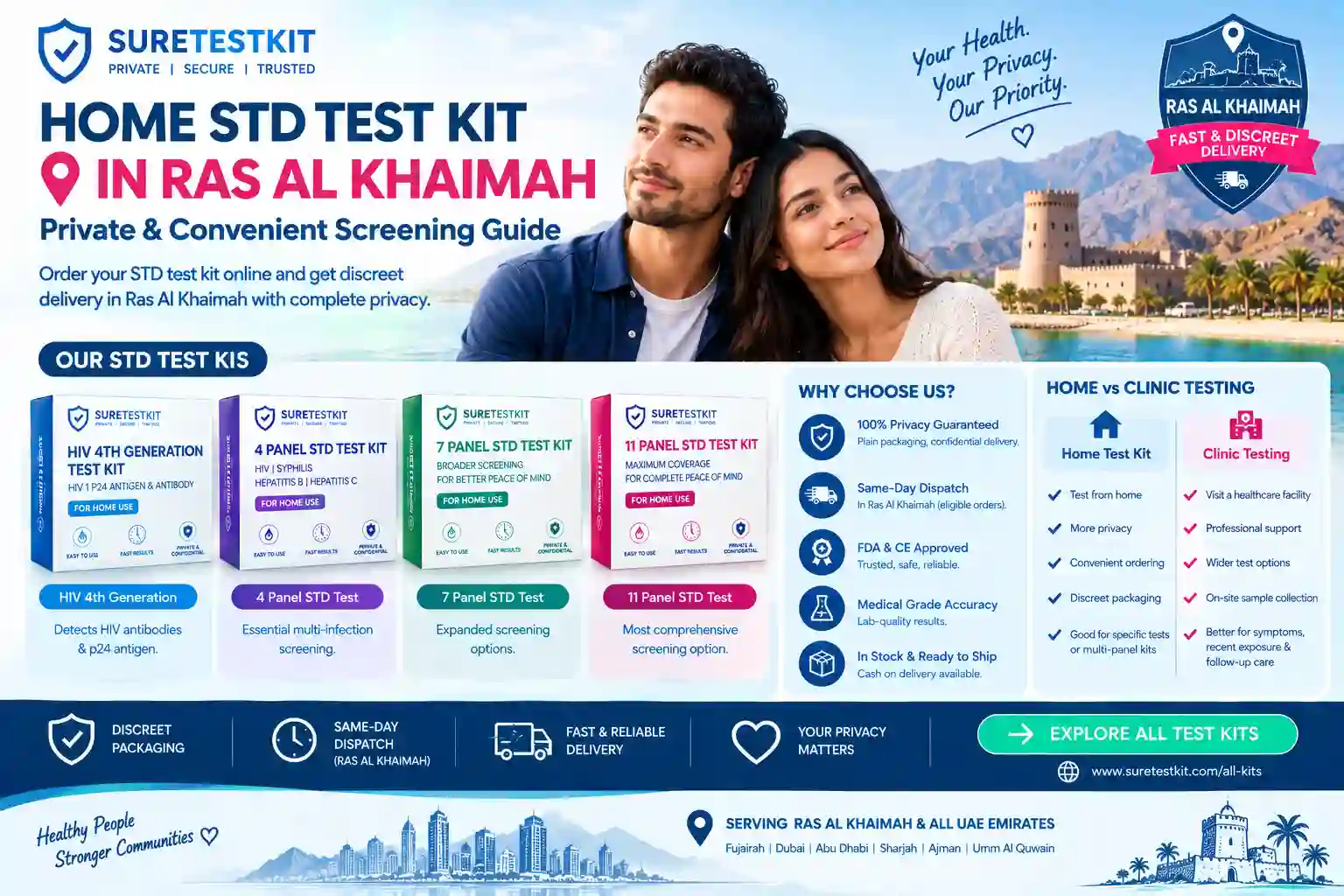
Home STD Test Kit in Ras Al Khaimah: Private & Convenient Screening Guide (2026)
Taking care of your sexual health is an important part of overall well-being. Yet, many people delay screening because they feel uncomfortable discussing personal concerns, have busy schedules, or are unsure which test they need.If you live in Ras Al Khaimah, understanding your options can help you make a more informed decision. Home STD test kits may provide a convenient way to begin screening for certain infections, while healthcare facilities offer professional assessment, laboratory testing, and treatment when needed.Whether you are searching for an HIV test kit, an individual STI test, or a multi-panel screening option, the key is to choose a test that matches your needs and understand its limitations.This guide explains how to compare home STD test kits in Ras Al Khaimah, what to consider before ordering online, and when professional medical care is important.1. Can You Order an STD Test Kit Online in Ras Al Khaimah?Online shopping makes it possible to compare health-screening products without visiting multiple stores. Depending on the product and applicable requirements, a home test kit may allow you to carry out an initial screening test at home.When ordering an STD test kit online, check the following details:Intended use: Confirm which infection or marker the test is designed to detect.Sample type: Different tests may require blood, urine, a swab, or another sample.Testing method: Determine whether the kit is a rapid test or a sample-collection kit intended for laboratory processing.Instructions: Read the requirements for sample collection, timing, and result interpretation.Limitations: Understand the test's window period and whether confirmatory testing may be needed.Delivery: Confirm availability, delivery charges, and estimated arrival time for your address.SureTestKit offers an online collection of HIV and STI-related screening products for customers in the UAE. You can begin by browsing the SureTestKit home page or comparing products in the complete test kit collection.Remember that a home screening kit does not replace a medical assessment when you have symptoms, a recent possible exposure, or a result requiring confirmation.2. Which Home STD Test Kit Should You Choose?The right test depends on the infection you want to screen for, the time since possible exposure, and the type of test available.Choosing a kit simply because it includes more panels may not be the best approach. Start by identifying the specific screening targets and checking whether the test is suitable for your situation.HIV test kitsHIV tests differ in the markers they detect and how soon after exposure they may identify infection.For example, antibody tests detect antibodies produced by the immune system, while fourth-generation antigen/antibody tests are designed to detect both HIV antibodies and the p24 antigen. The window period depends on the specific test and testing method.You can review the HIV 1/2 antibody test kit and the HIV fourth-generation test kit.Before choosing a product, verify its intended use, sample requirements, instructions, and stated window period. A negative result obtained too early after exposure may need to be repeated.If a possible HIV exposure occurred within the last 72 hours, seek urgent medical assessment about post-exposure prophylaxis (PEP). Do not wait for a home test result before seeking advice.Syphilis screeningSyphilis can cause symptoms that are easily overlooked, and some people may have no noticeable symptoms. Testing decisions depend on exposure history, symptoms, and the type of test being used.The syphilis test kit is one product to review when comparing available screening options. Check the manufacturer's instructions and whether the test is intended for your circumstances.If you have a painless sore, rash, or other possible signs of syphilis, seek medical assessment rather than relying solely on a home test.Chlamydia and gonorrhea testingChlamydia and gonorrhea are common bacterial STIs, and either infection can occur without obvious symptoms.Testing typically requires an appropriate method and sample, often using a nucleic acid amplification test (NAAT). Depending on the exposure, testing from more than one body site may be recommended.Review the chlamydia test kit, gonorrhea test kit, and combined gonorrhea and chlamydia kit product specifications carefully.Do not assume a product is suitable solely from its name. Confirm its intended use, sample type, and testing method before purchasing.Multi-panel STD screeningMulti-panel products combine several screening targets, but the exact contents differ between products. They do not necessarily detect every STI or replace a clinician's recommended screening plan.You can compare the 4-panel STD test kit, 7-panel STD test cassettes, and 11-panel STD/STI test cassettes.Check the listed targets and intended use of each product before deciding which option fits your screening needs.3. Home STD Testing vs Clinic Testing in Ras Al KhaimahBoth home testing and clinic-based testing can have a role in sexual health screening. Neither is universally the best option for every person or every infection.ConsiderationHome STD Test KitClinic-Based TestingConvenienceCan be used at home if designed for home useRequires arranging a visit or clinic servicePrivacyOffers a private setting for initial screeningPrivacy depends on the facility's proceduresTesting optionsDepends on the specific kitMay provide more test methods and sample typesProfessional guidanceUsually relies on the product instructionsHealthcare professionals can assess individual needsSymptomsNot a substitute for clinical assessmentAppropriate for evaluation of symptomsReactive resultsMay require confirmatory testingFollow-up testing and treatment may be arrangedRecent exposureWindow periods still applyA clinician can advise on urgent steps and testing schedulesIf you are asymptomatic and want to explore an appropriate screening option, a home test may be convenient. If you have symptoms, need a tailored testing plan, or are concerned about a recent exposure, seek professional medical advice.For a broader comparison, read our guide to STD test kits versus clinic testing in the UAE.4. How Accurate Are Home STD Test Kits?Accuracy depends on the specific product and how it is used. It is not possible to make one accuracy claim that applies to all home STD test kits.Several factors influence the reliability of a result.The testing method: Different methods detect different biological markers and are intended for different uses.The window period: A test may not detect an infection immediately after exposure. The relevant window period varies by infection and test type.Sample collection: Using the wrong sample or collecting it incorrectly can affect the result.Following instructions: Observe the specified procedure and read results only within the manufacturer's stated time window.Confirmatory testing: A reactive screening result may require additional testing before a diagnosis can be established.A negative result does not always rule out infection, particularly if testing took place too early or the wrong test was used.If you are concerned about a result, possible exposure, or persistent symptoms, speak with a qualified healthcare professional.5. Is Discreet STD Test Kit Delivery Available in Ras Al Khaimah?Privacy is one reason some people prefer to explore online screening options. Ordering a suitable test online may reduce the need to purchase a product in person, but privacy also depends on how the seller handles orders, payments, customer information, and delivery.Before placing an order, review the following:Whether the parcel is plain or discreetly packaged.What information appears on the outer packaging.How delivery notifications are sent.Which payment methods are available.How your personal information is handled.Whether someone else may receive the parcel at your delivery address.SureTestKit states that it offers discreet packaging and delivery across the UAE. Review the current policies and delivery information on the website before ordering.A discreet parcel can help protect privacy during delivery, but no retailer should be assumed to offer complete anonymity across every stage of an online purchase.6. Delivery to Ras Al Khaimah: What Should You Know?Delivery time is an important consideration when choosing an online screening product.SureTestKit's stated delivery policy provides next-day delivery to emirates outside Dubai and Sharjah for eligible orders placed before 8 PM. Delivery availability and timing can depend on the order and destination, so confirm the latest estimate at checkout.Before completing your order, check:Whether the product is in stock.Whether your delivery address is covered.The applicable delivery charge.The estimated arrival date.The available payment methods, including whether cash on delivery is offered for your order.If you need urgent medical attention, do not wait for a test kit to arrive. Seek appropriate care, especially after a recent possible HIV exposure or if you have severe or worsening symptoms.7. When Should You Visit a Healthcare Professional?A home STD test kit may be useful for certain screening situations, but professional care is important in several circumstances.You have symptomsSeek medical assessment if you notice genital sores, unusual discharge, pain during urination, pelvic pain, testicular pain, or a new rash that concerns you. These symptoms can have several causes, and a clinician can help determine the appropriate testing and treatment.You may have been exposed recentlyDifferent infections have different window periods. A healthcare professional can help you decide which tests to take now and whether repeat testing is necessary.For possible HIV exposure within 72 hours, seek urgent assessment for PEP.Your result is reactive or positiveFollow the test instructions and arrange the recommended confirmatory testing. A reactive screening result is not always a final diagnosis.You need treatment or follow-upA test kit does not treat an infection. A healthcare professional can advise on treatment, additional testing, and whether sexual partners should be informed or tested.8. How to Choose the Right STD Test Kit Before OrderingUse this practical checklist before buying a home STD test kit in Ras Al Khaimah.Step 1: Identify the screening target. Decide which infection or infections you need to discuss or screen for.Step 2: Check the sample type. Ensure that the required blood, urine, or swab sample matches the product's intended use.Step 3: Understand the testing window. Check how soon after possible exposure the test can be used and whether repeat testing may be needed.Step 4: Read the product instructions. Review the test's limitations and the procedure for interpreting results.Step 5: Consider whether a clinic is more appropriate. Symptoms, recent exposure, or complex screening needs may require professional assessment.Step 6: Plan for follow-up. Know where you can obtain confirmatory testing or medical advice if the result is reactive, invalid, or inconsistent with your symptoms.Step 7: Confirm delivery details. Review availability, charges, payment methods, and estimated arrival time before ordering.If you are unsure which tests you need, a healthcare professional can help you choose a suitable screening plan.Frequently Asked QuestionsCan I order an STD test kit online in Ras Al Khaimah?You can explore online screening products offered for delivery in the UAE, subject to product availability and applicable requirements. Check the product's intended use, delivery coverage, sample requirements, and instructions before ordering.Which STD test kit is best for Ras Al Khaimah residents?There is no single best kit for everyone. The appropriate option depends on which infections you need to screen for, the time since possible exposure, and whether the product is suitable for home use. Compare the exact panel contents and testing methods before making a decision.Can I use an HIV test kit after recent exposure?The timing matters because HIV tests have different window periods. If possible exposure occurred within the past 72 hours, seek urgent medical advice about PEP. Do not delay care while waiting to test.Does a negative home STD test mean I am infection-free?Not necessarily. Testing too early, using an unsuitable test, or collecting a sample incorrectly can affect the result. Follow the test's instructions and seek professional guidance if you remain concerned.Are multi-panel STD test kits better than individual tests?Not automatically. A multi-panel kit may screen for several targets, but it may not include every infection you need to consider. An individual test may be more appropriate for a specific testing need. The right choice depends on your circumstances and the product's intended use.Is discreet delivery available across the UAE?SureTestKit states that it offers discreet packaging and UAE-wide delivery. Check the current delivery policy and checkout information to confirm the arrangements for your address.Should I use a home test if I have symptoms?Symptoms warrant professional medical assessment. A home screening kit should not replace evaluation, particularly when you may need a specific sample, additional diagnostic testing, or treatment.What should I do after a reactive home test result?Follow the instructions supplied with the product and arrange appropriate confirmatory testing through a healthcare provider. Avoid treating a screening result as a final diagnosis without the recommended follow-up.Conclusion: Explore Suitable Screening Options in Ras Al KhaimahChoosing a home STD test kit in Ras Al Khaimah starts with understanding what you need to test for, which testing method is suitable, and when a result can be trusted.Home screening may offer convenience for certain situations, while clinic testing provides access to professional assessment, additional diagnostic options, and treatment when necessary.Before ordering, review the product specifications, window period, sample requirements, and follow-up instructions. If you have symptoms or are concerned about a recent exposure, seek appropriate medical advice rather than relying on a home test alone.To compare available products, visit the SureTestKit collection and review each product's intended use before choosing.
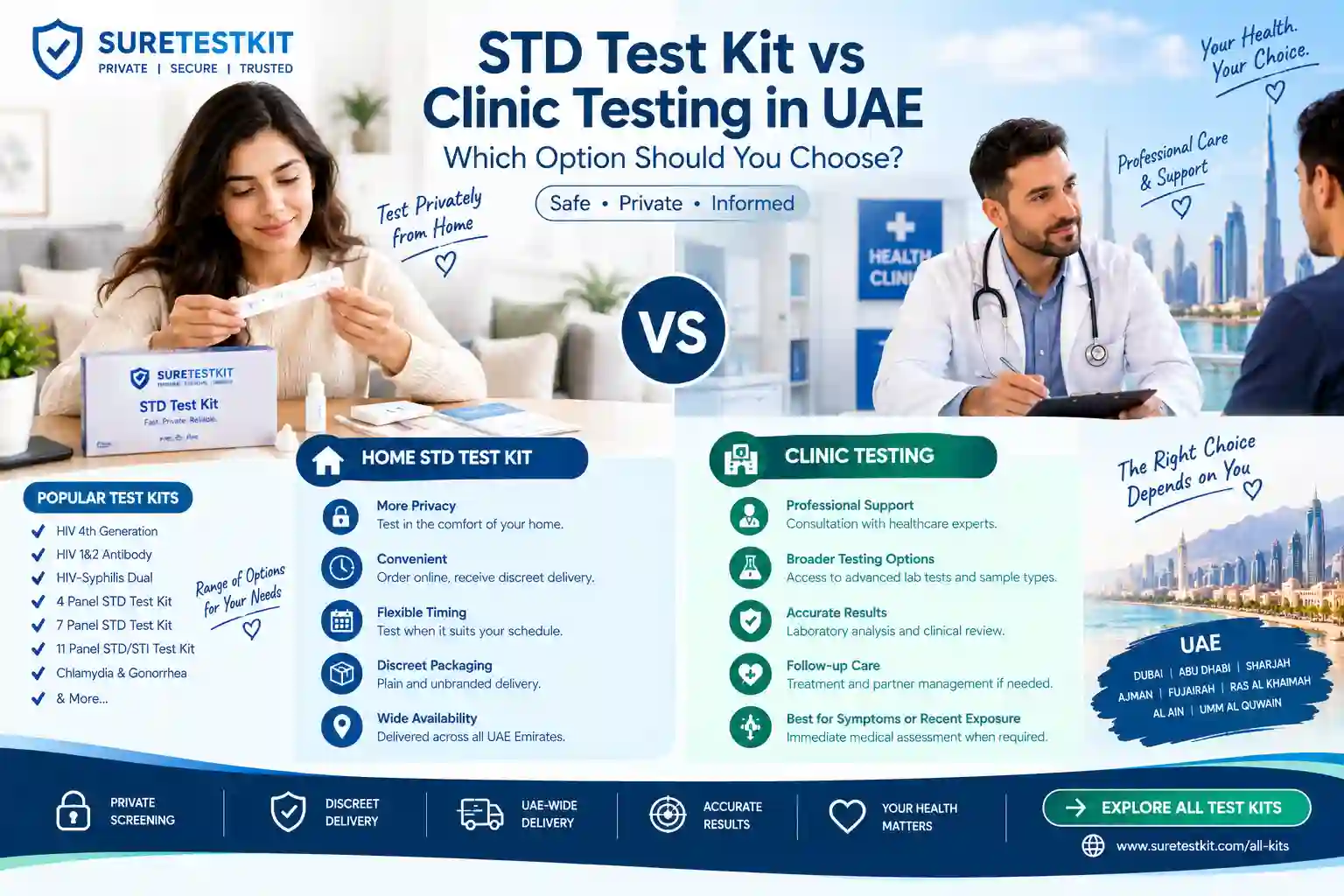
STD Test Kit vs Clinic Testing in UAE: Which Option Should You Choose? (2026 Guide)
When considering sexual health screening, one of the first questions people ask is whether they should use a home STD test kit or visit a clinic. Both options can play a role in identifying sexually transmitted infections (STIs), but they differ in convenience, the type of testing available, professional support, and how results are confirmed.For people living in Dubai, Abu Dhabi, Sharjah, Ajman, Fujairah, and other parts of the UAE, understanding these differences can make it easier to choose an appropriate screening option.Home test kits may offer convenience and privacy, while clinic-based testing can provide professional assessment, laboratory testing, and guidance about follow-up care. The most suitable option depends on the infection being tested for, the time since possible exposure, your symptoms, and the specific test being considered.In this guide, we compare STD test kits and clinic testing in the UAE to help you make a more informed decision.1. What Is a Home STD Test Kit?A home STD test kit is a product designed to help users screen for one or more sexually transmitted infections without necessarily visiting a clinic for the initial test.However, not all home test kits work in the same way. Some are rapid screening devices intended for use at home, while others are collection kits that require a sample to be sent to a laboratory. The type of sample, testing method, and instructions depend on the specific product.Common screening categories include:HIV screeningSyphilis screeningHepatitis B and hepatitis C screeningChlamydia and gonorrhea testingHerpes-related testingMulti-panel STI screening optionsImportant: A test kit's listed targets do not automatically mean it can detect every infection at every stage. Check the product's intended use, sample requirements, approved testing method, and instructions before purchasing.You can explore the available options in the SureTestKit product collection.2. What Is Clinic-Based STD Testing?Clinic-based STD testing involves assessment or testing through a healthcare facility, medical laboratory, or qualified healthcare professional.Depending on the infection and clinical situation, testing may involve blood, urine, or swab samples. A clinician can help select suitable tests based on symptoms, exposure history, and the time elapsed since possible exposure.Clinic testing may be particularly useful when:You have symptoms such as unusual discharge, sores, pain during urination, or genital discomfort.You may have been exposed to an STI recently.You need testing that requires a laboratory or a particular type of sample.You need help interpreting a result.A screening result is reactive or positive and requires confirmation.You need treatment, follow-up testing, or partner-management advice.A clinic is not necessarily the only appropriate first step for every screening situation, but professional care is important whenever symptoms, recent exposure, or a result requiring follow-up are involved.3. Home STD Test Kit vs Clinic Testing: Key DifferencesThe table below provides a general comparison. Actual performance and suitability depend on the specific test, infection, and healthcare provider.FeatureHome STD Test KitClinic-Based TestingConvenienceCan be used at home if the product is intended for home useRequires attending a facility or arranging a clinic servicePrivacyAllows screening at home; delivery and packaging policies varyPrivacy depends on the facility and its proceduresTest optionsDepends on the kit and its intended useMay offer a wider range of tests and sample typesProfessional guidanceMay be limited to the instructions providedClinicians can assess symptoms and exposure historyResult interpretationRequires following the product instructions carefullyProfessional assistance may be availableConfirmation of a reactive resultFurther testing may be requiredClinicians can arrange appropriate confirmatory testingSymptoms or complicationsNot a substitute for medical assessmentBetter suited to clinical assessment and treatment planningWindow periodsVary by test and infectionAlso vary by test and infectionThe most important distinction is not simply where the test is performed. It is whether the specific test is appropriate for your circumstances and whether you can access follow-up care if needed.4. Which Option Is More Accurate?It is not medically accurate to say that every home test is less accurate than every clinic test—or that home testing is always equally reliable.Accuracy depends on several factors:Testing method: Different technologies detect different markers of infection.Test quality: Products differ in performance and intended use.Timing: Testing too soon after exposure can produce a negative result even when an infection is present.Sample collection: Incorrect sample collection can affect results.Test procedure: Failure to follow the instructions may compromise the result.Interpretation: Rapid tests must be read according to the manufacturer's specified procedure and time window.A negative result should not automatically be treated as conclusive if testing occurred during the relevant window period.Likewise, a reactive screening result does not always establish a diagnosis. Follow the test instructions and obtain the recommended confirmatory testing through an appropriate healthcare provider.For more details, read our guide to how accurate home STD test kits are.5. Understanding the HIV Testing Window PeriodThe HIV window period is the time between possible exposure to HIV and the point when a particular test can reliably detect the infection.Different HIV tests have different window periods. For example, antibody tests and laboratory-based antigen/antibody tests do not necessarily detect infection at the same time.A negative result obtained too early may need to be repeated after the relevant window period. Follow the instructions for your specific test and seek professional advice if you are unsure when to test.If a possible HIV exposure occurred within the last 72 hours, seek urgent medical advice about post-exposure prophylaxis (PEP). PEP is time-sensitive, and you should not wait for a home test result before seeking assessment.Explore the HIV 1/2 antibody test kit or learn about the HIV fourth-generation test kit. Before choosing either product, verify its intended use, sample requirements, and testing window.6. When Is a Home STD Test Kit a Practical Choice?A home test kit may be a practical screening option when you:Prefer to perform an appropriate screening test at home.Want to understand your screening options before visiting a healthcare facility.Are looking for a test designed for a specific infection.Want to compare individual and multi-panel screening products.Can follow the instructions and arrange medical follow-up if needed.For example, someone comparing individual HIV screening with a multi-panel product should first check which infections each kit is designed to screen for.A multi-panel kit may cover several targets, but it should not be assumed to cover every STI or replace a clinician's recommended screening plan.Individual vs multi-panel test kitsAn individual kit focuses on a particular infection or marker. A multi-panel product combines multiple screening targets, depending on the product's specifications.Consider these options from SureTestKit:HIV 1/2 antibody test kit — for the specific HIV screening purpose stated in the product instructions.Syphilis test kit — for syphilis screening as specified by the manufacturer.Chlamydia test kit — review the sample type and intended use carefully.Gonorrhea test kit — check which testing method and sample are required.4-panel STD test kit — review the listed screening targets and limitations before purchasing.7-panel STD test cassettes — check the exact panel contents and whether the product is suitable for your intended use.All available test kits — compare product specifications before choosing.Product-selection note: A blood-based rapid screening cassette is not interchangeable with a urine or swab-based test. In particular, chlamydia and gonorrhea testing commonly requires a suitable nucleic acid amplification test (NAAT) or another validated method. Verify the product's intended use rather than relying on its name alone.7. When Should You Choose Clinic Testing Instead?Clinic testing or professional medical assessment is particularly important in the following circumstances.You have symptomsSymptoms such as genital sores, unusual discharge, pelvic pain, testicular pain, or pain during urination deserve appropriate medical assessment. Some STIs cause few or no symptoms, so symptoms alone cannot establish which infection is present.Seek urgent medical care for severe pain, fever with significant pelvic or genital symptoms, or other rapidly worsening symptoms.You have had a recent possible exposureThe right testing schedule depends on the infection, the type of exposure, and the test. A healthcare professional can help determine which tests are appropriate now and whether repeat testing will be needed.If HIV exposure may have occurred within the past 72 hours, seek urgent PEP assessment rather than waiting for testing.A result is reactive or positiveFollow the instructions supplied with the test and arrange appropriate confirmatory testing. Do not start or stop medication solely on the basis of an unconfirmed home screening result without suitable medical guidance.You need treatmentScreening identifies a possible need for further evaluation; it does not itself treat an infection. A healthcare provider can advise on treatment, follow-up, and whether partners should be notified or tested.8. How Much Does STD Testing Cost in the UAE?The cost varies according to the test, number of infections screened, testing method, healthcare facility, and whether consultation or follow-up is included.When comparing a home kit with clinic testing, consider the total cost, not only the advertised price.For a home kit, check:The listed product price.Delivery charges, if any.Whether the kit is intended for home use.Whether laboratory processing is included or required.Whether confirmatory testing may incur an additional cost.For clinic testing, ask whether the quoted fee includes the consultation, sample collection, laboratory analysis, and result review.A lower upfront price does not necessarily mean a lower overall cost if additional testing or a clinical consultation is needed.9. Is Home STD Testing Private in the UAE?Privacy is a common consideration when people explore sexual health screening. A home test allows you to carry out the initial screening in a familiar environment, while online ordering may reduce the need to discuss the purchase in person.However, privacy depends on the retailer's data-handling practices, delivery arrangements, payment method, and the product's intended use.Before ordering, review:The seller's privacy policy.Whether the parcel is discreetly packaged.How order updates and delivery notifications are sent.The available payment methods.How the product is delivered and whether someone else may receive it.SureTestKit offers online ordering and discreet packaging according to its stated service policies. Check the current delivery and payment details on the website before placing an order.You can begin by browsing the SureTestKit home page or viewing the complete kit collection.10. Home STD Test Kit Delivery Across the UAEConvenience also depends on whether a product can be delivered to your location and how quickly it arrives.When ordering online, confirm the current delivery estimate for your emirate, the dispatch cut-off time, and whether cash on delivery is available for your order.SureTestKit's stated delivery arrangements include same-day delivery in Dubai and Sharjah for eligible orders placed before 8 PM, and next-day delivery in other emirates for eligible orders placed before 8 PM. Availability and timing should be confirmed at checkout.Wherever you live in the UAE, do not delay urgent medical assessment while waiting for a delivery if you have symptoms or a time-sensitive exposure.11. How to Choose the Right Screening OptionBefore buying a home STD test kit or arranging clinic testing, work through these questions:Which infection do I need to screen for? A test for one infection does not rule out other STIs.How long has it been since possible exposure? The relevant window period can change the best time to test.Do I have symptoms? If so, professional assessment may be more appropriate than relying on a home screening kit alone.What sample does the test require? Make sure the method is suitable for the infection being tested.What does the product actually detect? Review the intended use, limitations, and instructions.What happens if the result is reactive or invalid? Understand the recommended next steps before testing.Can I obtain follow-up care? Have a plan for confirmatory testing and treatment if necessary.If you are unsure which screening option is appropriate, a qualified healthcare professional can help you choose based on your circumstances.Frequently Asked QuestionsIs a home STD test kit as accurate as clinic testing?It depends on the specific test, the infection, the sample, the timing, and how the test is performed. Some home tests are validated for particular uses, while other testing needs laboratory analysis. Compare the test's specifications and follow the recommended confirmation process.Can I test for STDs at home in the UAE?Home screening options may be available, depending on the product and its intended use. Before ordering, check the manufacturer's instructions, sample requirements, and any applicable UAE requirements. Seek professional care for symptoms, recent exposure, or results that require confirmation.Does a negative home STD test mean I do not have an STI?Not necessarily. A negative result may be unreliable if the test was taken during the relevant window period, if the wrong test was used, or if sample collection was incorrect. Some infections require different tests or testing at more than one body site.Should I use a home test if I have STD symptoms?Do not rely on a home test as a substitute for medical assessment when symptoms are present. A clinician can evaluate possible causes, select appropriate tests, and recommend treatment if needed.What should I do if my home HIV test is reactive?Follow the kit's instructions and arrange prompt confirmatory testing through an appropriate healthcare provider. A reactive screening result is not, by itself, a final HIV diagnosis. If a possible exposure occurred within the past 72 hours, seek urgent advice about PEP regardless of a home test result.Is clinic testing always better than home testing?Neither option is universally best. Home testing can be convenient for suitable screening situations, while clinic testing provides access to professional assessment, a broader range of diagnostic methods, and follow-up care. The right choice depends on the clinical circumstances and the test.Can one multi-panel STD test kit detect every STI?No. The infections and markers included vary by product, and a panel may not cover every STI or every relevant body site. Check the exact product specifications and ask a healthcare professional whether additional tests are recommended.How do I choose between an individual and a multi-panel test kit?Start with the infections you need to screen for, the type of sample required, and the test's intended use. A multi-panel product may combine several targets, but the panel should match your screening needs rather than being selected solely because it contains more tests.ConclusionChoosing between an STD test kit and clinic testing in the UAE comes down to the type of screening you need, the timing of possible exposure, your symptoms, and the follow-up support available.A suitable home test may offer convenience and privacy for initial screening. Clinic testing is especially important when symptoms are present, exposure is recent, a result requires confirmation, or treatment may be needed.Before purchasing a test, review its intended use, sample requirements, limitations, and window period. If you are uncertain about the right testing schedule or the meaning of a result, seek professional medical advice.Explore the SureTestKit collection to compare available products and their specifications.
Home STD Test Kit in Fujairah: Private & Convenient Screening Guide (2026)
Looking for a home STD test kit in Fujairah can be a convenient option if you prefer private screening from home.Whether you're looking for an HIV test, a specific STI test, or a broader multi-panel screening option, choosing the right kit depends on what you want to screen for and the type of test available.For people in Fujairah, home testing can provide an alternative to arranging an in-person visit simply to purchase or begin a screening test. With online ordering and discreet packaging, the process can be completed privately.SureTestKit provides HIV and STD test kits for customers across the UAE, including Fujairah, with discreet packaging and delivery.This guide explains:How home STD testing worksWhich HIV and STD test kits are availableHow to choose between individual and multi-panel testsWhat discreet delivery meansWhat to consider when testing at homeCommon questions about STD testing in Fujairah Why Consider Home STD Testing in Fujairah?There are several reasons someone may prefer a home screening option.PrivacySexual health testing is personal. Some people simply feel more comfortable ordering and testing privately at home.ConvenienceOnline ordering means you don't have to arrange a visit just to obtain a home screening kit.Flexible TimingDepending on the test and its instructions, you can complete the screening at a time that is convenient for you.Discreet DeliveryA discreet package can help protect your privacy during delivery.Different Screening OptionsYou can choose between individual tests and multi-panel options depending on the type of screening you're looking for. How Does Home STD Testing Work?The process is generally straightforward, but you should always follow the specific instructions supplied with the test you purchase.Step 1: Choose Your TestFirst, decide whether you need an individual test or a broader screening panel.For example, SureTestKit offers individual tests for conditions such as HIV, chlamydia, gonorrhea, syphilis, hepatitis B, hepatitis C, and herpes, as well as multi-panel options.Step 2: Order OnlineChoose your product and provide your delivery details during checkout.Step 3: Receive Your PackageYour order is delivered in discreet packaging.Step 4: Read the InstructionsBefore testing, carefully read the manufacturer's instructions, including information about the sample type, testing procedure, timing, and interpretation of results.Step 5: Interpret the Result CorrectlyA home screening result needs to be interpreted according to the specific test instructions.If a result is reactive or positive, follow the manufacturer's guidance and seek appropriate healthcare evaluation and confirmatory testing where recommended. Which STD Test Kit Should You Choose in Fujairah?There is no single test kit that is appropriate for everyone.Your choice should depend on what you want to screen for.SureTestKit offers both individual STI tests and multi-panel screening kits. 1. HIV Test KitsIf your primary concern is HIV, you can choose from different HIV screening options.HIV 4th Generation Test KitThe HIV 4th Generation option is designed to detect HIV-related markers including HIV antibodies and p24 antigen, according to the specific product's instructions.This can be an option for people specifically looking for an HIV screening test.HIV ab/ag p24 4th Generation Test Kit 2. HIV & Syphilis Dual Test KitIf you want to screen for both HIV and syphilis, a dual test can provide a convenient two-target screening option.HIV-Syphilis Test KitThis may be useful for people who want more than HIV screening but don't necessarily need a large multi-panel kit. 3. 4 Panel STD Test KitThe 4 Panel STD Test Kit is designed for broader screening and includes:HIVSyphilisHepatitis BHepatitis CThis can be an option for customers who want to screen for several infections rather than purchasing individual kits.4 Panel STD Test Kit 4. 7 Panel STD Test KitThe 7 Panel STD Test Kit provides a broader screening option than a smaller panel.It may be considered by customers who want expanded screening in one multi-panel product.7 Panel STD Test Kit 5. 11 Panel STD/STI Test KitFor customers looking for the broadest multi-panel option available from SureTestKit, the 11 Panel STD/STI Test Kit provides expanded screening.It can be considered when someone wants to screen for multiple infections rather than selecting several individual kits.11 Panel STD/STI Test Kit Individual STD Test Kits in FujairahNot everyone needs a multi-panel test.If you're specifically looking for a particular STI screening option, an individual test may be more appropriate.SureTestKit offers individual products including:Chlamydia Test KitGonorrhea Test KitSyphilis Test KitHepatitis B Test KitHepatitis C Test KitHerpes Test KitHPV Test KitMycoplasma Test KitChoosing an individual test can make sense when you are specifically interested in one infection. Individual Test vs Multi-Panel TestNot sure whether you need one test or several?Consider the difference:Screening GoalPossible OptionHIV onlyHIV Test KitHIV + SyphilisHIV-Syphilis Dual TestHIV + Syphilis + Hepatitis B + Hepatitis C4 PanelBroader screening7 PanelMore comprehensive multi-panel screening11 PanelSpecific STI concernIndividual STI TestThe number of panels should not be the only consideration. Make sure the infections included in the kit actually match what you want to screen for. Is Home STD Testing Private?Privacy is one of the main reasons people choose home testing.With discreet delivery, the package is designed to avoid unnecessarily revealing the nature of the purchase.For customers ordering sexual health products, this can be particularly useful if:You share a home with other people.You don't want the contents discussed during delivery.You prefer ordering online.You want to manage your screening privately.SureTestKit uses discreet packaging for orders delivered across the UAE. STD Test Kit Delivery in FujairahSureTestKit delivers HIV and STD test kits to customers in Fujairah.Delivery availability and timing can depend on the order and destination.For Fujairah and other Emirates outside Dubai and Sharjah, customers should check the current delivery information during checkout.If you are ordering because you want to test at a particular time, remember that delivery time and the appropriate testing window are two different things. Receiving a kit quickly does not necessarily mean that testing immediately after a possible exposure will provide a definitive result. When Should You Take an STD Test?The appropriate time to test depends on:The infection being tested forThe type of testWhen a possible exposure occurredWhether symptoms are presentThe manufacturer's testing guidanceDifferent infections have different window periods.For example, HIV tests do not all detect infection at exactly the same time after exposure. A test taken too early may not detect an infection even if exposure occurred.If you are concerned about a recent exposure, consult a qualified healthcare professional about the appropriate timing and whether repeat or laboratory testing is recommended. What If You Have Symptoms?Home testing should not replace professional medical care when you have concerning symptoms.Symptoms such as unusual discharge, sores, genital irritation, pain during urination, rashes, or other changes may have different causes.If you have symptoms, seek appropriate medical advice rather than relying only on a home test.Likewise, if you have had a known exposure to an STI or HIV, professional medical guidance can help determine which tests are appropriate and when they should be performed. What Happens If a Home Test Is Positive?A reactive or positive screening result should be taken seriously, but the next step depends on the specific test.For many infectious diseases, an initial reactive screening result requires confirmatory testing or professional evaluation.Do not assume that a home screening result by itself establishes a final diagnosis.If your result is reactive:Read the manufacturer's instructions.Contact a qualified healthcare professional.Arrange appropriate confirmatory testing where recommended.Follow medical advice regarding treatment and prevention.If you have symptoms or believe you may have been recently exposed to HIV, seek medical care promptly rather than waiting for a home test. Why Choose a Multi-Panel Test?Multi-panel tests can be convenient because they combine screening for multiple targets.Instead of purchasing several individual products, a multi-panel kit can provide broader screening through one product.This can be useful for people who:Want broader screeningAre unsure which individual infection to test forPrefer a single multi-panel optionWant to compare different levels of screeningHowever, broader does not automatically mean medically necessary. The right screening approach depends on your individual circumstances and healthcare guidance. Home STD Testing for Couples in FujairahCouples may also consider sexual health screening together.Testing together can provide an opportunity to discuss:Sexual healthPrevious testingSafer-sex practicesFuture screeningWhen to seek medical adviceSome couples may prefer an individual HIV test, while others may choose a broader multi-panel option.The choice should be based on the screening needs of both partners rather than simply selecting the largest panel. Who May Consider Home STD Screening?Home screening may be considered by people who:Want convenient access to screeningPrefer private testingWant to screen after a potential riskAre planning a new relationshipWant routine sexual health screeningPrefer ordering test kits onlineHowever, people with symptoms, known exposure, or significant concerns should consider professional medical advice as well. Frequently Asked QuestionsCan I order an STD test kit in Fujairah?Yes. SureTestKit provides HIV and STD test kits with delivery available to customers in Fujairah.Can I order an HIV test kit in Fujairah?Yes. Several HIV screening options are available, including HIV antibody and HIV 4th Generation products.Which STD test kit is suitable for broader screening?SureTestKit offers 4 Panel, 7 Panel, and 11 Panel options. The appropriate choice depends on which infections you want to screen for.Is STD test kit delivery discreet?SureTestKit uses discreet packaging for HIV and STD test kit orders.Can I order individual STI tests?Yes. Individual options include tests for conditions such as chlamydia, gonorrhea, syphilis, hepatitis B, hepatitis C, herpes, HPV, and mycoplasma.Is a positive home test a final diagnosis?Not necessarily. Depending on the test, a reactive result may require confirmatory testing or professional evaluation.Can I test immediately after possible exposure?Testing immediately after exposure may be too early for some infections. The appropriate testing window varies by infection and test type. Follow the product instructions and seek healthcare guidance when appropriate. Key TakeawaysHome STD testing can provide privacy and convenience for people in Fujairah.SureTestKit offers individual HIV and STI tests as well as multi-panel options.4 Panel, 7 Panel, and 11 Panel kits provide different levels of screening.Discreet packaging helps protect customer privacy.Testing windows vary between infections and test types.A reactive home screening result may require confirmatory testing.Anyone with symptoms or a known recent exposure should consider professional medical advice. ConclusionIf you're searching for an STD test kit in Fujairah, home screening can provide a convenient and private way to access sexual health testing.SureTestKit offers a range of options, from individual HIV, chlamydia, gonorrhea, syphilis, hepatitis, herpes, HPV, and mycoplasma test kits to broader 4 Panel, 7 Panel, and 11 Panel STD/STI screening kits.Choosing the right kit starts with understanding what you want to screen for. If you're unsure which test is appropriate—particularly after a recent exposure or if you have symptoms—consider speaking with a qualified healthcare professional.Explore all HIV and STD test kits from SureTestKit and choose the screening option that matches your needs.