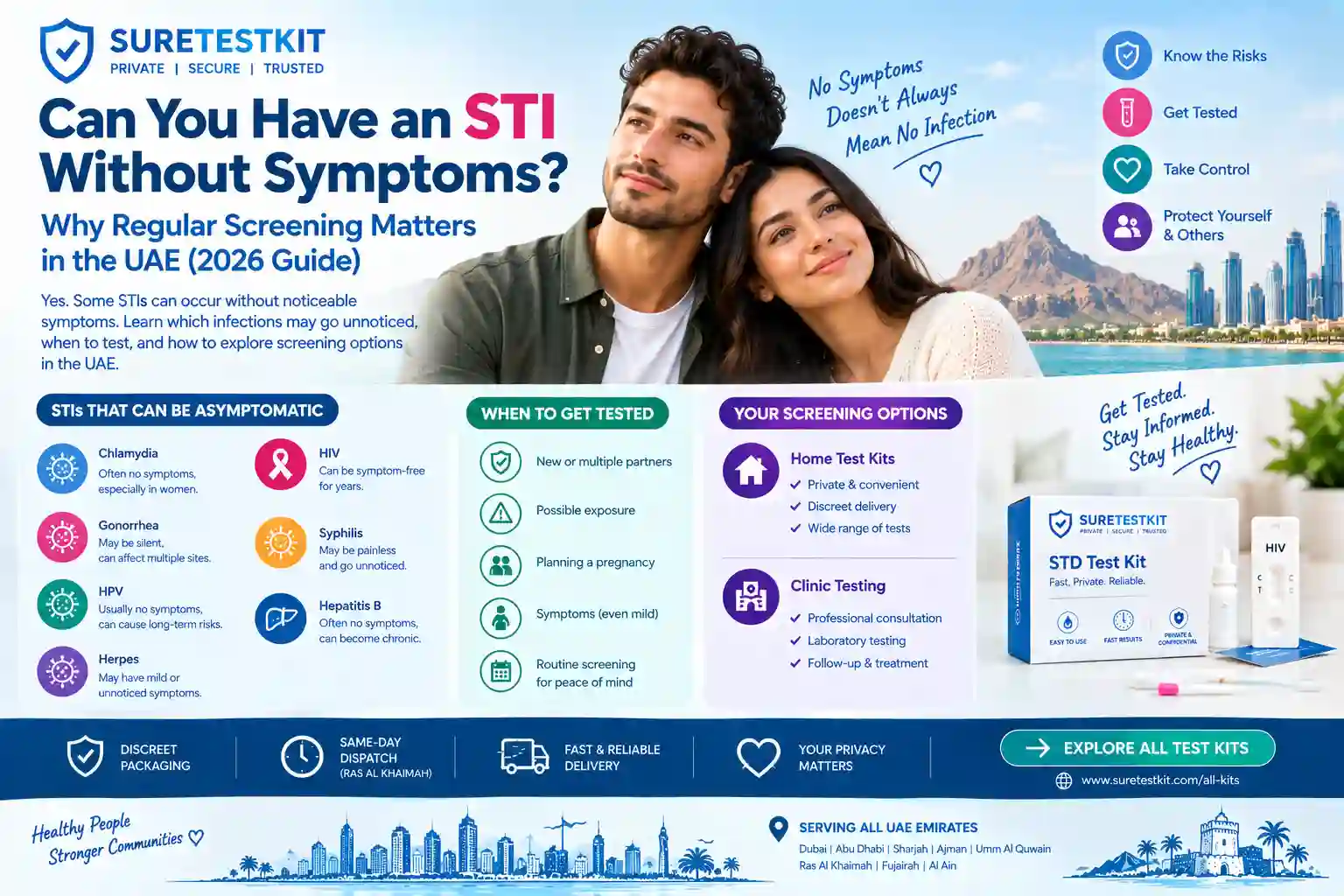
Can you have a sexually transmitted infection (STI) without noticing any symptoms? Yes. Some STIs can be present without obvious signs, meaning a person may feel completely well and still have an infection.
This is one reason sexual health screening matters. Waiting for symptoms before considering a test may delay diagnosis and treatment. It can also make it harder to know when an infection was acquired or whether a partner could have been exposed.
For people in Dubai, Abu Dhabi, Sharjah, Ajman, Fujairah, Ras Al Khaimah, and other parts of the UAE, understanding asymptomatic STIs can help support informed screening decisions.
In this guide, we explain which infections may go unnoticed, when testing may be appropriate, how home screening options differ, and when professional medical advice is important.
1. What Does It Mean to Have an STI Without Symptoms?
An asymptomatic STI is an infection that does not cause noticeable symptoms at a particular time.
Some infections never cause obvious symptoms in certain people. Others may cause mild symptoms that are overlooked, disappear temporarily, or resemble another health condition.
For example, a person may not notice changes in their health even when an infection is present. The absence of symptoms does not reliably establish whether an STI is present or absent.
It is also important to distinguish between two situations:
Asymptomatic infection: An infection is present, but noticeable symptoms are absent.
No infection: Testing and clinical assessment do not identify an infection, although the meaning of a negative result depends on the test used and when it was taken.
You cannot reliably distinguish between these situations based on how you feel alone. When testing is appropriate, a suitable diagnostic test provides more useful information than symptoms alone.
2. Which STIs Can Occur Without Symptoms?
Several sexually transmitted infections can be asymptomatic. The likelihood of symptoms varies by infection, individual circumstances, and the body site affected.
Chlamydia
Chlamydia frequently causes no noticeable symptoms. When symptoms do occur, they may include unusual genital discharge, pain during urination, pelvic discomfort, or testicular pain.
Untreated chlamydia can lead to complications, including pelvic inflammatory disease in some women and other reproductive health problems.
Because symptoms may be absent, testing can be important after a relevant exposure or when recommended by a healthcare professional.
Learn more about the chlamydia test kit and confirm which testing method and sample type are appropriate for the intended use.
Gonorrhea
Gonorrhea may also occur without noticeable symptoms, particularly in some genital infections. Infections affecting the throat or rectum may be missed if testing focuses only on genital symptoms.
When symptoms appear, they can include discharge, pain during urination, rectal discomfort, or throat symptoms, depending on the site of infection.
A suitable test should be selected according to the exposure and body site. Nucleic acid amplification testing (NAAT) is commonly used to diagnose gonorrhea.
Review the gonorrhea test kit or the combined gonorrhea and chlamydia kit, paying close attention to the stated sample requirements and intended use.
Human papillomavirus (HPV)
HPV is common, and many infections cause no symptoms and clear naturally. Certain types can cause genital warts, while persistent infection with particular high-risk types can contribute to cancers.
There is no single routine HPV test suitable for every person or every body site. Screening recommendations depend on factors such as age, anatomy, medical history, and local guidance.
If you are concerned about HPV, consult a healthcare professional about appropriate screening rather than assuming that a general STI panel will detect it.
Herpes
Herpes simplex virus can be present without recognizable sores. Some people have mild symptoms that they do not identify as herpes, while others experience recurring blisters or ulcers.
When sores are present, a clinician may recommend a swab test. Blood tests have specific uses and limitations, and a positive antibody result does not necessarily establish when the infection was acquired or where it is located.
Explore the herpes 12 IgG/IgM test kit specifications carefully and seek professional guidance about whether that testing approach is appropriate for your circumstances.
HIV
HIV may cause flu-like symptoms during the early stage of infection, but not everyone notices them. A person can also have HIV without feeling unwell for a prolonged period.
Symptoms alone cannot determine HIV status. Testing is the reliable way to find out, but the appropriate test and timing matter.
You can review the HIV 1/2 antibody test kit or the HIV fourth-generation test kit to understand the available screening categories.
Different HIV tests have different window periods. A negative result taken too early after exposure may need to be repeated.
Urgent reminder: If a possible HIV exposure occurred within the past 72 hours, seek urgent medical advice about post-exposure prophylaxis (PEP). Do not wait for symptoms or a home test result before seeking assessment.
Syphilis
Syphilis can cause a sore that is often painless and may go unnoticed, especially if it occurs in a location that is difficult to see. Later symptoms can include a rash or other changes, but symptoms may disappear even when the infection remains.
Untreated syphilis can cause serious complications. If you think you may have been exposed, seek medical advice about appropriate testing and follow-up.
You can review the syphilis test kit, while confirming the test's intended use and whether additional testing is recommended.
Hepatitis B
Hepatitis B can be asymptomatic, particularly during chronic infection. Some people experience symptoms such as fatigue, nausea, abdominal discomfort, or jaundice, but others may not notice any changes.
Testing depends on the clinical context and the markers being assessed. Vaccination can prevent hepatitis B, but vaccination status and the need for testing should be discussed with a healthcare professional when relevant.
The hepatitis B self-test kit is one product to review. Confirm its intended use and whether its testing method is appropriate for your situation.
3. Why You Should Not Wait for Symptoms Before Testing
There are several reasons why screening may be appropriate even when you feel healthy.
Some infections are silent. You may not notice an infection, particularly during its early stages.
Symptoms are not specific. Discharge, irritation, pain, and sores can have multiple causes. They cannot reliably identify a particular STI without appropriate assessment.
Early treatment may prevent complications. Some untreated infections can cause reproductive health problems or other complications.
Partners may also need testing. If an infection is diagnosed, a healthcare professional can advise whether partners should be informed, tested, or treated.
Testing can clarify uncertainty. A suitable test, taken at the right time, can provide more meaningful information than trying to assess risk from symptoms alone.
Screening does not need to be approached with fear or embarrassment. It is a routine part of taking care of your health when recommended or warranted by your circumstances.
4. When Should You Consider STI Screening?
The right screening schedule depends on your sexual history, possible exposures, age, medical circumstances, and local clinical recommendations. There is no single schedule that applies to everyone.
Consider discussing testing with a healthcare professional if:
You have had sex without a barrier method and are concerned about possible exposure.
A current or previous partner has told you they have an STI.
You have a new partner and want to discuss screening together.
You have had multiple partners or other circumstances associated with increased exposure risk.
You are pregnant or planning a pregnancy and need advice about recommended screening.
You have symptoms that may be related to an STI.
A previous test was taken too early or follow-up testing was recommended.
A clinician can help determine which infections to test for and whether samples from different body sites are needed.
5. Can You Test for an STI at Home in the UAE?
Home screening products may offer a convenient option for certain testing situations, but the type of test matters.
Some products are rapid screening devices designed for use at home. Other home-testing services provide sample-collection kits that require a laboratory to process the sample.
These are not interchangeable. A product's suitability depends on its intended use, sample requirements, testing method, and limitations.
Before choosing a home STI test, check:
Which infection or marker the test detects.
Whether the test is designed for home use.
Which sample is required.
When the test can reliably be used after possible exposure.
Whether a reactive result requires confirmation.
Whether testing at a clinic would be more appropriate.
Browse the SureTestKit collection to compare available products and their stated specifications.
Home screening should not replace medical assessment when you have symptoms, need urgent evaluation, or may require treatment.
6. Individual STI Tests vs Multi-Panel Screening
If you are considering testing for more than one infection, it is important to understand what an individual test and a multi-panel product can—and cannot—tell you.
Individual tests
An individual test is designed to screen for a specific infection or marker. It may be appropriate when there is a particular testing need, provided the method and sample are suitable.
Examples include products intended for HIV or syphilis screening.
Multi-panel tests
A multi-panel product combines multiple screening targets, but the exact targets vary. The number of panels does not automatically indicate that a product is more suitable for every person.
Before purchasing a multi-panel kit, review the complete list of targets and confirm whether the test methods and sample types are appropriate.
For example, the 4-panel STD test kit lists HIV, syphilis, hepatitis B, and hepatitis C screening targets in its product name. Review the product details to understand exactly what it detects and what additional testing may be necessary.
A screening panel may not cover every STI. Chlamydia, gonorrhea, HPV, and herpes may require different approaches depending on the infection and the clinical situation.
7. What If You Have No Symptoms but Your Test Is Positive?
A positive or reactive result can be worrying, especially when you feel completely well. However, the next step is to follow the instructions for that particular test and arrange the recommended medical follow-up.
Here is a practical approach:
Read the result according to the test instructions. Check the specified reading time and whether the result is valid.
Do not assume a reactive screening result is a final diagnosis. Some tests require confirmatory testing.
Contact an appropriate healthcare provider. Ask which additional tests or assessments are needed.
Follow treatment recommendations. If an infection is confirmed, complete the recommended treatment and follow-up.
Ask about partner management. A clinician can advise whether recent partners need notification, testing, or treatment.
Follow guidance on sexual activity. Depending on the infection, you may need to avoid sexual contact or take specific precautions until treatment and follow-up requirements are met.
The absence of symptoms does not mean a confirmed infection is unimportant. At the same time, a screening result should be interpreted according to the specific test rather than treated as a diagnosis without appropriate confirmation.
8. What If Your STI Test Is Negative but You Still Have Concerns?
A negative result can be reassuring, but its meaning depends on the circumstances.
You may need further assessment if:
You tested before the relevant window period had passed.
You used a test that does not detect the infection you are concerned about.
The sample did not match the body site exposed.
You have symptoms despite a negative result.
A healthcare professional has recommended repeat testing.
For example, a urine test may not identify an infection at the throat or rectum. The appropriate sample depends on the type of exposure and the test.
If symptoms persist or you believe you may have been exposed, seek professional advice rather than relying on a single negative result.
9. Is Private STI Screening Available Across the UAE?
People may have different preferences when arranging sexual health screening. Some prefer a healthcare facility, while others value the convenience of exploring home screening products online.
When purchasing online, consider the retailer's privacy policy, packaging, delivery notifications, payment options, and handling of personal information.
SureTestKit states that it offers discreet packaging and delivery across the UAE. Its stated delivery arrangements include same-day delivery in Dubai and Sharjah for eligible orders placed before 8 PM, and next-day delivery in other emirates for eligible orders placed before 8 PM. Confirm current availability, charges, and estimated delivery at checkout.
Privacy arrangements can vary, and discreet packaging does not mean every part of an online transaction is anonymous. Review the relevant policies before placing an order.
10. Frequently Asked Questions
Can you have an STI without any symptoms?
Yes. Infections such as chlamydia, gonorrhea, HPV, herpes, HIV, syphilis, and hepatitis B may occur without noticeable symptoms in some people. Appropriate testing is needed to assess infection status.
Which STI is most likely to have no symptoms?
Several STIs can be asymptomatic, and the likelihood varies by infection, body site, and individual circumstances. Chlamydia, HPV, and HIV may go unnoticed in some people. No single symptom pattern can reliably rule an infection in or out.
Can an STI go away without treatment?
Some infections may clear naturally, while others can persist and cause complications without treatment. Symptoms disappearing does not necessarily mean an infection has cleared. Seek medical advice about the appropriate testing and treatment for the specific infection.
Should I get tested if my partner has no symptoms?
A partner's lack of symptoms does not establish that they do not have an STI. If you have concerns about exposure or a partner has received an STI diagnosis, ask a healthcare professional which tests and timing are appropriate.
Can a home STD test detect every STI?
No. Home test products differ in their targets, sample requirements, and testing methods. A single kit or panel may not cover every STI or every relevant body site.
How soon after sex should I get tested?
The timing depends on the infection and the test. Some infections may not be detectable immediately after exposure. A healthcare professional can advise on appropriate initial and repeat testing. If HIV exposure may have occurred within 72 hours, seek urgent PEP assessment.
Do I need a test if I feel completely healthy?
Not everyone needs the same screening schedule, but being symptom-free does not rule out an STI. Whether testing is appropriate depends on your exposures, history, and clinical recommendations.
What should I do if a home test is reactive?
Follow the product instructions and arrange appropriate confirmatory testing through a healthcare provider. Ask about treatment and partner management if an infection is confirmed.
Conclusion: Screening Matters Even When You Feel Healthy
Some sexually transmitted infections can be present without noticeable symptoms. That is why relying only on how you feel is not a dependable way to assess your sexual health.
The most useful approach is to understand your potential exposure, choose an appropriate test, follow the relevant window period, and seek medical advice when necessary.
Home screening may be convenient for certain situations, but it does not replace professional evaluation when symptoms, recent exposure, or confirmatory testing are involved.
If you are exploring screening options in the UAE, compare the intended use and limitations of products in the SureTestKit collection. Choose a test based on your needs—not simply on the number of infections listed on the package—and seek professional care whenever you are uncertain about the next step.
Disclaimer
This content is intended for informational purposes only and should not be considered a substitute for professional advice. Always consult with a qualified professional for specific concerns.