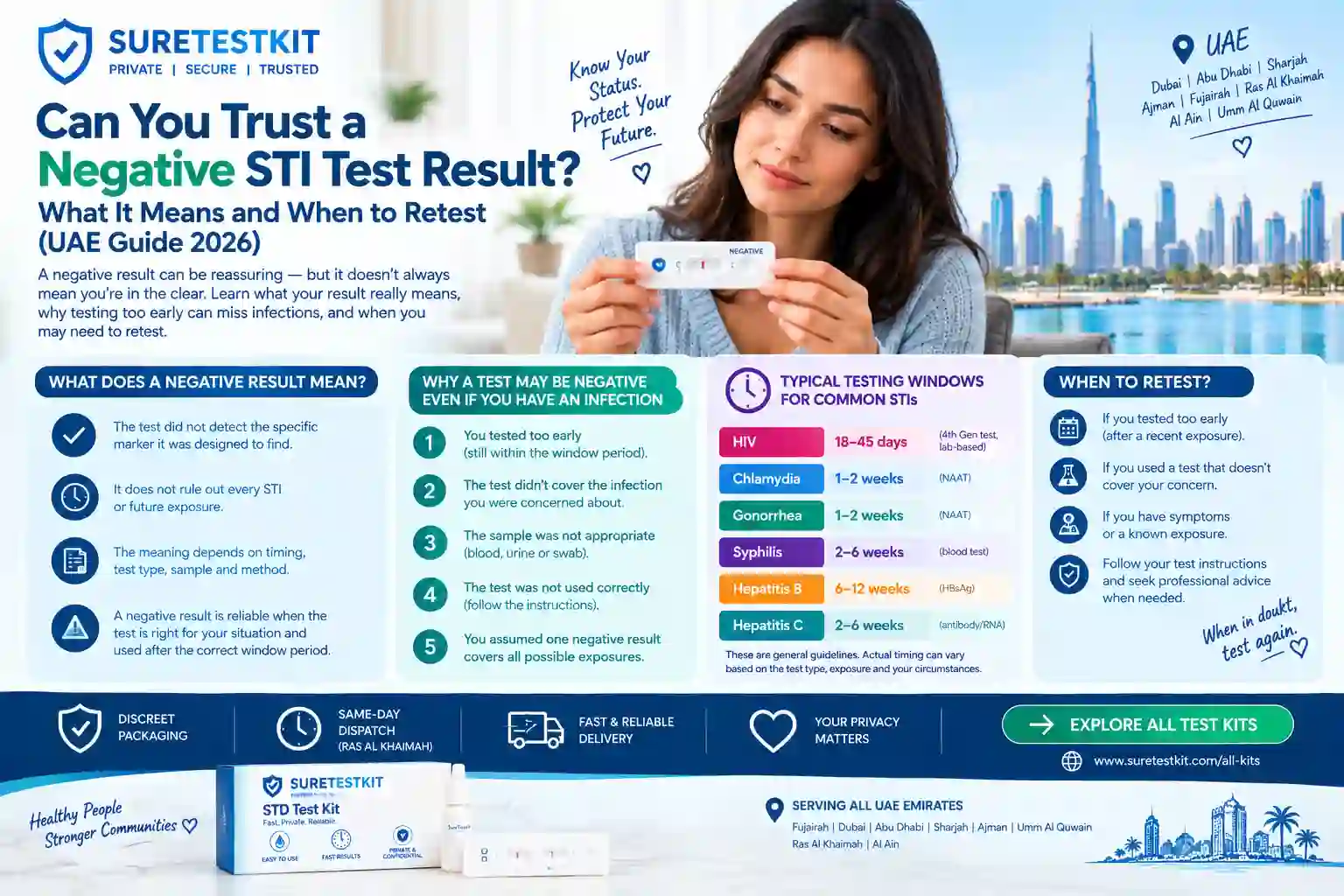
Receiving a negative sexually transmitted infection (STI) test result can bring relief. But does a negative result always mean you do not have an infection?
Not necessarily. A negative result is reassuring when the test is appropriate for the infection, performed correctly, and taken after the relevant detection window. If you test too soon after exposure, use an unsuitable sample, or take a test that does not screen for the infection you are concerned about, the result may not tell the whole story.
For people living in Dubai, Abu Dhabi, Sharjah, Ajman, Fujairah, Ras Al Khaimah, and other parts of the UAE, understanding what a negative result means can help make sexual health decisions more confidently.
In this guide, we explain when a negative STI test result is reliable, when you may need to repeat testing, how different infections are tested, and how to choose a suitable home screening option.
What Does a Negative STI Test Result Mean?
A negative result generally means the test did not detect the specific infection marker it was designed to identify in the sample provided.
However, it does not automatically rule out every sexually transmitted infection.
The meaning of your result depends on several factors:
Timing: Was the test taken after the relevant detection window?
Test type: Does it detect antibodies, antigens, genetic material, or another marker?
Sample type: Was the correct blood, urine, or swab sample used?
Collection and handling: Were the instructions followed correctly?
Infection coverage: Does the test actually screen for the infection you are concerned about?
Exposure site: Was testing performed at the relevant anatomical site?
For example, a negative genital test may not rule out an infection in the throat or rectum if those sites were exposed but not tested.
A negative result should therefore be interpreted in the context of the exposure and the test's instructions.
Five Reasons an STI Test May Be Negative Even When an Infection Is Present
1. You tested too early
This is one of the most important reasons an infection may go undetected.
After exposure, an infection or the marker used to detect it may need time to become measurable. During this period, a test may return a negative result even if infection has occurred.
This is known as the window period.
Different infections and test methods have different window periods. A test that is suitable several weeks after exposure may be less informative when used only a few days afterward.
If you tested soon after a possible exposure, check the specific test instructions and ask a healthcare professional whether repeat testing is recommended.
2. The test did not cover the infection you were concerned about
Not all STI tests screen for the same infections.
An HIV test, for example, does not automatically test for chlamydia, gonorrhea, syphilis, herpes, or hepatitis.
Similarly, a multi-panel screening product only covers the infections explicitly listed in its specifications.
Before choosing a product, check which infections it detects and whether it is designed for the type of sample you need to provide.
You can compare available options through the SureTestKit All Kits collection.
3. The sample was not appropriate
Different infections may require different samples.
Depending on the infection and test method, testing may involve blood, urine, or a swab. Some infections can affect multiple anatomical sites, and a sample from one site may not identify an infection at another.
If you have had oral or anal sexual contact, tell your healthcare professional. They can advise whether throat, rectal, genital, or other testing is appropriate.
4. The test was not used correctly
Home screening products have specific instructions for sample collection, timing, storage, and result interpretation.
Using the wrong amount of sample, reading the result outside the stated time window, or storing a test incorrectly may affect its validity.
Always follow the instructions supplied with your specific product. If the result is invalid, unclear, or difficult to interpret, follow the manufacturer's guidance and seek professional advice when needed.
5. You assumed a negative result covered every possible exposure
A negative result relates to the sample and test performed at that time. It does not protect against future infection or automatically address exposures that occurred after testing.
If you have another potential exposure after a negative test, you may need a new testing plan based on the most recent exposure.
When Should You Repeat an STI Test?
The correct time to repeat testing depends on the infection, the test method, the date of exposure, and whether you have symptoms.
The following table offers general guidance. It is not a substitute for the instructions for a particular test or advice from a qualified healthcare professional.
| Infection or test | What to consider after a negative result |
|---|---|
| HIV | Check the detection window for the exact test. Repeat testing may be necessary if the first test was taken within that window. |
| Chlamydia | If testing was performed very soon after exposure, a clinician may recommend repeat testing. The appropriate sample site also matters. |
| Gonorrhea | Early testing may need follow-up depending on the test, exposure site, and clinical advice. |
| Syphilis | Blood tests may be negative early in infection. Repeat testing may be advised after a recent exposure. |
| Hepatitis B | Timing depends on the marker tested, vaccination status, and exposure circumstances. |
| Hepatitis C | Antibody and RNA tests detect different markers and have different detection windows. Follow-up may be needed after recent exposure. |
| Herpes | A swab from a fresh lesion may be more informative when sores are present. Blood antibody tests have different limitations and timing considerations. |
Important distinction: Repeat testing after a recent exposure is not the same as retesting after treatment. For example, people treated for chlamydia or gonorrhea may be advised to test again later to check for reinfection. The schedule depends on the infection and clinical circumstances.
Can You Trust a Negative HIV Test?
A negative HIV test can be reassuring when it is performed correctly and after the applicable window period. The exact detection window depends on the test used.
Commonly cited detection windows include:
Laboratory fourth-generation antigen/antibody test using blood from a vein: usually 18–45 days after exposure.
Rapid finger-stick antigen/antibody test: approximately 18–90 days.
Antibody-only test: approximately 23–90 days.
Nucleic acid test (NAT): approximately 10–33 days.
These are general ranges, not guarantees for every product. A self-test should not automatically be assumed to have the same detection window as a laboratory test.
If your HIV result is negative but the test was taken before the relevant window has passed, follow the test instructions and seek advice about repeat testing.
You can review the product information for the HIV 1/2 Antibody Test Kit and the HIV 4th Generation Test Kit. Confirm the exact test method and intended use before relying on any stated detection window.
What if you had a recent possible HIV exposure?
Do not rely on an early negative test to rule out infection.
If a possible HIV exposure occurred within the last 72 hours, seek urgent medical assessment for post-exposure prophylaxis (PEP). PEP should be started as soon as possible and no later than 72 hours after exposure. Do not wait for a home test result before seeking care.
What If Your STI Test Is Negative but You Have Symptoms?
A negative result does not mean you should ignore persistent or concerning symptoms.
Symptoms such as unusual discharge, pain when urinating, genital sores or blisters, a rash, pelvic pain, or testicular pain can have several causes. Some STIs may also be present without obvious symptoms.
If symptoms continue after a negative test:
Arrange a medical assessment.
Tell the clinician when the possible exposure occurred.
Explain which test you took and when you took it.
Mention the type of sexual contact and any symptoms.
Ask whether repeat testing, a different sample, or testing for another condition is appropriate.
Seek prompt medical care for severe pain, fever with significant pelvic or testicular symptoms, or other urgent concerns.
Do not take antibiotics or other prescription medicines without appropriate medical advice.
Does a Negative Multi-Panel STD Test Mean You Are Clear of All STIs?
No. A multi-panel test can screen for several infections in one product, but it cannot automatically rule out every STI.
The term “multi-panel” describes the number or selection of tests included; it does not mean that all infections are covered or that every possible exposure site has been assessed.
Before buying a multi-panel product, check:
The exact infections included.
The type of sample required for each test.
Whether the product is intended for self-testing.
The stated detection window and limitations.
What to do after a negative, positive, reactive, or invalid result.
If you are comparing screening options, you can review the 4 Panel STD Test Kit and the Gonorrhea and Chlamydia Test Kit. Read each product's specifications carefully because test coverage and intended use vary.
Home STI Testing vs. Clinic Testing After a Negative Result
Home testing and clinic testing can serve different purposes. The right choice depends on the test you need, your exposure history, and whether you have symptoms.
When home testing may be useful
A suitable home test may offer convenience and privacy for screening when used according to its instructions.
When comparing products, look for clear information about the infection tested, sample type, intended use, window period, and follow-up steps.
SureTestKit provides an online catalogue of home screening products. Review the available test kits to understand the options and their individual specifications.
When clinical testing may be more appropriate
Consider professional assessment if:
Your exposure was recent and you are unsure when to test.
You have symptoms despite a negative result.
Your partner has been diagnosed with an STI.
You need testing at multiple anatomical sites.
You need an infection-specific test that your home kit does not provide.
Your result is reactive, invalid, or unclear.
You need treatment, confirmatory testing, or follow-up.
A healthcare professional can help interpret a negative result and decide whether additional testing is necessary.
How to Make Your Next STI Test More Informative
If you want to reduce the risk of misunderstanding a test result, follow these practical steps.
Step 1: Record your exposure date. Note when the possible exposure happened and whether there have been any subsequent exposures.
Step 2: Identify the infections relevant to your situation. Different infections require different tests.
Step 3: Check the detection window. Read the instructions for the exact test rather than relying on a general timeframe found online.
Step 4: Use the appropriate sample. Follow the product instructions and seek advice if testing at a different anatomical site may be needed.
Step 5: Follow up when advised. If you tested early, have symptoms, or were exposed to a known infection, ask whether repeat or clinical testing is appropriate.
Step 6: Interpret the result correctly. A negative result is not a guarantee against every infection. A reactive screening result may require confirmatory testing.
Step 7: Consider future prevention. Condoms and other barrier methods can reduce the risk of many STIs, although protection varies by infection and type of contact. Vaccination is available for certain infections, including hepatitis B and HPV.
Private STI Test Kit Options in the UAE
For residents across the UAE, online home screening products can provide another way to explore selected testing options. However, privacy and convenience should go hand in hand with understanding the product's limitations.
Before ordering, verify that the test matches your screening needs and that you understand its sample requirements, detection window, and follow-up guidance.
SureTestKit offers product information online, along with discreet-ordering options. Delivery availability, timing, and payment methods can depend on your location and order conditions, so check the current details at checkout.
If you receive a negative result but remain concerned because of a recent exposure, symptoms, or a partner's diagnosis, do not assume that the result settles the matter. Seek appropriate medical advice.
Frequently Asked Questions
1. Does a negative STI test mean I do not have an STI?
Not always. A negative result means the test did not detect the marker it was designed to identify. If the test was taken too early, used an unsuitable sample, or did not include the infection of concern, further testing may be necessary.
2. How soon can I trust a negative STI test?
There is no universal timeframe. Detection windows vary by infection and test type. Follow the instructions for your specific test and ask a healthcare professional if you are unsure when a negative result can be considered reliable.
3. Should I repeat an HIV test after a negative result?
You may need to repeat it if you tested before the applicable window period had passed or if a clinician recommends follow-up. The correct timing depends on whether you used a laboratory antigen/antibody test, a rapid test, or an antibody-only test.
4. Can I have an STI without symptoms even if my test is negative?
Yes. Some STIs can occur without symptoms, and a negative test may not exclude an infection if it was taken too early or did not test the relevant site. If you have a known exposure or ongoing concerns, seek advice about appropriate testing.
5. Can a home STI test be wrong?
Any test has limitations. Results may be affected by timing, sample collection, test performance, or incorrect use. Follow the instructions carefully and seek clinical advice if the result is invalid, unclear, or inconsistent with your symptoms or exposure history.
6. Does a negative result mean my partner does not have an STI?
No. Your result does not establish your partner's status. Each person may need appropriate testing based on their own exposure history and the timing of their test.
7. What should I do if my test is negative but my partner tested positive?
Contact a healthcare professional promptly. They can advise whether you need testing, repeat testing, preventive treatment, or other follow-up based on the specific infection and timing.
8. Can I order a home STI test kit online in the UAE?
You can review available screening products online, including options at SureTestKit. Before ordering, check exactly what the product tests for, the sample required, its detection window, and the next steps for each possible result.
Final Thoughts
A negative STI test result can be reassuring, but its reliability depends on the test, the sample, and the time since exposure. Testing too early or screening for the wrong infection can leave important questions unanswered.
If you have concerns after a negative result, check the test's detection window and ask whether repeat testing or a clinical assessment is appropriate. Seek urgent medical advice after a possible HIV exposure within 72 hours, because PEP is time-sensitive.
For people exploring home screening options in the UAE, the best starting point is to understand what you need to test for and choose a product designed for that purpose.
Explore the SureTestKit All Kits collection to review available home screening options and their product-specific information.
Disclaimer
This content is intended for informational purposes only and should not be considered a substitute for professional advice. Always consult with a qualified professional for specific concerns.