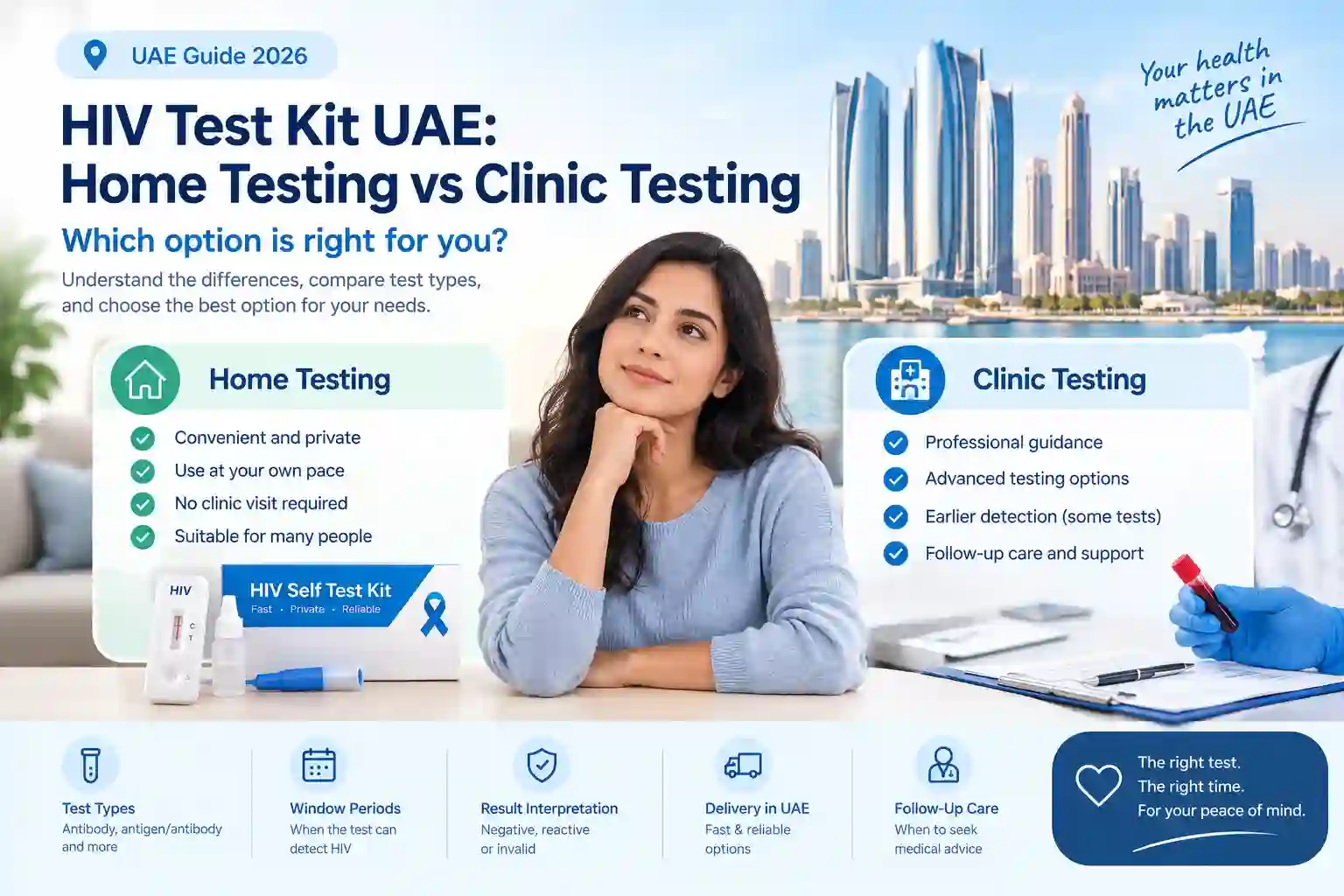
Choosing an HIV test kit in the UAE can feel confusing when you are comparing home screening options, laboratory tests, detection windows, privacy, and result interpretation. The right choice depends on when a possible exposure occurred, the type of test available, and whether you need a rapid screening option or a laboratory-based assessment.
For people in Dubai, Sharjah, Abu Dhabi, and other parts of the UAE, understanding the difference between home HIV testing and clinic testing can make it easier to choose an appropriate next step.
This guide explains how the two options compare, what to know about HIV test kit types, and when professional medical advice is important.
What Is an HIV Test Kit?
An HIV test kit is a screening tool designed to detect markers associated with human immunodeficiency virus (HIV). Depending on the test, it may detect HIV antibodies, the p24 antigen, or other markers.
Some HIV self-tests are designed for use at home, allowing a person to collect a sample, perform the test, and interpret the result according to the manufacturer's instructions. Other HIV tests are performed by trained professionals in clinics or laboratories.
An important distinction is that an HIV self-test is a screening tool, not a definitive diagnosis. A reactive result requires follow-up testing with a qualified healthcare provider.
If you are comparing products, explore the HIV test kit options available from SureTestKit and review the instructions, intended use, sample type, and detection claims for the specific product before choosing.
Home HIV Testing vs Clinic HIV Testing
Both home and clinic testing can play a role in HIV screening, but they serve different needs.
1. Home HIV testing
Home HIV testing allows you to carry out an appropriate self-test in a private setting, following the kit's instructions.
Potential advantages include:
Convenience: You can perform the test in a suitable private setting.
Privacy: You manage the testing process yourself.
Control: You can read the instructions carefully and take the test at the time specified by the manufacturer.
Flexible access: A suitable self-test may be an option for people who prefer not to begin with an in-person screening appointment.
However, home testing also has limitations. You must follow the instructions correctly, use the specified sample, check the expiry date, and interpret the result within the stated time. A home test may also be unsuitable for assessing a very recent exposure because the test's detection window may not have passed.
A reactive result must be followed by professional testing. A non-reactive result may require repeat testing if the test was taken during its window period.
2. Clinic or laboratory HIV testing
Clinic-based testing involves a healthcare professional or laboratory conducting an appropriate HIV test.
Potential advantages include:
Professional guidance: A healthcare professional can help select an appropriate test based on your circumstances.
Laboratory options: Certain laboratory-based tests can detect infection earlier than many antibody-only self-tests.
Follow-up support: The provider can explain the result and arrange further testing when required.
Care pathway: If a result is reactive or there are concerns about a recent exposure, professional services can guide the next steps.
The exact process and time required for results depend on the facility and test type. Clinic testing may also involve an appointment, travel, and sharing information with healthcare staff.
Home vs clinic testing: comparison
| Consideration | Home HIV self-test | Clinic or laboratory test |
|---|---|---|
| Where testing happens | Private setting chosen by the user | Healthcare facility or laboratory |
| Who performs the test | User follows kit instructions | Trained professional or laboratory process |
| Test types | Depends on the specific approved self-test | May include laboratory antigen/antibody tests and other methods |
| Result interpretation | User follows the manufacturer's instructions | Professional guidance may be available |
| Reactive result | Needs follow-up testing | Follow-up testing is arranged according to the testing pathway |
| Recent exposure | May not be suitable for immediate detection | A clinician can assess which test and follow-up timing are appropriate |
Neither option is automatically best for every situation. The appropriate choice depends on the test's intended use, the timing of exposure, and whether professional assessment is needed.
Which Types of HIV Test Kits Are Available?
Understanding the test type is more important than choosing a kit based only on its name or advertised speed.
HIV antibody tests
Antibody tests look for antibodies produced by the immune system in response to HIV. Many rapid HIV self-tests use this method.
According to the US Centers for Disease Control and Prevention (CDC), antibody tests can usually detect HIV around 23–90 days after exposure. The exact window depends on the test and the circumstances.
If you are comparing antibody-based options, review the HIV 1/2 antibody test kit and confirm the manufacturer's instructions and stated detection window before use.
HIV antigen/antibody tests
These tests look for both HIV antibodies and an antigen called p24. Depending on the test format, they may detect infection earlier than antibody-only tests.
The CDC gives the following usual detection windows:
Laboratory antigen/antibody test using blood from a vein: 18–45 days after exposure.
Rapid antigen/antibody test using a finger-stick blood sample: 18–90 days after exposure.
These ranges are not interchangeable. A test described as a fourth-generation test should not automatically be assumed to have the same detection window in every format or setting.
You can review the HIV 4th-generation test kit information, then check the specific product's intended use, sample type, and instructions. If you need to assess a recent exposure, a healthcare professional can advise whether a laboratory test is more appropriate.
Why the HIV Window Period Matters
The window period is the time between a possible HIV exposure and the point when a particular test can reliably detect infection.
Testing too early can produce a non-reactive result even when infection has occurred. This is why the test type and the date of possible exposure both matter.
The CDC's general detection windows are:
| Test type | Usual detection window after exposure |
|---|---|
| Nucleic acid test (NAT) | 10–33 days |
| Laboratory antigen/antibody test using venous blood | 18–45 days |
| Rapid finger-stick antigen/antibody test | 18–90 days |
| Antibody test | 23–90 days |
These ranges are general guidance, not a guarantee for an individual. The product's instructions and clinical circumstances may affect the appropriate testing schedule.
If your result is negative but you tested before the window period ended, repeat testing after the relevant window period may be necessary. If you have taken HIV prevention medicines such as PEP or PrEP, ask a healthcare professional about the appropriate testing schedule.
For further guidance, see the CDC's HIV testing information.
How to Choose an HIV Test Kit in the UAE
Before choosing an HIV test kit in the UAE, consider the following factors.
1. Check the test's intended use
Confirm whether the product is intended for self-testing or professional use. A test designed for use by trained professionals should not be assumed suitable for home use.
2. Understand what the test detects
Check whether the test detects antibodies alone or both antigen and antibodies. Read the product documentation rather than relying only on the product title.
3. Review the sample requirements
Different tests may use different sample types. Confirm the required sample, collection method, and handling instructions before purchasing.
4. Consider the timing of possible exposure
If the exposure was recent, a self-test may not detect infection yet. If the possible exposure occurred within the past 72 hours, do not wait for a home kit: seek urgent medical assessment for possible post-exposure prophylaxis (PEP).
5. Read the instructions and limitations
Check the expiry date, storage requirements, result-reading time, and the meaning of reactive, non-reactive, and invalid results.
6. Check delivery and ordering information
If ordering online in Dubai, Sharjah, Abu Dhabi, or another UAE emirate, review the seller's delivery terms, product information, payment options, and customer support details before placing an order.
You can browse the SureTestKit product range to compare available screening options. Always confirm the details of the individual product before purchase.
What Do HIV Test Results Mean?
The interpretation depends on the particular test, so follow its instructions exactly.
Non-reactive result
A non-reactive result means the test did not detect the marker it was designed to detect. It does not necessarily exclude infection if you tested during the window period or did not follow the instructions correctly.
If exposure was recent, follow the recommended testing schedule. Seek professional advice if you are uncertain about the result.
Reactive result
A reactive self-test is a preliminary screening result, not a confirmed HIV diagnosis.
Arrange follow-up testing with a qualified healthcare provider as soon as possible. Do not attempt to diagnose yourself based on a single self-test.
Invalid result
An invalid result means the test did not produce a valid result according to its instructions. Possible causes include an incorrect procedure or a missing control indicator.
Follow the manufacturer's instructions for repeating the test with a new kit if permitted. If you remain uncertain, seek professional testing.
When Should You Seek Medical Care Instead of Relying on a Home Test?
A home HIV test is not the right first step in every situation.
Seek urgent medical assessment if a possible HIV exposure occurred within the past 72 hours. A healthcare professional can assess whether PEP is appropriate. PEP should be started as soon as possible when indicated and no later than 72 hours after exposure.
You should also seek professional guidance if:
Your self-test result is reactive.
You tested during the window period.
You have symptoms that concern you after a possible exposure.
You are unsure which test is suitable.
You are taking or have recently taken PEP or PrEP and need a testing schedule.
Testing is a step toward understanding your health status. If you need medical care, do not delay it while waiting for a kit to arrive or trying another home test.
Is Home HIV Testing Private?
Home testing can offer greater control over where you perform the test. However, privacy depends on the product, seller, ordering process, delivery arrangements, and how you store or dispose of the packaging.
If privacy is important to you, review the seller's privacy policy and confirm the available packaging and delivery arrangements before ordering. Avoid assuming that every seller offers anonymous ordering or identical packaging.
For UAE customers, read the relevant product and delivery information carefully so you know what to expect before completing your order.
Frequently Asked Questions
1. Can I use an HIV test kit at home in the UAE?
Some HIV self-tests are designed for home use. Check that the specific product is intended for self-testing and follow its instructions. If you need medical assessment, have a reactive result, or are concerned about a recent exposure, contact a qualified healthcare professional.
2. Is a home HIV test as good as a laboratory test?
The answer depends on the specific test, its intended use, the timing of testing, and how correctly it is performed. Laboratory antigen/antibody tests using blood from a vein generally have a shorter usual detection window than many antibody self-tests. No test should be judged without considering its specifications and limitations.
3. How soon after exposure can I take an HIV test?
Different tests have different detection windows. A NAT may usually detect HIV around 10–33 days after exposure, while antibody tests may take 23–90 days. If exposure occurred within the past 72 hours, seek urgent medical assessment for possible PEP rather than waiting for a test.
4. Does a negative HIV self-test mean I definitely do not have HIV?
Not in every circumstance. A negative result may not exclude infection if the test was taken during its window period or was not performed correctly. Follow the product instructions and seek advice about repeat testing when needed.
5. What should I do if my HIV self-test is reactive?
Arrange follow-up testing with a qualified healthcare provider. A reactive self-test is not, by itself, a confirmed diagnosis.
6. Can I buy an HIV test kit online in Dubai, Sharjah, or Abu Dhabi?
You can review the product information and ordering terms available from online sellers serving the UAE. Before purchasing, confirm the product's intended use, instructions, delivery arrangements, and applicable requirements.
7. Which HIV test kit should I choose?
Choose based on the test method, sample type, detection window, intended user, and timing of possible exposure—not simply the product name. A healthcare professional can help you decide if you need testing sooner or a laboratory-based option.
Final Thoughts: Choose the Right HIV Testing Option
When comparing an HIV test kit in the UAE, consider more than convenience. The test method, window period, correct use, and follow-up plan all matter.
Home self-testing may suit people who prefer a private screening option and can follow the instructions carefully. Clinic or laboratory testing may be more appropriate when a recent exposure needs assessment, earlier detection is important, or professional guidance is required.
Explore the available HIV test kit options from SureTestKit and read the information for each product before making a decision.
Important medical note: This article is for general educational purposes and does not replace medical advice, testing, or diagnosis. Follow the specific test instructions and consult a qualified healthcare professional when you have concerns about HIV exposure or test results.
Disclaimer
This content is intended for informational purposes only and should not be considered a substitute for professional advice. Always consult with a qualified professional for specific concerns.