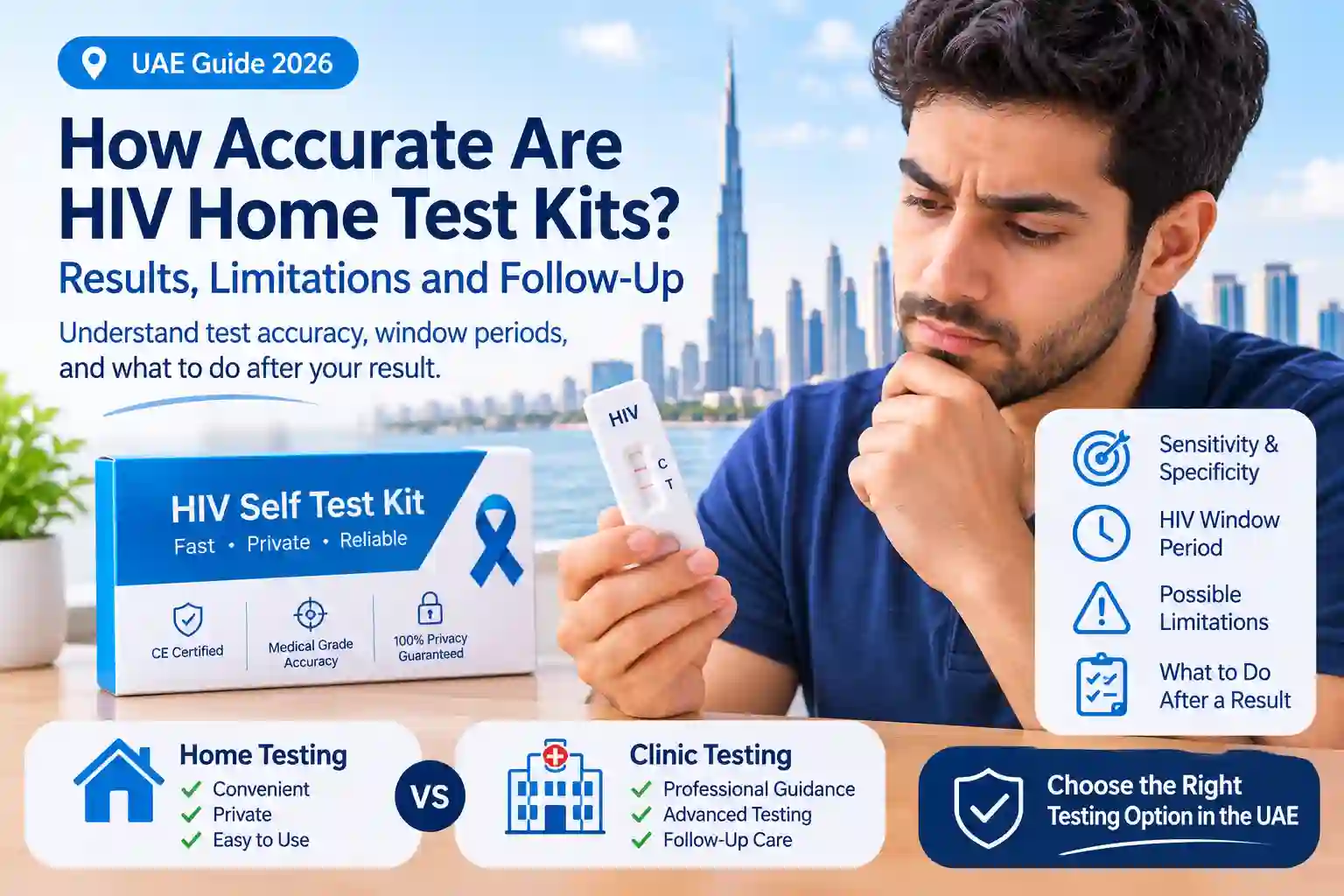
If you are considering an HIV home test kit in the UAE, one of the first questions you may have is: How accurate are HIV self-tests, and can you trust a negative result?
Home HIV test kits can provide a convenient way to screen for HIV in a private setting. However, their reliability depends on several important factors, including the type of test, the time since possible exposure, correct sample collection, and following the manufacturer's instructions.
Whether you are ordering an HIV test kit in Dubai, Sharjah, Abu Dhabi, or another emirate, understanding these factors can help you make a more informed decision.
In this guide, we explain HIV home test accuracy, the difference between sensitivity and specificity, why false-negative results can happen, and what to do after receiving a reactive, non-reactive, or invalid result.
How Accurate Are HIV Home Test Kits?
HIV self-tests can be reliable screening tools when they are properly validated, used correctly, and taken at an appropriate time after possible exposure.
However, no HIV test can detect infection immediately after exposure. Every test has a detection window, and a negative result obtained too early may not rule out HIV.
The World Health Organization (WHO) recognises HIV self-testing as an additional approach to HIV testing services. It can help people access screening in a private and convenient setting. However, a reactive self-test is not a confirmed HIV diagnosis and must be followed by testing with a trained healthcare provider.
The important point is that test accuracy and test timing must be considered together.
A test may perform well under its validated conditions but still produce a non-reactive result when used during its window period.
What Do Sensitivity and Specificity Mean?
When evaluating an HIV test kit, two technical terms are particularly important: sensitivity and specificity.
1. Sensitivity
Sensitivity measures how well a test identifies people who have the condition being tested for.
A highly sensitive HIV test is designed to detect HIV in people who are infected. A test that fails to detect an infection may produce a false-negative result.
2. Specificity
Specificity measures how well a test identifies people who do not have the condition being tested for.
A highly specific test is less likely to produce a false-reactive result in someone who does not have HIV.
Why do both matter?
A reliable screening test needs good performance in both areas. However, even a test with strong validated performance has limitations.
For example:
Testing before the detection window has passed can result in a false-negative result.
Incorrect sample collection can affect the test process.
Reading the result outside the manufacturer's specified time can lead to misinterpretation.
A reactive screening result needs follow-up testing.
When comparing products, check the manufacturer's instructions and supporting performance information rather than relying only on general claims such as "high accuracy" or "rapid results."
Understanding the HIV Test Window Period
The HIV window period is the time between a possible exposure to HIV and the point when a particular test can detect infection.
This is one of the most important factors affecting HIV self-test accuracy.
Different tests detect different markers, so their detection windows are not identical.
According to the US Centers for Disease Control and Prevention (CDC), the usual detection windows are:
| HIV test type | Usual detection window after exposure |
|---|---|
| Nucleic acid test (NAT) | 10–33 days |
| Laboratory antigen/antibody test using blood from a vein | 18–45 days |
| Rapid finger-stick antigen/antibody test | 18–90 days |
| Antibody test, including most self-tests | 23–90 days |
These are general ranges, not guaranteed detection dates for every individual or product.
Why can an early test be negative?
After HIV exposure, the markers detected by a particular test may not yet be present at detectable levels.
For example, an antibody-based home test looks for antibodies produced by the immune system. If the test is taken before enough antibodies have developed, it may return a non-reactive result even if infection has occurred.
This is why a negative result during the window period should not be treated as conclusive.
Practical advice: Check the exact detection window in the instructions supplied with your HIV test kit. If you tested too early, arrange repeat testing after the relevant window period.
Can an HIV Home Test Give a False-Negative Result?
Yes. A false-negative result is possible.
A false negative occurs when a test reports a non-reactive result even though the person has HIV.
Several factors can contribute to this.
1. Testing too early
This is one of the most important reasons a home HIV test may not detect an infection.
If the test is taken before its detection window has passed, the markers it looks for may not be present at detectable levels.
2. Incorrect sample collection
Home testing requires the user to follow the specified sample collection procedure.
Problems may include:
Collecting an insufficient sample.
Using the wrong sample type.
Not following the required collection steps.
Failing to use the supplied components correctly.
Always read the instructions before starting the test.
3. Incorrect testing procedure
Every HIV test kit has a specific procedure. Differences in the number of drops, sample application, buffer use, and waiting time can affect whether the test works correctly.
Do not assume all HIV test kits use the same method.
4. Reading the result at the wrong time
Most rapid tests specify a particular time range for interpreting the result.
Reading the test too early or after the permitted time can cause confusion. Follow the exact timing instructions supplied with the product.
5. Use of PEP or PrEP
Antiretroviral medicines used for HIV prevention, including post-exposure prophylaxis (PEP) and pre-exposure prophylaxis (PrEP), can affect the interpretation and timing of HIV testing.
If you have taken or are taking these medicines, ask a healthcare professional about the appropriate testing schedule. Do not rely on a standard self-test window period without considering your medication history.
Can an HIV Home Test Give a False-Positive Result?
A reactive HIV self-test does not automatically mean that a person has HIV.
A false-reactive result can occur when a screening test reacts even though the person does not have HIV.
This is one reason screening tests and diagnostic testing are treated differently.
If your home HIV test produces a reactive result:
Stay calm and avoid assuming that the result is a confirmed diagnosis.
Contact a qualified healthcare provider or appropriate testing service.
Arrange follow-up testing using the recommended diagnostic testing process.
Follow the healthcare provider's advice about further care.
The WHO recommends that reactive HIV self-test results be followed by further testing by a trained provider using the applicable testing algorithm.
Do not attempt to confirm a reactive result simply by taking several home tests.
What Do Non-Reactive, Reactive and Invalid Results Mean?
Understanding the three common result categories can help you respond appropriately.
Non-reactive result
A non-reactive result means the test did not detect the marker it was designed to identify.
However, it does not necessarily rule out HIV if:
You tested during the window period.
You had another possible exposure after the test.
The sample or procedure was incorrect.
You are taking or have recently taken PEP or PrEP and need a different testing schedule.
If you tested too early, repeat testing after the relevant window period.
Reactive result
A reactive result means the test detected the marker it was designed to identify.
It is a preliminary screening result, not a confirmed HIV diagnosis.
Arrange follow-up testing with a qualified healthcare provider.
Invalid result
An invalid result means the test did not produce a valid result according to its instructions.
This may happen if the control indicator does not appear or the procedure was not completed correctly.
Follow the manufacturer's instructions for repeating the test with a new kit, or seek professional testing if you remain uncertain.
How to Improve the Reliability of an HIV Home Test
Correct use is essential when performing an HIV self-test.
Here are practical steps to follow.
1. Choose a test intended for self-testing
Check whether the product is specifically designed and authorised for home self-testing in its intended market.
Do not assume that every HIV rapid test is suitable for untrained users.
2. Check the expiry date
Never use an expired test kit. Check the packaging before opening it.
3. Follow the storage instructions
Some tests require particular storage conditions. Exposure to unsuitable temperatures, moisture, or direct sunlight may affect product performance.
Follow the manufacturer's stated storage requirements.
4. Read the complete instructions
Before beginning, understand:
The required sample type.
How to collect the sample.
How to apply the sample.
Whether a buffer is required.
How long to wait.
The correct result-reading time.
What each result means.
5. Use the supplied components
Do not substitute other collection tools or testing liquids unless the manufacturer's instructions specifically permit it.
6. Read the result within the stated time
Use the manufacturer's interpretation guide. Do not interpret faint lines or other visual indicators using assumptions from a different brand or test.
7. Understand the window period
Even a correctly performed test may not detect a recent infection.
If you are unsure whether enough time has passed since possible exposure, seek professional advice about the most appropriate test and repeat-testing schedule.
Is a Fourth-Generation HIV Test More Accurate Than an Antibody Test?
Fourth-generation HIV tests are designed to detect both HIV antibodies and the p24 antigen.
Antibody-only tests detect antibodies produced by the immune system.
Because the p24 antigen can appear before antibodies develop, certain fourth-generation tests can detect HIV earlier than antibody-only tests.
However, the type of test and sample collection method matter.
For example, a laboratory antigen/antibody test using blood from a vein has a usual detection window of 18–45 days, while a rapid finger-stick antigen/antibody test has a usual window of 18–90 days.
Therefore, the phrase "fourth generation" alone does not tell you the exact detection window of every product.
Before choosing a test, check:
Whether it detects antibodies, antigen and antibodies, or another marker.
Whether it is a laboratory or rapid test.
The sample type.
Whether it is intended for home self-testing.
The manufacturer's stated detection window.
You can review the HIV 4th-generation test kit information and the HIV 1/2 antibody test kit to compare the available product information.
When Should You Choose Professional HIV Testing?
Home HIV testing can be useful for screening, but some situations require professional medical assessment.
Consider professional testing or medical advice if:
You have had a possible HIV exposure recently.
Your home test result is reactive.
Your test result is invalid or unclear.
You tested before the recommended window period.
You are taking or have recently taken PEP or PrEP.
You are unsure which test is appropriate for your circumstances.
Important: Seek urgent advice about PEP within 72 hours
If you think you may have been exposed to HIV within the past 72 hours, do not wait for a home test or delivery.
Contact a healthcare provider or emergency medical service immediately to ask about post-exposure prophylaxis (PEP).
PEP should be started as soon as possible when indicated and no later than 72 hours after a possible exposure. A healthcare professional will assess your circumstances and advise you about treatment and follow-up testing.
Choosing an HIV Test Kit in Dubai, Sharjah and Abu Dhabi
People searching for an HIV test kit in the UAE may have different priorities, including convenience, product information, privacy, and delivery arrangements.
Before ordering an HIV home test kit online, consider the following:
Product suitability: Confirm that the test is intended for the type of use you need.
Testing method: Understand whether it is an antibody test or an antigen/antibody test.
Instructions: Make sure clear instructions and result interpretation guidance are provided.
Expiry and storage: Check the product's expiry date and storage requirements.
Delivery information: Review the seller's delivery terms for your emirate before placing an order.
Customer support: Check whether the seller provides a way to ask questions about product information and ordering.
SureTestKit provides a range of home screening products for customers in the UAE. You can explore the HIV test kit collection or browse all available test kits.
Always read the individual product details and instructions before making a purchase.
Frequently Asked Questions About HIV Home Test Accuracy
1. Are HIV home test kits accurate?
HIV home self-tests can be reliable screening tools when they are appropriately validated and used correctly. Their performance depends on the specific product, sample collection, testing procedure, and timing. A test taken during its window period may produce a false-negative result.
2. Can an HIV self-test be negative even if someone has HIV?
Yes. A false-negative result can occur, particularly when testing takes place before the test's detection window has passed. If you have had a possible recent exposure, follow the recommended repeat-testing schedule.
3. How long should I wait before taking an HIV home test?
Most antibody-based HIV self-tests have a usual detection window of 23–90 days after exposure. The exact timing depends on the product. Check its instructions and seek professional advice if you need testing sooner.
4. Is a fourth-generation HIV test more reliable?
Fourth-generation tests detect both HIV antibodies and the p24 antigen. Certain laboratory fourth-generation tests can detect HIV earlier than antibody-only tests. However, rapid tests and laboratory tests may have different detection windows, so check the specific test's specifications.
5. What should I do if my HIV home test is reactive?
A reactive result is preliminary and does not confirm an HIV diagnosis. Contact a qualified healthcare provider and arrange follow-up testing through the recommended diagnostic process.
6. Can I trust a negative HIV test result?
A negative result is reassuring when the test has been performed correctly after its relevant window period and there has been no subsequent possible exposure. If testing occurred too early, repeat testing may be necessary.
7. Does taking PEP or PrEP affect HIV test results?
PEP and PrEP can affect the interpretation and timing of HIV testing. If you have used either medication, follow a healthcare professional's testing schedule rather than relying only on the standard window period for a home test.
Final Thoughts: Understand HIV Home Test Accuracy Before You Choose
HIV home test kits can make screening more accessible and convenient, but understanding their limitations is essential.
The most important factors are the test's intended use, detection method, window period, sample collection procedure, and correct interpretation of results.
A non-reactive result taken too early may not rule out HIV. A reactive self-test requires professional follow-up, while an invalid result means the test should be repeated according to the manufacturer's instructions or replaced with professional testing.
If you are comparing an HIV test kit in Dubai, Sharjah, Abu Dhabi, or elsewhere in the UAE, take time to review the product details and choose an option appropriate for your circumstances.
Explore the HIV test kit options at SureTestKit and read the instructions for the specific product before use.
Medical disclaimer: This article is intended for general educational purposes only. It does not replace professional medical advice, HIV diagnosis, or confirmatory testing. If you may have been exposed to HIV within the past 72 hours, seek urgent medical assessment for possible PEP.
Disclaimer
This content is intended for informational purposes only and should not be considered a substitute for professional advice. Always consult with a qualified professional for specific concerns.