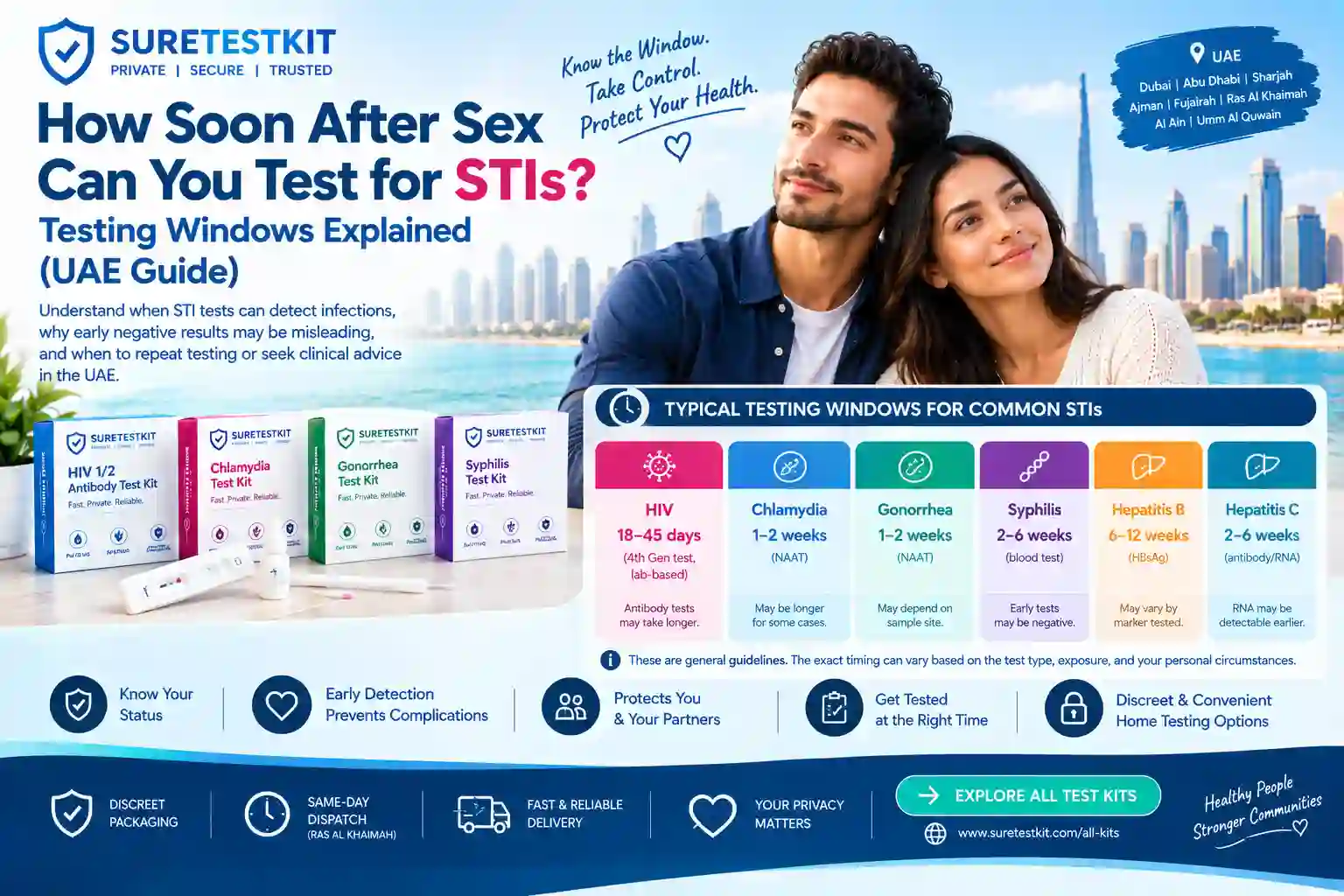
Understanding when to test after sexual contact can help you make informed decisions about your sexual health. Testing too early may produce a negative result even when an infection is present. The right testing time depends on the infection, the type of test used, the sample collected, and whether you have symptoms.
For people in Dubai, Abu Dhabi, Sharjah, Ajman, Fujairah, Ras Al Khaimah, and other parts of the UAE, understanding STI testing windows can make it easier to decide when to seek testing and whether a repeat test may be necessary.
In this guide, we explain testing windows for common sexually transmitted infections (STIs), why early testing can be misleading, how home test kits compare with clinical testing, and when you should seek professional medical advice.
What Is an STI Testing Window?
An STI testing window is the period between a possible exposure to an infection and the point at which a particular test can reliably detect it.
After exposure, an infection may need time to produce detectable levels of a virus, bacterium, antibody, or antigen. During this period, a test may return a negative result even if an infection has occurred.
There is no single testing window that applies to every STI.
For example:
Some bacterial infections may be detectable within days to a few weeks, depending on the test and sample.
HIV tests have different detection windows depending on whether they detect antibodies, antigens, or both.
Certain infections may require follow-up testing because antibodies develop gradually.
Testing may need to be repeated if the first test was taken too soon.
A negative result should therefore be interpreted according to the specific test instructions and the time since the possible exposure.
How Soon Can You Test for Common STIs?
The following table provides general guidance, not a guarantee that an infection will be detected at a particular time. The appropriate timing can vary by test method, exposure type, symptoms, and clinical circumstances.
| Infection | General testing considerations |
|---|---|
| Chlamydia | A healthcare professional may recommend testing around 1–2 weeks after exposure. Earlier testing may miss an infection. |
| Gonorrhea | Testing is often considered around 1–2 weeks after exposure, depending on the test and exposure site. |
| HIV | Detection windows vary significantly by test type. Laboratory fourth-generation antigen/antibody tests generally detect infection earlier than antibody-only tests. |
| Syphilis | Blood tests may not become reactive immediately. Testing and follow-up may be needed over several weeks. |
| Hepatitis B | Detectability depends on the marker tested and the stage of infection. Clinical advice can help determine the appropriate schedule. |
| Hepatitis C | Blood tests for antibodies and tests that detect viral RNA have different detection windows. |
| Herpes (HSV) | A fresh sore or blister can often be sampled for a PCR test. Blood antibody tests have different limitations and timing considerations. |
| HPV | There is no universal routine screening test for every person or every HPV type. Screening recommendations depend on anatomy, age, and clinical guidelines. |
Important: These are broad planning ranges, not definitive deadlines. Follow the instructions for your specific test and consult a healthcare professional if you need a reliable testing schedule.
HIV Testing: Why the Type of Test Matters
HIV testing is one area where understanding the window period is particularly important. Different tests look for different markers of infection, so they do not all detect HIV at the same time.
1. HIV antibody tests
Antibody tests look for the body's immune response to HIV. Antibodies take time to develop, so an antibody-only test may not detect a very recent infection.
If you are considering an antibody-based option, review the product's stated detection window and follow-up instructions.
Explore the HIV 1/2 Antibody Test Kit to review the product information.
2. HIV fourth-generation tests
Fourth-generation tests detect both HIV antibodies and the p24 antigen. Laboratory-based fourth-generation antigen/antibody tests usually detect HIV earlier than antibody-only tests.
According to widely used public health guidance, a laboratory fourth-generation antigen/antibody test using blood from a vein typically detects HIV about 18–45 days after exposure. Rapid finger-stick antigen/antibody tests may have a longer window, commonly up to 90 days.
These ranges apply to the specified test types and should not automatically be assumed to apply to every home kit. Check the exact product instructions and whether the test is intended for self-testing.
You can review the HIV 4th Generation Test Kit product information.
3. When should you repeat an HIV test?
If you test during the window period and receive a negative result, you may need to repeat the test after the relevant window has passed. The recommended timing depends on the test type and any ongoing exposure.
If a possible HIV exposure occurred within the last 72 hours, do not wait for a home test. Seek urgent medical assessment for post-exposure prophylaxis (PEP), which must be started as soon as possible and no later than 72 hours after exposure.
Chlamydia and Gonorrhea: Timing and Sample Choice
Chlamydia and gonorrhea can occur without noticeable symptoms. Testing may be appropriate even when you feel well, particularly after a potential exposure or when a partner has been diagnosed.
Healthcare professionals commonly use nucleic acid amplification tests (NAATs) to detect these infections. Depending on the exposure, testing may involve a urine sample or a swab from the relevant body site.
A genital test does not necessarily detect an infection at the throat or rectum. Tell your healthcare professional about the type of contact so they can recommend appropriate sampling.
Testing around one to two weeks after exposure is often discussed for these infections, but the best timing depends on the test and circumstances. If you test very early, a clinician may recommend repeating the test.
Learn more about the options available on our Chlamydia Test Kit, Gonorrhea Test Kit, and Gonorrhea and Chlamydia Test Kit pages. Always verify which sample types, intended users, and detection claims apply to the specific product.
Syphilis and Hepatitis: Why Follow-Up May Be Needed
Syphilis
Syphilis can initially cause a painless sore that may go unnoticed. Blood tests may not become positive immediately after exposure, so a negative early result does not always rule out infection.
A healthcare professional may recommend an initial test followed by repeat testing based on the exposure date, symptoms, and initial result.
See the Syphilis Test Kit for product-specific information.
Hepatitis B
Hepatitis B testing may involve different blood markers, such as the surface antigen and antibodies. These markers appear at different stages, and no single test result should be interpreted without considering the testing context.
Vaccination status is also important. If you may have been exposed to hepatitis B recently, contact a healthcare professional promptly because post-exposure measures may be time-sensitive.
Review the Hepatitis B Self-Test Kit details and confirm its intended use and limitations.
Hepatitis C
Hepatitis C antibody tests and tests that detect viral RNA have different detection windows. Antibodies may take weeks to develop, while RNA may become detectable earlier.
If you have had a recent exposure, ask a healthcare professional which test is appropriate and whether follow-up testing is needed.
You can also review the Hepatitis C Test Kit product information.
Should You Test Immediately After Sexual Contact?
Testing immediately may be useful in some circumstances, but it cannot reliably rule out every infection from a recent exposure.
A healthcare professional may recommend an initial assessment to check for existing infections, followed by repeat testing at the appropriate time. This can be particularly important if you have symptoms, a partner has tested positive, or the exposure involved a known infection.
Seek medical advice promptly if you develop unusual discharge, pain when urinating, genital sores or blisters, a rash, pelvic or testicular pain, or other concerning symptoms. Do not delay assessment simply because a test might be within its window period.
Until you have received appropriate advice, consider avoiding sexual contact or using barriers to reduce the risk of transmission. Some infections can still be transmitted without symptoms.
Home STI Test Kits vs. Clinic Testing
Both home testing and clinic testing may have a role in sexual health screening, but they are not interchangeable in every situation.
Home testing may suit some screening needs
Depending on the specific kit, home testing can offer:
The convenience of reviewing test instructions at home.
Privacy when ordering and receiving a product.
Access to selected screening options without an initial clinic visit.
Individual or multi-panel options where the product is designed and validated for those uses.
Before ordering, check what the kit detects, the sample required, the test's intended user, its stated window period, and what to do after a negative or reactive result.
Browse the SureTestKit All Kits collection to review available options.
Clinical testing may be preferable when:
The exposure was recent and the correct testing schedule is unclear.
You have symptoms or a partner has a confirmed STI.
You need testing from more than one anatomical site.
You require a test that is not available through the home-testing option you are considering.
You receive a reactive result or need treatment and follow-up.
You may need time-sensitive prevention, such as HIV PEP or hepatitis B post-exposure care.
A home test should not delay urgent medical assessment or replace clinical care when it is needed.
How to Plan Your STI Testing Timeline
If you are unsure when to test, use these steps as a starting point.
Step 1: Record the exposure date. Write down when the possible exposure occurred and whether there have been any additional exposures.
Step 2: Identify the infections you may need to test for. Different sexual activities and exposure sites can require different tests.
Step 3: Check the exact test method. Read the product instructions carefully. Do not assume all HIV, syphilis, hepatitis, or multi-panel tests have the same window period.
Step 4: Seek urgent advice when appropriate. If HIV exposure may have occurred within 72 hours, seek PEP assessment immediately. Contact a clinician promptly for symptoms or a known exposure to an infection.
Step 5: Follow the recommended testing schedule. If the first test is negative but was taken too early, arrange repeat testing when advised.
Step 6: Confirm reactive results. Screening results that are reactive or positive may require confirmatory testing. Do not make treatment decisions based on a screening result alone.
Ordering a Home STI Test Kit in the UAE
For residents in Dubai, Abu Dhabi, Sharjah, Ajman, Fujairah, Ras Al Khaimah, and other UAE locations, SureTestKit provides an online catalogue of home screening products.
When comparing products, prioritize the test's intended use, sample requirements, stated detection window, storage conditions, expiry date, and instructions for interpreting results. Consider whether the product tests for the specific infection you are concerned about.
SureTestKit offers discreet-ordering options and delivery information on its website. Delivery timing and payment availability may vary by location and order conditions, so check the current information at checkout.
Remember that privacy and convenience are useful, but the most important factor is choosing an appropriate test and using it at the right time.
Frequently Asked Questions
1. How many days after sex should I get an STI test?
There is no single number that applies to every STI. Some tests may be useful after several days, while others require weeks or longer to become reliably detectable. The correct timing depends on the infection, test method, and exposure.
2. Can an STI test be negative if I have an infection?
Yes. Testing too early can produce a negative result because the infection or the marker being tested for may not yet be detectable. Follow the test instructions and ask a healthcare professional whether repeat testing is needed.
3. Can I take an HIV test one week after exposure?
You can seek medical advice and may be offered an initial test, but a negative result after one week generally cannot rule out HIV from that exposure. Follow the detection window for the specific test. If the exposure was within 72 hours, seek urgent assessment for PEP rather than waiting for a test.
4. Is a fourth-generation HIV test better for early detection?
Laboratory-based fourth-generation antigen/antibody tests can detect HIV earlier than antibody-only tests in many circumstances. However, the window period depends on the specific test type. A home or rapid test should not automatically be assumed to have the same detection window as a laboratory test.
5. Should I test if I have no symptoms?
Yes, testing can still be appropriate after a potential exposure, because several STIs can occur without noticeable symptoms. Your testing plan should reflect your exposure, medical history, and applicable screening recommendations.
6. Do multi-panel STD test kits detect every STI?
No. A multi-panel kit only tests for the infections listed in its product specifications, and each component may have its own sample requirements and limitations. Review the included tests before purchasing.
7. What should I do if my home STI test is reactive?
Follow the instructions provided with the test and arrange appropriate confirmatory testing or clinical assessment. Avoid assuming that a screening result alone establishes a final diagnosis.
8. Can I order an STI test kit online in the UAE?
You can review available products through online retailers such as SureTestKit. Before ordering, verify that the product is suitable for your needs, understand its limitations, and check current delivery and payment terms.
Final Thoughts
Knowing when to test after sexual contact is an important part of responsible sexual health care. A test taken too early may not detect an infection, and different STIs have different testing windows.
Choose a test based on the infection you need to screen for, the test method, and the time since exposure. If you have symptoms, a known exposure, a reactive result, or uncertainty about timing, seek advice from a qualified healthcare professional.
For possible HIV exposure within the past 72 hours, seek urgent PEP assessment. Do not wait for a home test result.
To compare available home screening options, visit the SureTestKit All Kits page.
Disclaimer
This content is intended for informational purposes only and should not be considered a substitute for professional advice. Always consult with a qualified professional for specific concerns.