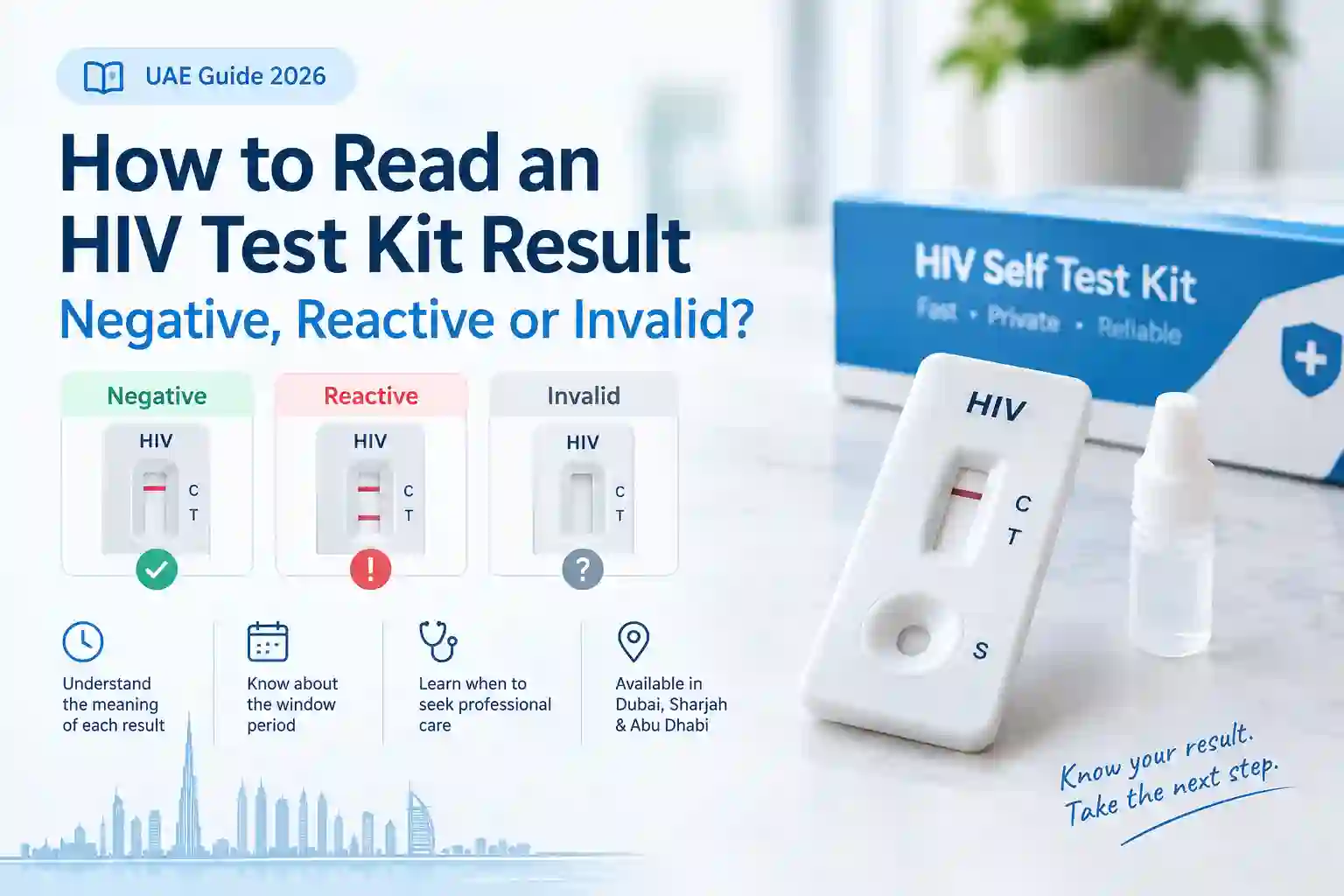
When using an HIV test kit at home, understanding the result is just as important as choosing the right test. You may see terms such as negative, reactive, positive, or invalid in the instructions, and knowing what they mean can help you decide what to do next.
For people in Dubai, Sharjah, Abu Dhabi, and across the UAE, home HIV screening can offer a convenient way to access certain screening options. However, every test has limitations, and a result must be interpreted according to the specific product instructions, the time since possible exposure, and your circumstances.
In this guide, we explain how to understand common HIV test kit results, what each result can and cannot tell you, and when follow-up testing or professional medical advice is important.
What Do HIV Test Kit Results Mean?
HIV home screening tests generally display a result using a visual indicator or another method specified by the manufacturer. The meaning of that result depends on the particular test.
Before interpreting any result, read the instructions supplied with your kit. Different products may use different indicators, control markers, and reading procedures.
The three common result categories are:
Negative or non-reactive: The test did not detect the HIV marker it is designed to identify in the sample.
Reactive: The test detected a marker that requires follow-up and confirmatory testing.
Invalid: The test did not produce a valid result, so it cannot be interpreted as negative or positive.
A screening result is not the same as a final medical diagnosis. Understanding this distinction is essential when using an HIV test kit at home.
1. What Does a Negative HIV Test Result Mean?
A negative result generally means the test did not detect the marker it was designed to identify.
This can be reassuring when the test has been used correctly and enough time has passed since the possible exposure for the specific test to detect infection reliably.
However, a negative result does not always rule out HIV.
Why might a negative result need follow-up?
There are several reasons:
Testing too early: The test may have been used during the HIV window period, before the marker becomes detectable.
Incorrect use: Not following sample collection or reading instructions can affect the validity of the result.
Wrong test for the situation: Different tests detect different markers and have different detection windows.
A later exposure: A negative result cannot rule out an exposure that occurred after the test.
If you tested shortly after possible exposure, check the instructions for the exact test and seek medical advice about whether and when to repeat it.
How soon can an HIV test detect infection?
The window period varies by test type. Commonly cited ranges from the US Centers for Disease Control and Prevention (CDC) are:
| HIV test type | Typical detection window after exposure |
|---|---|
| Nucleic acid test (NAT) | 10–33 days |
| Laboratory antigen/antibody test using blood from a vein | 18–45 days |
| Rapid finger-stick antigen/antibody test | 18–90 days |
| Antibody test | 23–90 days |
These ranges are general guidance, not a guarantee for every product. A home self-test should not automatically be assumed to have the same detection window as a laboratory test.
If you are uncertain about the test type or when your result can be considered reliable, consult a qualified healthcare professional.
2. What Does a Reactive HIV Test Result Mean?
A reactive result means the screening test has detected a marker that needs further investigation.
A reactive home screening result does not, by itself, confirm that a person has HIV. Follow-up testing through an appropriate healthcare service is necessary to establish the diagnosis.
If your result is reactive:
Read the manufacturer's instructions carefully.
Arrange prompt medical assessment and confirmatory testing.
Follow the healthcare professional's advice about additional tests and next steps.
Avoid trying to confirm or dismiss the result by repeatedly using home tests without appropriate guidance.
It is understandable to feel worried after a reactive result, but a screening result is a starting point for follow-up, not a final diagnosis.
A healthcare professional can explain the confirmatory testing process and discuss any further care that may be needed.
3. What Does an Invalid HIV Test Result Mean?
An invalid result means the test has not produced a result that can be interpreted reliably.
It is not the same as a negative result.
Depending on the product, an invalid result may occur if the control indicator does not appear, the sample was collected incorrectly, the test was used improperly, or the test was damaged or stored outside its specified conditions.
If your result is invalid:
Do not interpret it as evidence that you are HIV-negative.
Review the instructions to understand the product's invalid-result criteria.
Check the expiry date and any storage requirements.
Use a new test only as directed by the manufacturer.
Contact a healthcare professional if you are uncertain or if a recent exposure requires timely assessment.
If the possible exposure occurred within the last 72 hours, do not delay seeking urgent medical advice while trying another test.
4. How Do You Read Lines on an HIV Test Kit?
Some rapid HIV tests use visual lines or other indicators. The exact interpretation depends on the model.
One test may use a control line and a test line, while another product may use a different indicator or result display.
For that reason, there is no universal rule that applies to every HIV test kit.
When reading a line-based test:
Identify the control and test indicators shown in the manufacturer's diagram.
Check that the required control indicator appears.
Read the result only within the time window stated in the instructions.
Compare the result with the examples provided for that exact product.
Follow the manufacturer's guidance if the result is faint, unclear, or invalid.
Do not assume that a faint line has the same meaning across all products. If you cannot confidently interpret the result, contact the manufacturer or a healthcare professional for guidance.
5. Why the HIV Test Type Matters
HIV tests differ in what they detect. Understanding the type of test can help you interpret a result more appropriately.
HIV antibody tests
Antibody tests look for antibodies produced by the immune system in response to HIV. Because antibodies take time to develop, an antibody test may not detect a very recent infection.
You can review the HIV 1/2 Antibody Test Kit product information to understand its stated intended use and instructions.
Fourth-generation antigen/antibody tests
Fourth-generation tests detect HIV antibodies and the p24 antigen. Laboratory-based fourth-generation tests can generally detect infection earlier than antibody-only tests.
However, not every test described as a fourth-generation test has the same intended use, sample type, or detection window. Always check the exact product specifications.
See the HIV 4th Generation Test Kit page for product-specific information.
Choosing a suitable HIV test kit
Before choosing a product, consider:
Which HIV markers it detects.
Whether it is intended for self-testing or professional use.
What sample it requires.
Its stated detection window.
How results are interpreted.
What follow-up is recommended after a reactive or invalid result.
You can also browse the SureTestKit HIV test kit options to review the information available for the listed product.
6. When Should You Repeat an HIV Test?
Repeat testing may be appropriate if your first test was taken during the window period, if your healthcare professional recommends follow-up, or if you have had another potential exposure.
The timing depends on the test type and your exposure history. Do not assume that every HIV test can reliably rule out infection after the same number of days.
If you have ongoing concerns after a negative result, seek professional advice about the appropriate testing schedule.
Important: Possible HIV exposure within 72 hours
If you think you may have been exposed to HIV within the past 72 hours, seek urgent medical assessment for post-exposure prophylaxis (PEP).
PEP should be started as soon as possible and no later than 72 hours after exposure. Do not wait for a home test result before seeking care.
7. Can You Trust a Home HIV Test Kit?
A home HIV test can be useful when it is suitable for your needs and used according to its instructions. But no test should be treated as infallible.
When evaluating a product, look for clear information about:
The manufacturer and product identity.
The intended use and sample type.
The test's stated performance and limitations.
The detection window.
Storage conditions and expiry date.
Result interpretation and follow-up instructions.
Be cautious about claims that a test is 100% accurate or that a negative result immediately after exposure rules out HIV.
A reliable decision involves more than the product label. Timing, proper use, and appropriate follow-up all matter.
8. Ordering an HIV Test Kit in Dubai, Sharjah and Abu Dhabi
If you are considering a home HIV test kit in the UAE, review the product details before ordering.
SureTestKit provides online product information for customers in Dubai, Sharjah, Abu Dhabi, and other UAE locations. Delivery availability and timing depend on the destination and current order conditions; check the website and checkout information for the latest details.
When comparing products, prioritize suitability and clear instructions rather than choosing solely on price or speed.
For customers who want to compare the available options, start with the HIV test kit product page.
Remember that a home screening product does not replace urgent medical care, confirmatory testing, or professional advice when needed.
Frequently Asked Questions
1. Does a negative HIV test result mean I definitely do not have HIV?
Not always. A negative result may not rule out infection if the test was taken during its window period. Follow the instructions for the exact test and seek advice about repeat testing if needed.
2. Does a reactive HIV test mean I have HIV?
A reactive screening result needs confirmatory testing. It is not, by itself, a final diagnosis. Arrange medical follow-up promptly.
3. What should I do if my HIV test kit result is invalid?
Do not interpret the result as negative. Follow the manufacturer's instructions for invalid results and use a new test only as directed. Seek medical advice if you need help interpreting the result.
4. Can I read an HIV test kit result after the recommended time?
You should read the result only within the time window specified by the manufacturer. Reading it too early or too late may lead to misinterpretation.
5. Are all HIV test kits read in the same way?
No. Different products may use different indicators and result criteria. Always follow the instructions supplied with your particular test.
6. Which HIV test kit should I choose?
Consider the test type, intended use, sample requirements, window period, and follow-up instructions. If you are unsure which test is appropriate for your situation, consult a healthcare professional.
7. Can I order an HIV test kit online in the UAE?
You can review available products on the SureTestKit website. Check each product's intended use, instructions, limitations, and current delivery details before ordering.
Final Thoughts
Understanding your HIV test result is an important part of using a home screening kit responsibly.
A negative result may be reassuring, but it must be interpreted in light of the test's window period. A reactive result requires confirmatory testing, while an invalid result cannot be treated as negative.
If you have questions about your result, symptoms, or the timing of a possible exposure, consult a qualified healthcare professional. If a possible HIV exposure occurred within the last 72 hours, seek urgent assessment for PEP.
To review available options, visit the SureTestKit HIV test kit page.
Disclaimer
This content is intended for informational purposes only and should not be considered a substitute for professional advice. Always consult with a qualified professional for specific concerns.