Taking an HIV test can feel uncomfortable for some people, particularly when they are concerned about privacy or prefer not to visit a testing facility. An HIV self-test offers another option: it allows a person to collect their own sample, perform the test, and interpret the result privately.
However, using a home HIV test kit correctly is essential. Incorrect sample collection, unsuitable storage, testing too early, or reading the result outside the recommended time can affect the outcome.
If you are considering an HIV self-test kit in Dubai, Sharjah, Abu Dhabi, or elsewhere in the UAE, this guide explains how home testing works, what to check before starting, how to understand the result, and when professional follow-up is necessary.
1. What Is an HIV Self-Test Kit?
An HIV self-test kit is a screening test that allows an individual to collect their own specimen and perform the test without a healthcare professional conducting the procedure.
Depending on the product, an HIV self-test may use:
A small finger-prick blood sample.
An oral-fluid sample collected using a swab.
Many home HIV self-tests detect HIV antibodies. The exact testing method, sample type, and result time depend on the product.
The World Health Organization (WHO) recognises HIV self-testing as an additional approach to HIV testing services. It can make testing more accessible to people who prefer a private and convenient option.
Important: An HIV self-test is a screening test, not a definitive diagnosis. A reactive result must be followed by testing through a qualified healthcare provider.
2. Before Using Your HIV Home Test Kit
Before opening the kit, take a few minutes to check the packaging and instructions.
Check the following:
Expiry date: Do not use an expired test kit.
Packaging: Make sure the sealed packaging is intact and the components appear undamaged.
Storage conditions: Confirm that the kit has been stored within the temperature range stated by the manufacturer.
Sample type: Check whether the test requires finger-prick blood or oral fluid.
Instructions: Read the complete instructions before beginning.
Testing time: Check how long the test takes and when the result must be read.
Choose a clean, well-lit, private place where you can follow the instructions without interruption.
Do not use a different sample type, substitute equipment, or change the number of drops or waiting time specified by the manufacturer.
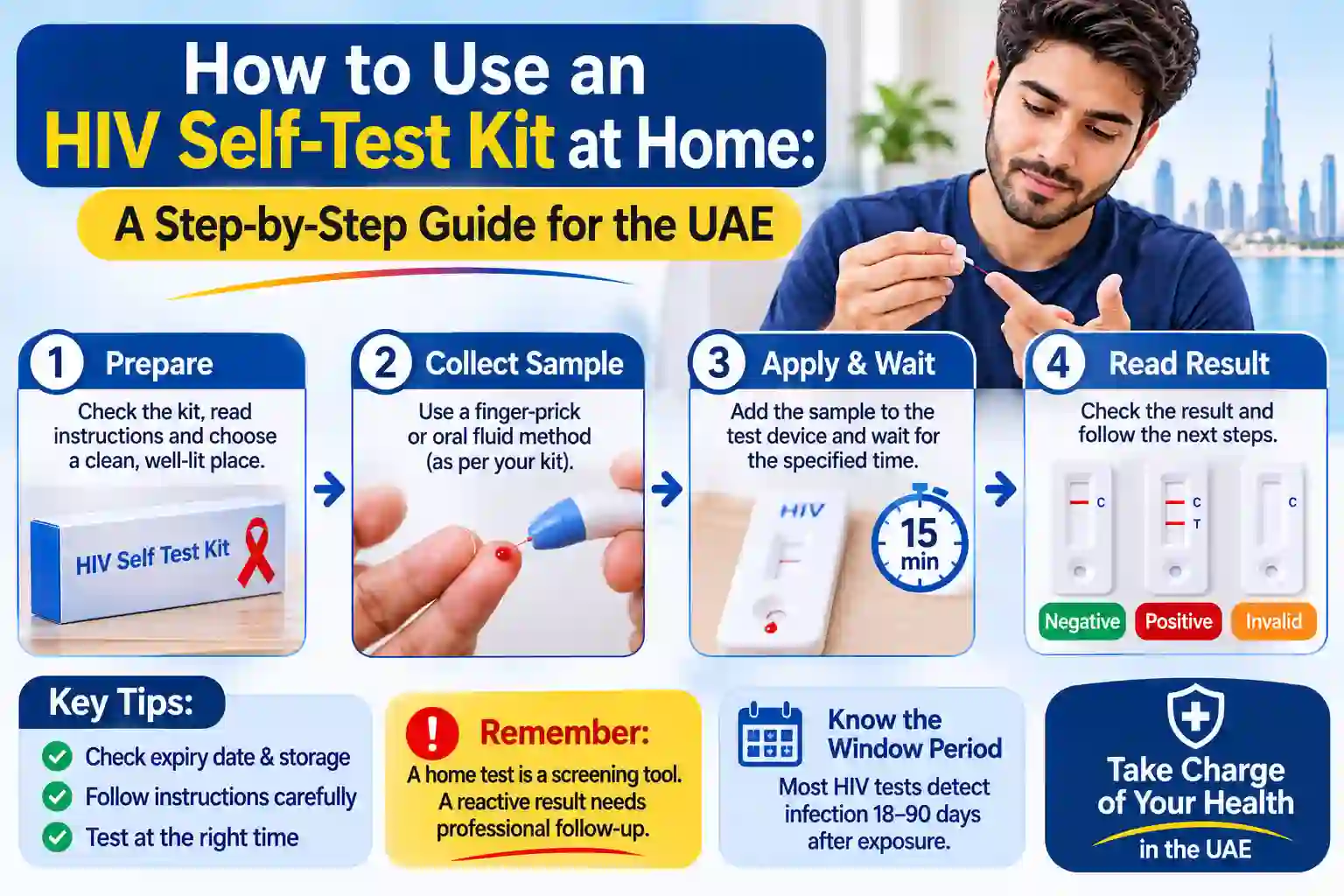
3. How to Use an HIV Self-Test Kit at Home: Step by Step
The procedure varies between products. A finger-prick blood test and an oral-fluid test do not use the same sample collection method.
The following is a general overview. Always follow the exact instructions supplied with your particular kit.
Step 1: Prepare the testing area
Wash and dry your hands if required by the product instructions.
Place all supplied components on a clean, flat surface. Check that you have everything needed before starting.
Avoid touching the sample collection area or other parts of the test device that should remain clean.
Step 2: Collect the required sample
The collection method depends on the test.
For a finger-prick blood test:
Use the supplied lancet according to the instructions.
Collect the required amount of blood using the supplied collection device.
Avoid using an alternative lancet or collection tool.
For an oral-fluid test:
Follow the manufacturer's instructions for collecting the oral-fluid sample.
Use the supplied collection device.
Observe any restrictions concerning eating, drinking, or oral hygiene before testing.
Do not assume that all HIV self-tests use the same sample collection procedure.
Step 3: Apply the sample to the test device
Transfer the sample to the specified area of the test device.
Some kits require a particular number of drops or an additional solution. Other products use a different collection mechanism.
Follow the instructions carefully. Adding too much or too little sample, or using the wrong application area, may produce an invalid result.
Step 4: Wait for the specified time
Place the test device on a stable surface and wait for the time stated in the product instructions.
Do not move the device unnecessarily or attempt to interpret the result too early.
Different kits have different reading times. Never assume that every HIV test produces a result within the same number of minutes.
Step 5: Read the result correctly
Check the result window at the exact time specified by the manufacturer.
Most rapid cassette-style tests include a control indicator and a test indicator, often marked C and T. However, result interpretation varies by product.
Do not rely on an online picture or another kit's instructions to interpret your result. Use the result guide supplied with your own test.
4. How to Understand Your HIV Self-Test Result
Most HIV self-tests produce one of three broad outcomes.
Non-reactive result
A non-reactive result generally means the test did not detect the HIV markers it is designed to identify.
However, a negative result does not always rule out infection from a recent exposure.
If you tested during the window period, repeat testing or a different test may be necessary.
Reactive result
A reactive result means the test detected a marker that requires further investigation.
It does not, by itself, confirm an HIV diagnosis.
Arrange follow-up testing with a qualified healthcare provider as soon as possible. Do not attempt to confirm the result using another home test alone.
Invalid result
An invalid result means the test did not produce a reliable reading.
Possible reasons include:
Incorrect sample collection.
Incorrect sample quantity.
Failure to follow the instructions.
An expired or damaged kit.
Reading the test outside the specified time.
Follow the manufacturer's guidance. You may need to repeat the test using a new kit or obtain testing from a healthcare provider.
5. When Is the Right Time to Use an HIV Self-Test?
The timing of an HIV test is extremely important.
The period between a possible HIV exposure and the point when a test can reliably detect infection is called the window period.
According to the US Centers for Disease Control and Prevention (CDC), typical detection windows are:
| HIV test type | Typical detection window |
|---|---|
| NAT | 10–33 days |
| Laboratory antigen/antibody test using venous blood | 18–45 days |
| Rapid antigen/antibody test using finger-prick blood | 18–90 days |
| Antibody test | 23–90 days |
Most HIV self-tests are antibody tests, although the exact product specifications must always be checked.
If you receive a non-reactive result before the relevant window period has passed, you may need to test again.
If you have had a possible significant HIV exposure within the last 72 hours, do not wait to use a home test. Seek urgent medical assessment for possible post-exposure prophylaxis (PEP). PEP should be started as soon as possible when indicated, and no later than 72 hours after exposure.
6. Common Mistakes to Avoid When Using an HIV Self-Test
Even a properly manufactured test can produce an unreliable result if it is not used correctly.
Avoid these common mistakes:
Using an expired kit: Always check the expiry date before opening the package.
Ignoring storage instructions: Excessive heat, humidity, or unsuitable storage conditions may affect the test.
Using the wrong sample: Only use the specimen specified by the manufacturer.
Applying the wrong sample quantity: Follow the stated sample and buffer requirements.
Reading the result too early: A test line may develop over time. Observe the specified reading interval.
Reading the result too late: Changes after the permitted reading time may not be valid.
Ignoring a missing control indicator: If the required control indicator does not appear, the test may be invalid.
Testing too soon after exposure: A non-reactive result during the window period may not rule out infection.
7. Can You Use an HIV Self-Test While Taking PEP or PrEP?
If you are taking PEP or PrEP, do not rely on a home HIV self-test as your only testing method.
Antiretroviral medicines can affect the timing and interpretation of HIV test results. People taking PEP need a healthcare professional's follow-up testing schedule.
People starting or continuing PrEP also need the HIV testing recommended as part of their clinical care.
Discuss your medication history with the healthcare professional before interpreting a self-test result.
8. Where Can You Buy an HIV Self-Test Kit in the UAE?
If you are comparing HIV home testing options in Dubai, Sharjah, Abu Dhabi, Ajman, or another UAE emirate, review the product information carefully before purchasing.
Look for:
A clearly identified test type.
The sample collection method.
Manufacturer instructions.
Detection-window information.
Expiry and storage details.
Appropriate product documentation.
You can explore the available options through SureTestKit:
HIV 4th Generation Antigen/Antibody Test Kit
Before ordering, check the individual product page to confirm the test method and sample requirements. Do not assume that every product described as an HIV home test uses the same technology.
9. What Should You Do After Taking an HIV Self-Test?
Your next step depends on the result and the timing of your test.
Non-reactive: Check whether the relevant window period has passed. If you tested too early, follow the recommended repeat-testing schedule.
Reactive: Arrange professional follow-up testing. A reactive self-test is not a confirmed diagnosis.
Invalid: Repeat with a new kit according to the instructions or seek testing from a healthcare provider.
Uncertain: Do not guess. Ask a qualified healthcare professional or testing service for guidance.
If you have ongoing exposure risk, discuss regular testing and prevention options such as PrEP with a healthcare professional.
Frequently Asked Questions
1. Can I perform an HIV test at home by myself?
Yes. HIV self-test kits are designed to allow individuals to collect their own sample and perform screening privately. Follow the specific manufacturer's instructions.
2. How long does an HIV home test take?
The result time depends on the test. Some rapid self-tests provide results in approximately 10–20 minutes, but you must follow the reading time specified for your product.
3. Are HIV home test kits accurate?
The performance of a home HIV test depends on the specific product, correct sample collection, storage, and timing. Testing during the window period can produce a non-reactive result even when infection is present.
4. What does one line on an HIV test mean?
The meaning depends on the test's design and the location of the line. On many cassette-style tests, a control line without a test line indicates a non-reactive result. Always use the interpretation guide supplied with your specific kit.
5. What if a faint second line appears?
Some tests interpret any visible test line within the specified reading period as reactive, even if it is faint. Other products may have different interpretation rules. Follow the product instructions and arrange professional follow-up if the result is reactive.
6. What should I do if my HIV self-test is reactive?
Contact a qualified healthcare provider and arrange follow-up testing. Do not treat a reactive home screening result as a confirmed diagnosis.
7. Can I take an HIV home test immediately after exposure?
A home test immediately after exposure cannot rule out infection from that exposure. If the exposure may carry HIV risk and occurred within 72 hours, seek urgent medical assessment for possible PEP.
8. Can I use an HIV self-test in Dubai, Sharjah, or Abu Dhabi?
You can review home screening options available through online retailers serving the UAE. Check the product's specifications, instructions, and suitability before ordering.
Final Thoughts
An HIV self-test can be a convenient way to screen privately, but getting a meaningful result depends on using the correct kit, collecting the sample properly, and testing at the appropriate time.
Before using a home HIV test kit, read the instructions carefully, check the expiry date, and understand the result interpretation guide.
Most importantly, remember that a reactive self-test needs professional follow-up, while a negative result during the window period may require repeat testing.
Whether you are in Dubai, Sharjah, Abu Dhabi, or elsewhere in the UAE, informed testing is an important part of taking care of your health.
Test correctly. Understand your result. Seek professional follow-up when needed.
Medical disclaimer: This article is for general educational purposes only and does not replace professional medical advice, diagnosis, or treatment. Always follow the instructions supplied with your specific test kit.
Disclaimer
This content is intended for informational purposes only and should not be considered a substitute for professional advice. Always consult with a qualified professional for specific concerns.