A possible HIV exposure can cause anxiety and uncertainty. You may wonder whether you need an HIV test immediately, whether you should visit a hospital, or whether there is anything you can do to reduce the risk of infection.
The most important thing to understand is that you may have a time-sensitive prevention option called HIV post-exposure prophylaxis (PEP).
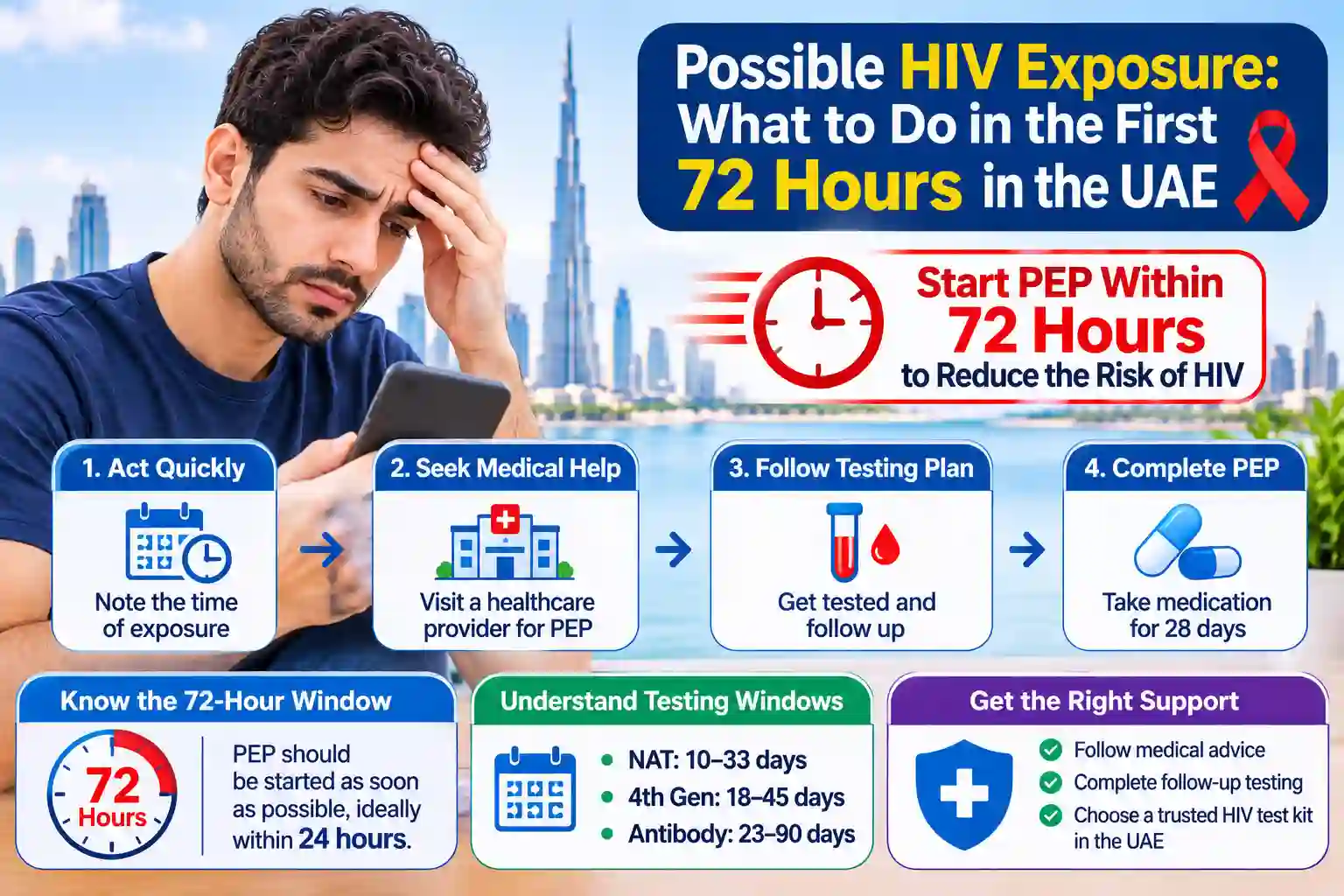
PEP is a short course of prescription medication that can help prevent HIV infection after a possible exposure. It must be started as soon as possible, ideally within 24 hours and no later than 72 hours after exposure.
If you are in Dubai, Sharjah, Abu Dhabi, or another part of the UAE and think you may have been exposed to HIV, this guide explains the immediate steps to consider, how PEP works, when to test, and why a home HIV test alone is not enough to manage a recent exposure.
1. What Should You Do Immediately After Possible HIV Exposure?
If you think you may have been exposed to HIV, do not panic, but do not delay seeking medical advice.
Take these steps:
Step 1: Note the time of possible exposure
Try to establish when the incident occurred. The time matters because PEP must be started within 72 hours.
Step 2: Seek urgent medical assessment
Visit an emergency department or a healthcare facility that can assess HIV exposure and provide PEP when indicated. Do not wait for symptoms to appear.
Step 3: Explain what happened to the healthcare professional
Share relevant information, including:
When the possible exposure occurred.
The type of exposure.
Whether a condom was used and whether it broke or slipped.
Whether the other person is known to have HIV, if this information is available.
Any medicines you currently take, including PrEP.
Step 4: Follow the recommended testing and prevention plan
A healthcare professional may recommend an initial HIV test, other blood tests, and PEP depending on the circumstances. If PEP is indicated, it should not be delayed while waiting for laboratory results.
2. What Is HIV PEP?
PEP stands for Post-Exposure Prophylaxis.
It involves taking antiretroviral medicines after a possible HIV exposure to reduce the chance of infection.
PEP is intended for emergency situations, not routine HIV prevention. It is not necessary after every type of contact; a healthcare professional assesses the exposure and determines whether PEP is appropriate.
Important facts about PEP:
It should be started as soon as possible.
Ideally, treatment begins within 24 hours.
It must be started no later than 72 hours after possible exposure.
A standard course is generally 28 days.
It must be taken exactly as prescribed.
Follow-up appointments and HIV testing are important.
The World Health Organization (WHO) and the US Centers for Disease Control and Prevention (CDC) both emphasize starting PEP promptly. UAE Ministry of Health and Prevention guidance also describes urgent initiation and a four-week treatment course.
Remember: PEP can reduce the risk of HIV infection, but it is not a guarantee. Do not obtain or take HIV medicines without medical assessment and a prescription.
3. Which Situations May Require a PEP Assessment?
Not every contact with another person creates a meaningful risk of HIV transmission.
A healthcare professional may consider PEP after certain exposures involving potentially infectious blood or sexual fluids reaching a mucous membrane, an open wound, or the bloodstream.
Examples that may require urgent assessment include:
Condom breakage or slippage during sex when HIV transmission risk is possible.
Condomless vaginal or anal sex involving a person with HIV whose viral suppression is not known or not sustained.
Sharing needles or other injection equipment.
A needlestick or occupational injury involving potentially infectious blood.
Sexual assault involving a possible HIV exposure.
The need for PEP depends on the details of the exposure and the source person's HIV status and treatment information.
Some activities, such as hugging, sharing food, using the same toilet, or contact with sweat and intact skin, do not transmit HIV. Ordinary social contact is not a reason to take PEP.
If you are unsure whether an incident presents a risk, seek professional assessment rather than trying to decide from a checklist.
4. Why the First 72 Hours Are So Important
PEP works best when started quickly after a possible exposure.
The recommended maximum starting window is 72 hours. Waiting until the last few hours is not advisable because every delay reduces the opportunity to start treatment promptly.
| Time after possible exposure | What to do |
|---|---|
| As soon as possible | Seek urgent medical assessment |
| Within 24 hours | Ideal time to begin PEP if prescribed |
| 24–72 hours | PEP may still be considered; seek care immediately |
| More than 72 hours | PEP is generally not recommended; seek medical advice about testing and other care |
If more than 72 hours have passed, do not assume there is nothing you can do. A healthcare professional can advise on HIV testing, other sexually transmitted infection screening, and prevention for the future.
5. Should You Take an HIV Test Immediately After Exposure?
An initial HIV test may be recommended when you attend a medical facility for PEP assessment.
However, an important distinction exists between a baseline test and a test that can detect a recent infection.
A test taken immediately after an exposure cannot rule out HIV infection from that same recent incident because the infection may not yet be detectable.
The baseline test helps healthcare professionals assess whether HIV infection may have existed before the recent exposure. Follow-up testing is needed to evaluate the more recent event.
Different tests have different detection windows:
| Test type | Typical detection window |
|---|---|
| NAT | 10–33 days |
| Laboratory antigen/antibody test using venous blood | 18–45 days |
| Rapid antigen/antibody test using finger-prick blood | 18–90 days |
| Antibody test | 23–90 days |
These are general CDC ranges for people not taking antiretroviral medication. PEP and PrEP can affect test detection timelines, so people taking these medicines need a clinician-directed testing schedule.
For more information, read our guide: When Should You Take an HIV Test After Exposure?.
6. What Happens During the 28-Day PEP Course?
If a healthcare professional determines that PEP is appropriate, you will receive a prescription and instructions for taking the medication.
The standard course is generally 28 days.
During treatment:
Take the medication exactly as prescribed.
Do not skip doses.
Do not stop early without speaking to your healthcare professional.
Report side effects or difficulties taking the medication.
Attend recommended follow-up appointments.
Ask about other STI and hepatitis screening if appropriate.
Your healthcare professional may arrange baseline tests and additional monitoring based on your health, medication history, and exposure.
If you miss a dose, contact your healthcare provider or pharmacist for advice rather than doubling your next dose unless specifically instructed.
7. When Should You Take Follow-Up HIV Tests After PEP?
Follow-up testing is essential because a baseline HIV test cannot rule out infection from the recent exposure.
Your healthcare provider will determine the testing schedule based on the PEP regimen, timing, and clinical circumstances.
Current CDC guidance recommends follow-up HIV testing that includes a laboratory antigen/antibody test and a diagnostic NAT. It describes interim testing around 4–6 weeks after exposure and final testing around 12 weeks after exposure.
UAE Ministry of Health and Prevention guidance also describes follow-up testing after PEP, including testing at the end of treatment and at a later follow-up point.
Because recommendations can vary with the clinical situation and the tests available, follow the schedule given by your treating healthcare professional rather than relying on a generic calendar.
Do not use a negative home self-test to replace the follow-up testing recommended after PEP.
8. Can You Use a Home HIV Test Kit After Possible Exposure?
Home HIV self-tests can be useful for screening, particularly when someone wants a convenient and private way to test. However, they are not a substitute for urgent medical care after a recent possible exposure.
A home antibody test may not detect a recent infection during its window period. PEP can also affect the timing and interpretation of follow-up tests.
A home HIV test may be considered as part of general screening when appropriate, but:
It cannot determine whether you need PEP.
It cannot rule out infection immediately after exposure.
A reactive result requires confirmatory testing.
A negative result during the window period may require repeat testing.
It should not replace a clinician-directed testing plan after PEP.
If you are looking for general HIV screening options in the UAE, you can explore:
SureTestKit HIV Testing Collection
HIV 4th Generation Antigen/Antibody Test Kit
Always review the product's actual test type, sample requirements, detection window, and instructions before choosing a kit.
9. What If More Than 72 Hours Have Passed?
If you discover the possible exposure more than 72 hours later, you should still contact a healthcare professional.
Although PEP is generally not recommended after this period, you can still take important steps:
Arrange an appropriate HIV test.
Ask when repeat testing should be performed.
Discuss screening for other STIs, including syphilis, gonorrhea, and chlamydia.
Follow medical advice if you develop symptoms or have other concerns.
Discuss PrEP if you may have ongoing or repeated HIV exposure risk.
Do not rely on the absence of symptoms to determine your HIV status. Some people have no noticeable symptoms, particularly during early infection.
10. HIV Prevention and Screening in Dubai, Sharjah and Abu Dhabi
People across the UAE have access to different healthcare and screening options. If you have experienced a possible HIV exposure, the priority is to obtain urgent medical assessment rather than waiting to order a home test.
For people seeking routine screening, home testing can offer an additional option when used according to the manufacturer's instructions and the appropriate testing window.
Whether you are in Dubai, Sharjah, Abu Dhabi, Ajman, Fujairah, or another emirate, understanding the difference between emergency prevention and routine screening can help you make informed decisions.
SureTestKit provides information about HIV screening products so customers can compare available options and review product specifications before ordering.
Frequently Asked Questions
1. Can I prevent HIV after exposure?
PEP can help prevent HIV infection after certain possible exposures. It must be started as soon as possible and no later than 72 hours after exposure. A healthcare professional must assess whether it is appropriate.
2. Is PEP effective after 72 hours?
PEP is generally not recommended when more than 72 hours have passed. Seek medical advice about appropriate HIV testing and other prevention options.
3. Can I take an HIV home test immediately after exposure?
You can take a test if advised, but a negative result immediately after exposure cannot rule out infection from that incident. Urgent PEP assessment is more important if you are still within the 72-hour window.
4. How long do I need to take PEP?
A standard PEP course is generally 28 days. Follow the exact prescription and do not stop treatment early without medical advice.
5. Can I take PEP without a prescription?
PEP requires medical assessment and a prescription. A healthcare professional must evaluate the exposure, medical history, possible drug interactions, and appropriate treatment.
6. Do I need an HIV test after completing PEP?
Yes. Follow-up HIV testing is important even if you completed the medication course and feel well. Your healthcare professional will determine the appropriate tests and timing.
7. Does a negative HIV test during PEP mean I am HIV-negative?
Not necessarily. A test during or shortly after PEP may not provide a final answer about the recent exposure. Follow the recommended testing schedule.
8. Can I buy an HIV test kit in Dubai or Abu Dhabi instead of visiting a hospital?
Home HIV test kits can support routine screening, but they cannot replace urgent medical assessment when a recent exposure may require PEP. If the exposure occurred within the past 72 hours, seek medical care immediately.
Final Takeaway
A possible HIV exposure can be stressful, but timely action matters.
Remember these three points:
Act quickly: Seek urgent medical assessment if you may have had a significant HIV exposure.
Know the PEP window: PEP should begin as soon as possible and no later than 72 hours after exposure, if prescribed.
Complete follow-up testing: A baseline test or home test alone cannot rule out infection from a recent exposure.
The most important decision is not which home test kit to buy first. It is getting the right medical assessment at the right time.
Medical disclaimer: This article is for general educational purposes only. It does not provide an individual diagnosis or treatment recommendation. PEP is a prescription intervention that requires urgent assessment by a qualified healthcare professional.
Disclaimer
This content is intended for informational purposes only and should not be considered a substitute for professional advice. Always consult with a qualified professional for specific concerns.