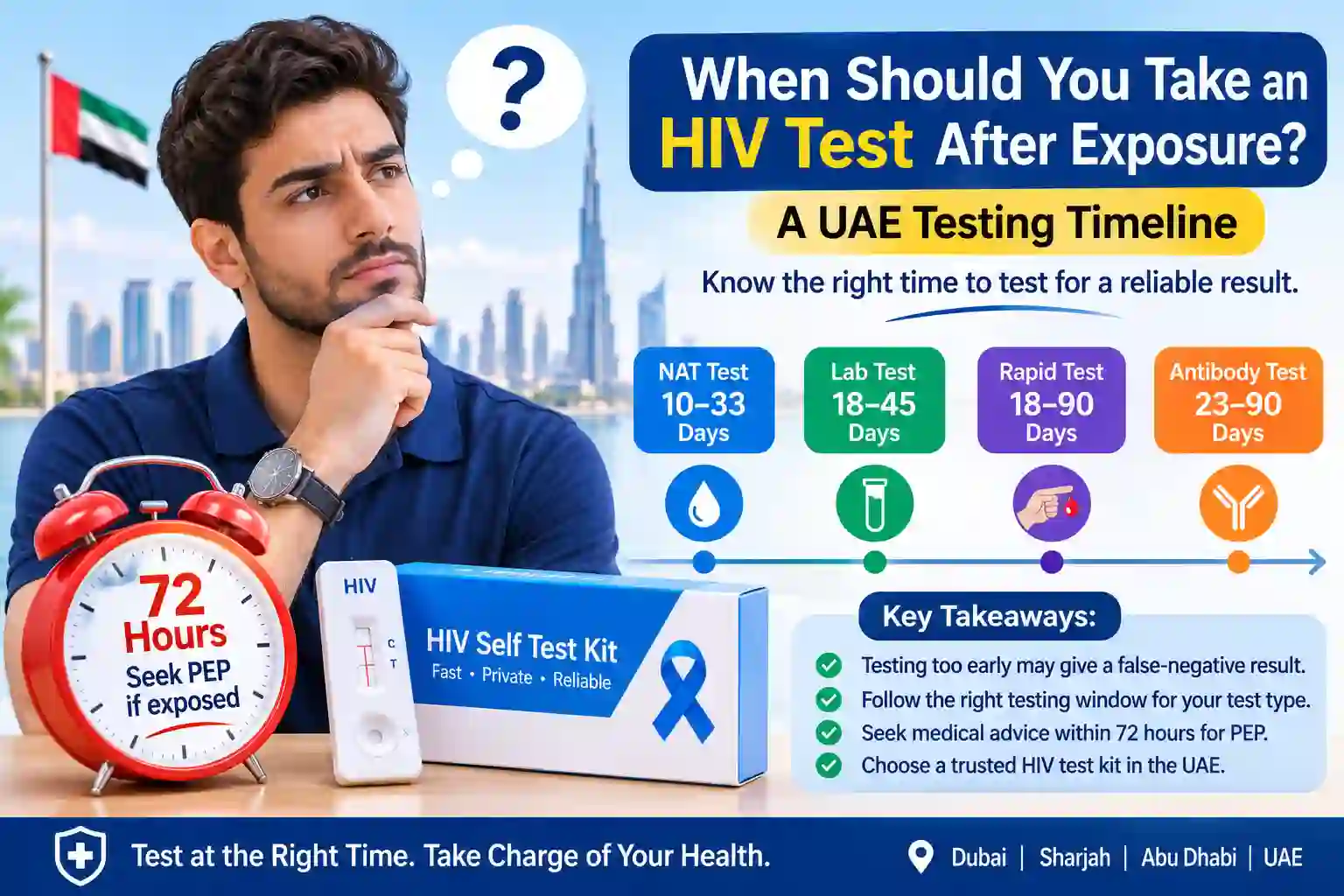
If you are worried about a possible HIV exposure, one of the most important questions is: When should you take an HIV test to get a reliable result?
Testing too early can produce a non-reactive result even when an infection has occurred. This is because different HIV tests detect different markers, and those markers become detectable at different times.
Whether you are looking for an HIV test in Dubai, Sharjah, Abu Dhabi, or elsewhere in the UAE, understanding the HIV testing window period can help you decide when to test and whether repeat testing may be necessary.
This guide explains when different HIV tests can usually detect infection, what to do during the first 72 hours after possible exposure, and how to choose an appropriate testing option.
1. Can an HIV Test Detect Infection Immediately After Exposure?
No. No HIV test can detect infection immediately after exposure.
The period between possible exposure and the point when a particular test can detect HIV is called the window period.
During this period, the virus or the markers detected by a particular test may not yet be present at detectable levels.
This means:
A test taken too early may produce a non-reactive result.
Different HIV tests have different detection windows.
A negative result may need to be repeated after the relevant window period.
The correct testing schedule may differ if you have taken PEP or PrEP.
The CDC explains that the window period depends on the type of HIV test used.
2. What Should You Do Within the First 72 Hours After Possible Exposure?
PEP is a course of HIV medicines used after a possible exposure to reduce the risk of acquiring HIV.
When PEP is indicated, it should be started as soon as possible, ideally within 24 hours, and no later than 72 hours after exposure.
A healthcare professional will assess the circumstances and determine whether PEP is appropriate.
Keep in mind:
PEP is time-sensitive.
A home HIV test immediately after exposure cannot rule out infection from that recent event.
A baseline HIV test may be performed during the medical assessment.
Follow-up testing is required according to the healthcare provider's schedule.
Do not delay seeking care while trying to arrange an online test.
For more information, read the CDC's clinical guidance for PEP.
3. HIV Testing Timeline: When Can Different Tests Detect HIV?
The appropriate testing time depends on the test method and sample type.
According to the CDC, the usual detection windows are:
| HIV test type | Usual detection window after exposure |
|---|---|
| Nucleic acid test (NAT) | 10–33 days |
| Laboratory antigen/antibody test using blood from a vein | 18–45 days |
| Rapid antigen/antibody test using finger-stick blood | 18–90 days |
| Antibody test, including most self-tests | 23–90 days |
These are general detection ranges, not guaranteed dates for every person or product. The ranges also assume that antiretroviral medicines such as PEP or PrEP have not affected detection.
NAT test: usually 10–33 days
A nucleic acid test looks for the virus itself in the blood.
It can usually detect HIV earlier than antibody or antigen/antibody tests. A healthcare provider may consider this test when there has been a recent possible exposure or when early infection is suspected.
NAT testing is generally performed by a laboratory using blood collected from a vein.
Laboratory fourth-generation test: usually 18–45 days
A laboratory antigen/antibody test detects both HIV antibodies and the p24 antigen.
Because it detects two types of markers, it can usually identify HIV earlier than an antibody-only test.
The CDC gives a usual detection window of 18–45 days for laboratory antigen/antibody tests using blood from a vein.
Rapid finger-stick antigen/antibody test: usually 18–90 days
Some rapid tests detect both antigen and antibodies using a finger-stick blood sample.
Their usual detection window can be longer than that of laboratory antigen/antibody testing using venous blood.
Antibody self-test: usually 23–90 days
Most HIV self-tests are antibody tests. They look for antibodies produced by the immune system in response to HIV.
The CDC gives a usual detection window of 23–90 days for antibody tests.
If you are considering a home HIV test, check the exact detection window in the product instructions.
4. When Should You Take an HIV Home Test?
The best time depends on the type of test and how long it has been since possible exposure.
For example:
If exposure was very recent, seek medical advice rather than relying on an immediate home test.
If you are considering testing during the first few weeks, ask a healthcare professional whether a laboratory-based test or another assessment is more appropriate.
If you are using an antibody self-test, follow its stated detection window and repeat-testing instructions.
If you receive a non-reactive result before the relevant window period has ended, arrange repeat testing at the appropriate time.
Do not assume that all HIV home test kits have the same detection window.
A product's intended use, test method, and sample type are important when deciding when to use it.
5. Does a Negative HIV Test Mean You Do Not Have HIV?
A negative or non-reactive result means the test did not detect the marker it was designed to identify.
However, the result must be interpreted in relation to the timing of the test.
A non-reactive result may not rule out HIV if:
You tested before the window period ended.
You had another possible exposure after the test.
The test was not performed according to the instructions.
You are taking or have recently taken PEP or PrEP and need a specific testing schedule.
If you tested too early, repeat testing after the relevant window period may be necessary.
If you have taken PEP or PrEP, ask your healthcare provider which tests and follow-up dates are appropriate. These medicines can affect the timing and interpretation of HIV testing.
6. What If Your HIV Test Result Is Reactive?
A reactive HIV self-test is a preliminary screening result. It does not, by itself, confirm an HIV diagnosis.
If your home test is reactive:
Avoid assuming that the result is a confirmed diagnosis.
Contact a qualified healthcare provider.
Arrange follow-up testing through the recommended diagnostic process.
Follow the provider's advice about further care and support.
Do not try to confirm a reactive result simply by taking several home tests.
Professional follow-up is important because a screening result and a confirmed diagnosis are not the same thing.
7. Can Symptoms Tell You When to Take an HIV Test?
Symptoms alone cannot confirm or exclude HIV.
Some people may experience flu-like symptoms during early HIV infection, while others may have no noticeable symptoms.
Possible symptoms can include:
Fever.
Sore throat.
Rash.
Swollen lymph nodes.
Fatigue.
Muscle aches.
These symptoms can also occur with many other illnesses.
If you have concerns about a possible exposure, do not wait for symptoms before seeking medical advice. Testing decisions should be based on exposure circumstances and the appropriate testing window, not symptoms alone.
8. How to Choose an HIV Test Kit in the UAE
If you are comparing an HIV test kit in Dubai, Sharjah, Abu Dhabi, or another UAE emirate, review the product information carefully.
Check the test method
Find out whether the test detects antibodies alone or both antigen and antibodies.
Confirm the intended use
Make sure the product is designed for home self-testing if you intend to use it yourself. Not every rapid HIV test is intended for untrained users.
Review the sample type
Check whether the test requires finger-stick blood, oral fluid, or another specified sample.
Read the detection window
Look for the manufacturer's stated detection window and any repeat-testing recommendations.
Check the instructions
Make sure the product explains sample collection, testing steps, result-reading time, and result interpretation.
Review product and delivery information
Before ordering online, check expiry information, storage instructions, seller details, and delivery terms for your emirate.
You can explore the HIV test kit options at SureTestKit and compare the information available for individual products.
You may also review:
Always confirm that the selected product is suitable for your intended use.
9. What If You Have Taken PEP or PrEP?
PEP and PrEP are medicines used to prevent HIV, but they can affect how HIV testing is interpreted and scheduled.
If you have taken PEP after a possible exposure, do not rely only on the usual window period for a standard home antibody test.
Your healthcare provider may recommend a specific follow-up schedule and particular laboratory tests.
The CDC's 2025 PEP recommendations include follow-up testing using laboratory antigen/antibody testing and diagnostic NAT in appropriate circumstances.
If you are taking PrEP, discuss your testing schedule with your healthcare provider as well.
Important: Do not stop or change prescribed HIV prevention medicines without medical advice.
Frequently Asked Questions About HIV Testing After Exposure
1. How soon after exposure can HIV be detected?
It depends on the test. A NAT can usually detect HIV 10–33 days after exposure, a laboratory antigen/antibody test 18–45 days, a rapid finger-stick antigen/antibody test 18–90 days, and an antibody test 23–90 days.
2. Can I take an HIV test one day after exposure?
You can receive a baseline assessment, but an HIV test taken one day after exposure cannot rule out infection from that recent event. If exposure occurred within 72 hours, seek urgent medical assessment for possible PEP.
3. When should I take an HIV home test after exposure?
Most antibody-based self-tests have a usual detection window of 23–90 days. Check the specific product instructions and seek professional advice about the appropriate timing.
4. Is a fourth-generation HIV test better for early detection?
Laboratory fourth-generation antigen/antibody tests can usually detect HIV earlier than antibody-only tests. However, rapid finger-stick antigen/antibody tests can have a longer detection window. The exact test format matters.
5. If my HIV test is negative after 30 days, am I clear?
Not necessarily. The answer depends on the test type, sample method, and whether PEP or PrEP was used. Some tests have detection windows extending beyond 30 days. Follow the appropriate testing schedule.
6. Do I need another HIV test after a negative result?
You may need another test if the first test was taken during its window period. Repeat testing should follow the specific test's instructions and healthcare guidance.
7. Can I order an HIV test kit online in Dubai, Sharjah, or Abu Dhabi?
You can review online sellers that serve your emirate. Before ordering, check the product's intended use, sample type, detection window, instructions, and current delivery information.
8. What should I do if my home HIV test is reactive?
A reactive self-test is not a confirmed diagnosis. Contact a qualified healthcare provider and arrange follow-up testing through the recommended diagnostic process.
Final Thoughts: Choose the Right Time for HIV Testing
Knowing when to take an HIV test after possible exposure is just as important as choosing the test itself.
Different HIV tests have different detection windows. A non-reactive result obtained too early may not rule out infection, so repeat testing may be necessary.
If you are looking for an HIV test kit in the UAE, compare the test method, intended use, sample type, and manufacturer's instructions before ordering.
Explore the HIV test kit collection at SureTestKit to review available home-screening options.
Remember: if possible exposure occurred within the past 72 hours, seek urgent medical assessment for PEP rather than waiting for a home test.
Medical disclaimer: This article is for general educational purposes only and does not replace professional medical advice, testing, or diagnosis. Testing schedules may differ for people taking PEP or PrEP. Consult a qualified healthcare professional for advice based on your circumstances.
Disclaimer
This content is intended for informational purposes only and should not be considered a substitute for professional advice. Always consult with a qualified professional for specific concerns.